
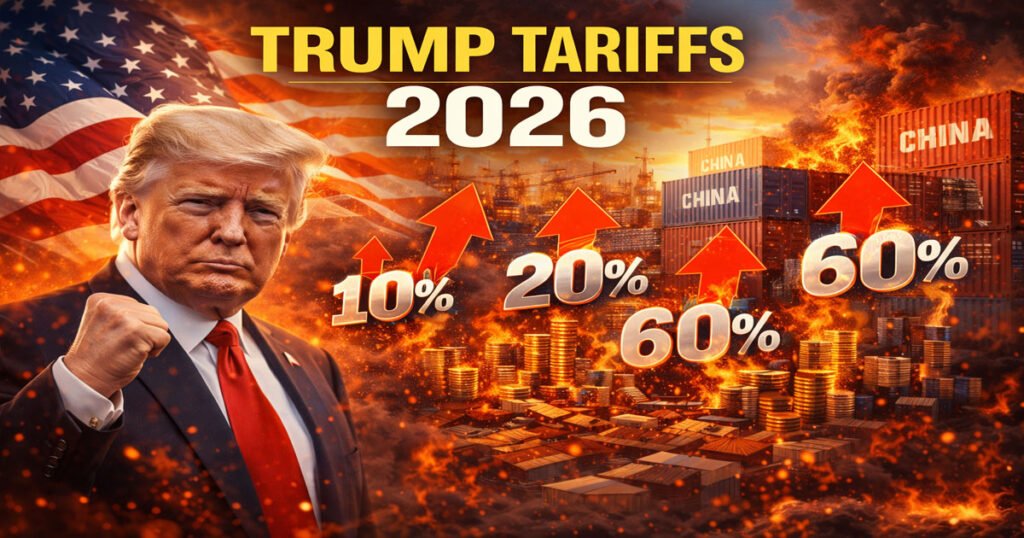
In 2025, President Donald Trump launched the most aggressive tariff campaign in modern American history. However, 2026 has turned everything upside down. In February 2026, the United States Supreme Court delivered a landmark 6-3 ruling that struck down Trump’s sweeping tariffs imposed under the International Emergency Economic Powers Act (IEEPA). Moreover, rather than stepping back, Trump responded by announcing new tariffs under a completely different legal authority — throwing global trade into a fresh wave of uncertainty. Therefore, the world is now watching closely as the largest trade war in modern history enters a dramatic new chapter.
Furthermore, the central question for businesses, governments, and consumers worldwide is this: what does Trump’s 2026 trade war actually mean for the global economy? In this analysis, we break down the key developments, their real-world consequences, and where this confrontation is heading.
Timeline: How Trump’s 2026 Tariff War Unfolded
Understanding the current situation requires a clear picture of how events escalated. Therefore, here is a concise timeline of the most significant developments:
| Date | Event | Key Impact |
| April 2025 | Liberation Day — IEEPA tariffs imposed | US average tariff rose from 2.3% to 15.8% |
| May 2025 | US Trade Court rules IEEPA tariffs illegal | Administration immediately appeals decision |
| Feb 20, 2026 | Supreme Court rules 6-3 against IEEPA tariffs | Largest tariff setback in decades for any US president |
| Feb 21, 2026 | Trump announces new 10% global tariff (Section 122) | Global trade uncertainty deepens overnight |
| Feb 24, 2026 | New 10% tariff officially takes effect | Covers approximately $1.2 trillion in US imports |
| Feb 28, 2026 | Trump signals raising tariff to 15% | Global markets and trade partners alarmed |
The Supreme Court Ruling: What It Really Means
The February 2026 Supreme Court ruling is historic. In a 6-3 decision, the court held that the IEEPA — a law designed for national security emergencies — does not grant the president authority to impose sweeping tariffs on virtually every country in the world. As a result, tariffs that had been generating an estimated $171 billion in annual federal revenue were declared unlawful overnight.
Furthermore, the ruling raises serious questions about the billions of dollars in tariff revenue already collected from importers. Moreover, businesses and foreign governments that paid these duties are now exploring legal avenues to seek refunds. Consequently, this creates enormous financial and administrative complications for the US Treasury that could persist for years. However, as legal analysts have noted, Trump’s immediate pivot to new tariff mechanisms under alternative legal authority makes clear that the trade war itself is far from finished.
Section 122: The New Tariff Weapon — and Its Limits
Trump’s use of Section 122 of the Trade Act of 1974 is significant but comes with a critical legal constraint. Section 122 allows the president to impose emergency tariffs, but only for a maximum of 150 days without Congressional approval. Therefore, the current 10-15% global tariff is effectively a temporary measure set to expire around mid-July 2026.
What Happens After 150 Days?
This is the urgent question that every trade economist and business leader is asking. Therefore, the Trump administration is widely expected to pursue at least three alternative legal pathways to preserve its tariff agenda:
- Section 232 — National Security Tariffs: Allows the president to impose tariffs on imports that threaten national security. Moreover, this mechanism has no time limit and was already used for steel and aluminum. It could be dramatically expanded to cover electronics, automobiles, and other sectors.
- Section 301 — Unfair Trade Practices Tariffs: Allows targeted tariffs against countries engaged in unfair trade. Furthermore, this mechanism is legally more durable than IEEPA, though slower to implement and more limited in scope.
- Congressional Authorization: Trump could seek formal Congressional approval for broad tariff authority. However, this faces significant political challenges given divided opinion even within Republican ranks on the economic consequences of the trade war.
Global Impact: Country by Country Analysis
United States: Rising Costs and Manufacturing Uncertainty
For American consumers and businesses, the tariff war carries a direct and measurable cost. According to the Tax Foundation, Trump’s 2026 tariffs represent the largest tax increase as a percentage of GDP since 1993 — amounting to an average additional burden of $1,500 per US household annually. Furthermore, despite Trump’s consistent promise that tariffs would reshore American manufacturing jobs, evidence of this happening at meaningful scale remains limited in 2026.
Moreover, the constant policy uncertainty — with tariff rates changing repeatedly over the past twelve months — has made long-term investment planning extremely difficult for American businesses. As a result, several major manufacturers have delayed planned US factory expansions, citing regulatory unpredictability as the primary concern.
China: Rare Earth Retaliation and Diplomatic Signals
China has been the most strategically sophisticated retaliator in this trade war. As a result of escalating tariffs, Chinese shipments to the US have fallen significantly over the past year. Moreover, Beijing has responded by restricting exports of rare earth metals — critical components in electronics, electric vehicles, and military technology — giving China powerful leverage over the US in the very industries America most wants to develop domestically.
However, the Supreme Court ruling has created a potential opening for diplomatic progress. Chinese officials have signaled willingness for honest negotiations, and Trump is reportedly planning a visit to Beijing in early April 2026. Furthermore, the ruling potentially reduces the effective tariff burden on Chinese goods from the previous peak rate back toward a more negotiable level — creating a narrow window for a deal that both sides may have reason to pursue.
European Union: Trade Deal in Legal Jeopardy
The EU finds itself in a particularly difficult and frustrating position. Last year, European negotiators struck a trade deal with the Trump administration setting a 15% tariff rate on most EU goods. However, with the Supreme Court ruling invalidating the IEEPA authority under which those tariffs were imposed, EU leaders argue the entire legal basis of that agreement has changed. Consequently, the European Parliament postponed ratification votes multiple times in the space of a single week.
Moreover, EU Trade Committee Chair Bernd Lange warned that Europe is fully prepared to retaliate if the US does not honor its trade commitments. As a result, transatlantic trade relations — already severely strained — now face what many analysts describe as their most serious legal and political crisis since the postwar period.
India: Emerging as a Relative Winner
India has positioned itself as one of the relative winners of the tariff chaos. In early February 2026, the US agreed to lower India’s tariff rate significantly, covering key exports including pharmaceuticals, textiles, precious stones, and clothing. Furthermore, India agreed to eliminate or reduce tariffs on US industrial goods and agricultural products, and committed to purchasing $500 billion worth of US imports in defense, energy, and technology over five years.
However, some Indian economists have questioned whether New Delhi moved too quickly to negotiate before the Supreme Court ruling, which subsequently reduced tariff pressures on countries that had held out. Therefore, while India’s deal delivers real benefits, it may have required larger concessions than would have been necessary had talks waited a few weeks longer.
Canada and the UK: Diversifying Away from the US
Canada has publicly welcomed the Supreme Court ruling but acknowledged that significant trade challenges remain, particularly around steel and aluminum tariffs under Section 232 authority. Furthermore, Canadian Prime Minister Mark Carney’s independent diplomatic outreach to China — made directly in response to the trade war — signals that Canada is actively and deliberately reducing its dependence on the American market for the first time in modern history.
The United Kingdom’s situation is particularly striking. Despite running a bilateral trade deficit with the US — meaning America actually sells more to Britain than it buys — the UK was nonetheless subjected to significant tariffs. Moreover, Prime Minister Keir Starmer has similarly begun diplomatic engagement with Beijing, reflecting a broader and accelerating pattern of traditional US allies quietly diversifying their trade relationships away from Washington.
The Bigger Picture: Is the Global Trade Order Ending?
Beyond the specific country-level impacts, Trump’s tariff war raises a profound question about the future of the rules-based global trading system that has underpinned world prosperity since 1945. Moreover, the pattern emerging in 2026 is striking: the EU is finalizing major trade agreements with Latin America and India. China is deepening economic ties across Southeast Asia and Africa. Canada and the UK are building bridges to Beijing. As a result, a new multipolar trade architecture is rapidly taking shape — one in which the United States plays a significantly smaller and less central role.
Furthermore, many economists argue that these structural shifts are not merely reactions to Trump’s tariffs, but accelerations of trends that were already underway. Therefore, even if a future US administration sought to rebuild old trade relationships, it would find the world had already reorganized itself around new partnerships and supply chains that are unlikely to simply revert.
What This Means for Businesses and Consumers Globally
For any business or individual connected to the global economy, the practical implications of Trump’s 2026 tariff war are significant and ongoing. Therefore, here are the key risk areas to watch:
- Supply Chain Restructuring: Companies that optimized their supply chains for a low-tariff world now face costly restructuring decisions. Moreover, the constant policy uncertainty makes it nearly impossible to plan investments with confidence, as tariff rates could change again within weeks.
- Consumer Price Inflation: Tariffs on imported goods translate directly into higher prices at the retail level. Furthermore, with US households already absorbing an estimated $1,500 in additional annual costs, the pressure on household budgets is real and growing.
- Investment Hesitancy: Sustained uncertainty is pushing both foreign governments and multinational businesses toward more cautious investment decisions globally, reducing the economic dynamism that drives job creation and growth on both sides of trade relationships.
- Currency and Financial Volatility: Trade war escalations typically create significant exchange rate volatility. As a result, businesses with international revenue streams or import-dependent cost structures face heightened financial risk that is difficult to hedge against in an environment of policy unpredictability.
Conclusion
Trump’s 2026 tariff war is not simply a trade dispute over import duties — it is a fundamental and potentially irreversible challenge to the global economic order that defined international relations for eighty years. Moreover, the Supreme Court’s landmark ruling has complicated rather than resolved the situation. Trump has demonstrated a clear and determined willingness to find every available legal pathway to maintain his tariff agenda, regardless of judicial setbacks.
Therefore, businesses, governments, and consumers worldwide must plan for sustained uncertainty rather than hoping for a swift resolution. Furthermore, the most consequential and lasting outcome of this trade war may not ultimately be measured in tariff rates at all — but in the long-term realignment of global trade relationships that it has permanently accelerated. The world of 2026 is reorganizing itself around a new and uncomfortable reality: that the United States can no longer be assumed to be a stable, predictable partner in the global economic system. As a result, every country, every business, and every investor must now plan accordingly.
Frequently Asked Questions (FAQs)
Q1: Did the Supreme Court completely end Trump’s tariffs in 2026?
No. The Supreme Court struck down the IEEPA tariffs in a 6-3 ruling in February 2026, but it did not end the trade war. Trump immediately replaced the invalidated tariffs with new ones under Section 122 authority and is widely expected to pursue additional mechanisms through Sections 232 and 301 to maintain tariff pressure beyond July 2026.
Q2: How much are Trump’s 2026 tariffs costing the average American family?
According to the Tax Foundation, Trump’s 2026 tariff regime amounts to an average additional annual cost of approximately $1,500 per US household — making it the largest effective tax increase as a percentage of GDP since 1993.
Q3: Which countries are most negatively affected by Trump’s tariffs?
China has faced the highest tariff rates and has retaliated most aggressively, including through rare earth export restrictions. The EU’s negotiated deal is now in legal uncertainty. Canada, Japan, and South Korea face complex balancing acts between trade concerns and security alliances. Countries like India and Vietnam have partially benefited by positioning themselves as alternative manufacturing bases.
Q4: How long will the new Section 122 tariffs last?
Section 122 tariffs can remain in effect for a maximum of 150 days without Congressional approval, meaning they are currently set to expire around mid-July 2026. The Trump administration is expected to use this window to implement longer-lasting tariff mechanisms through Section 232 national security provisions.
Q5: Could Trump’s tariff war trigger a global recession?
Most mainstream economists do not project an immediate global recession from current tariff levels alone. However, the cumulative effects of sustained uncertainty, reduced investment confidence, consumer price inflation, and the fragmentation of global supply chains are meaningful drags on economic growth. Furthermore, if tariff rates escalate further — particularly if China and the US move toward full economic decoupling — recession risks would increase substantially across multiple major economies.