
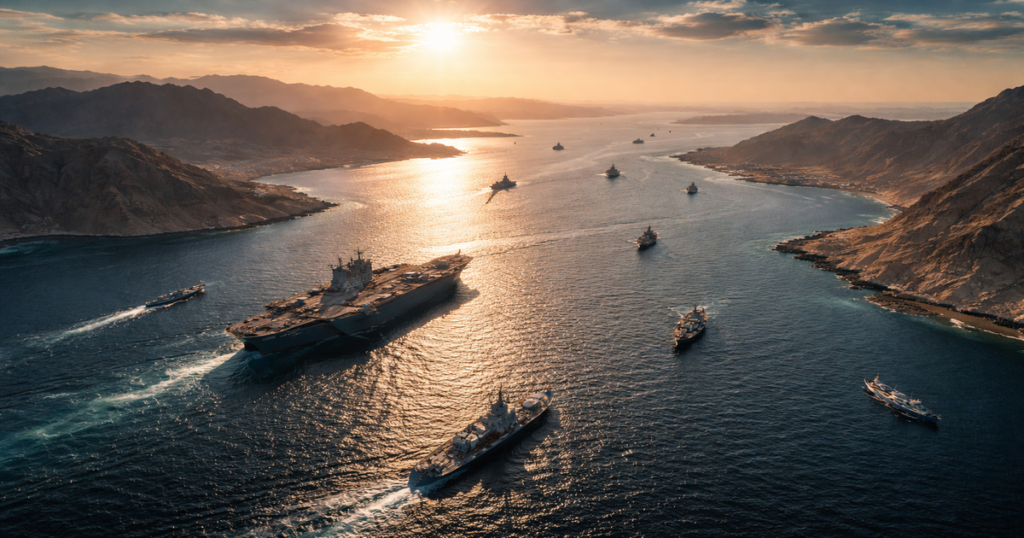
A 33-kilometre wide stretch of water sits between Iran and Oman. Through it flows approximately 20 million barrels of oil every single day. That figure represents 25% of all seaborne oil trade on earth. Moreover, 20% of the world’s entire LNG supply passes through this same narrow channel. No other route exists for LNG. No pipeline alternative carries sufficient volume. Therefore, this strip of water — the Strait of Hormuz — is arguably the single most strategically important piece of geography on the planet.
Furthermore, on March 2, 2026, Iran’s Revolutionary Guard officially declared the strait closed. They threatened to set fire to any ship attempting to pass. Traffic fell to near zero. Oil prices surged between 10% and 13%. European gas prices nearly doubled in 48 hours. Maersk, MSC, Hapag-Lloyd, and CMA CGM suspended all transits. As a result, the world got its first real taste of what a Hormuz closure actually means. Therefore, understanding this waterway — its geography, its history, and its current crisis — is essential for anyone trying to make sense of the world in 2026.
Geography: What and Where Is the Strait of Hormuz?
The Strait of Hormuz lies at the mouth of the Persian Gulf. It connects the Persian Gulf to the Gulf of Oman and from there to the Arabian Sea and Indian Ocean. Moreover, Iran sits on the northern coast and Oman — specifically its Musandam Peninsula exclave — sits on the southern coast. The UAE also shares the southern shore through its Musandam territory.
The strait stretches approximately 167 kilometres in length. At its widest point it measures about 97 kilometres. At its narrowest it narrows to just 33 to 54 kilometres. Furthermore, the actual shipping lanes are remarkably thin. Each directional lane measures only 3 kilometres wide. They run in opposite directions with a 3-kilometre buffer zone between them. Therefore, the entire volume of global oil commerce that flows through this strait squeezes through six kilometres of navigable water — barely wider than a large city.
Ancient History: A Trade Route Older Than Empires
The Strait of Hormuz has been a critical trade route for thousands of years. Long before oil, it served as the gateway between the Persian Gulf trading world and the Indian Ocean maritime network. Merchants carried spices, textiles, precious metals, and agricultural goods through these waters for millennia.
The Mughal Emperor Babur noted the strait’s importance in his memoirs. He described how almonds from the distant Ferghana Valley in Central Asia reached global markets only after passing through Hormuz. Moreover, the Portuguese recognised the strait’s strategic value early in the Age of Exploration. They seized the island of Hormuz in 1507 and built a fortress that controlled the passage for over a century. Furthermore, the Persian Safavid dynasty eventually expelled the Portuguese in 1622 with English assistance — an early example of great power competition for control of this critical waterway. As a result, the Strait of Hormuz has been a prize of geopolitics for over five centuries.
The Oil Era: How Hormuz Became the World’s Energy Lifeline
The discovery of vast oil reserves across the Persian Gulf in the 20th century transformed the Strait of Hormuz from an important regional trade route into a global energy artery of supreme importance. Moreover, as Saudi Arabia, Iran, Iraq, Kuwait, Qatar, and the UAE became the world’s dominant oil exporters, the strait became the only exit for their production.
The Numbers That Define Its Power
| Metric | Figure | Source |
| Daily oil transit | 20 million barrels per day | IEA |
| Share of seaborne oil trade | 25% | IEA / Congress.gov |
| Share of global LNG supply | 20-22% | IEA |
| Qatar LNG exports via Hormuz | 93% | IEA |
| UAE LNG exports via Hormuz | 96% | IEA |
| Share destined for Asian markets | 84% of crude flows | US EIA |
| Pipeline bypass capacity | Maximum 3 million barrels/day | Wikipedia / Congress.gov |
| Oil value transiting in 2018 | $1.2 billion per day at 2019 prices | Wikipedia |
| LNG alternatives if Hormuz closes | Zero — all LNG must use the strait | Congress.gov |
The pipeline bypass options deserve special attention. Saudi Arabia operates the East-West Pipeline with a capacity of approximately 5 million barrels per day. The UAE built the Habshan-Fujairah pipeline with a capacity of 1.5 million barrels per day. Moreover, Iraq operates the Iraq Pipeline through Saudi Arabia with 1.65 million barrels per day capacity. Together these carry a maximum of roughly 8 million barrels per day. Furthermore, the strait moves 20 million barrels daily. Therefore, even if every bypass pipeline ran at full capacity simultaneously, the shortfall would be 12 million barrels every single day. As a result, no bypass solution comes close to replacing the strait.
History of Crises: Every Major Hormuz Confrontation
1973: The Arab Oil Embargo
The 1973 Arab-Israeli War triggered the first modern oil crisis directly connected to Persian Gulf exports. Arab OPEC members — led by Saudi Arabia — imposed an oil embargo on Western nations supporting Israel. Moreover, this embargo did not close the Strait of Hormuz but demonstrated how the geography of Gulf oil exports could be used as a geopolitical weapon. Furthermore, oil prices quadrupled in months. Long queues formed at petrol stations across the United States and Europe. As a result, the vulnerability of Western economies to Gulf energy disruption became understood at the highest levels of global policy for the first time.
1980-1988: The Tanker War
The Iran-Iraq War produced the first direct military conflict involving the Strait of Hormuz. Iraq launched attacks on Iranian oil tankers and the Kharg Island oil terminal beginning in 1984. Iran retaliated by attacking tankers carrying Iraqi oil from Kuwait. Moreover, both sides attacked neutral shipping throughout the Gulf. The period became known as the Tanker War — the most intensive naval conflict involving commercial shipping since World War II.
Furthermore, Iran mined the strait — the first time the waterway had been physically threatened in the modern oil era. The United States responded with Operation Earnest Will in 1987, escorting Kuwaiti tankers through the strait under the American flag. Moreover, in April 1988, Iran and the US Navy fought the largest US naval surface engagement since World War II — Operation Praying Mantis — after a US warship struck an Iranian mine. As a result, the Tanker War established the pattern that has repeated itself since: Iran uses the strait as leverage, and the United States uses naval force to defend freedom of navigation.
1990s-2000s: Sanctions and Repeated Threats
Throughout the sanctions era of the 1990s and 2000s, Iran repeatedly threatened to close the Strait of Hormuz in response to Western pressure. Moreover, these threats reliably moved oil markets even without any physical disruption. Iranian officials developed a consistent formula: any escalation of sanctions or military pressure would be met with threats to the strait. Furthermore, Western naval planners developed increasingly sophisticated contingency plans for forcing passage through a mined or contested strait.
2012: The Red Line Moment
In 2012, as the US and EU tightened sanctions over Iran’s nuclear programme, Iranian officials issued some of their most specific Hormuz closure threats to that point. The US Fifth Fleet responded with an unusually direct statement: any attempt to close the strait would be an act of war and would be met with military force. Moreover, oil markets spiked repeatedly on the rhetoric alone. Furthermore, Iran ultimately did not act — but the episode demonstrated how the strait functions as a pressure release valve in US-Iran tensions. As a result, financial markets learned to price Hormuz risk into oil futures during every Iranian diplomatic crisis.
2019: Tanker Attacks Return
Tensions escalated sharply in 2019 after the Trump administration’s withdrawal from the Iran nuclear deal and reimposition of maximum pressure sanctions. Iran seized British tankers, attacked Saudi oil infrastructure, and struck tankers in the Gulf of Oman. Moreover, on June 13, 2019, two oil tankers — Front Altair and Kokuka Courageous — were attacked near the strait. Explosions struck both vessels. The USS Bainbridge rescued crew from one ship while Iranian ships rescued the other. Furthermore, satellite footage appeared to show an Iranian vessel removing an unexploded limpet mine from one tanker. As a result, insurance premiums for strait transit surged and global oil prices spiked sharply.
June 2025: Parliament Votes to Close
Following US and Israeli strikes on Iranian nuclear facilities in June 2025, Iran’s parliament — dominated by hardliners since the 2020 elections — voted to authorise Iran’s armed forces to close the Strait of Hormuz. Moreover, the vote required approval from the Supreme National Security Council to be enacted. It did not reach that threshold in 2025. However, the parliamentary vote sent a clear signal. Furthermore, war-risk insurance premiums for strait transit spiked immediately. Some tankers reversed course rather than risk the passage. As a result, the groundwork for 2026 was already being laid — both militarily and psychologically.
The 2026 Crisis: History’s Most Serious Closure
The 2026 Strait of Hormuz crisis began within hours of the US-Israel Operation Epic Fury strikes on February 28. Iran’s Islamic Revolutionary Guard Corps broadcast VHF radio warnings to all vessels: no ships were permitted to pass through the strait. Moreover, although the closure lacked formal legal binding status — Iran did not declare a blockade under international maritime law — the threat was real and immediate.
Hour-by-Hour Collapse of Traffic
Ship-tracking data showed the impact in real time. Traffic dropped approximately 70% within the first hours of the IRGC warnings. Moreover, over 150 oil tankers dropped anchor outside the strait to wait and assess the situation. By midnight of March 2, no tankers in the strait broadcast automatic identification system signals — indicating traffic had fallen to near zero. Furthermore, on March 2, the IRGC officially confirmed the closure and stated that any ship attempting passage would be set on fire. As a result, Iran attacked at least five ships attempting to transit — completing the effective closure of the world’s most important energy waterway for the first time in history.
Immediate Economic Shockwave
| Commodity/Market | Impact | Scale |
| Brent Crude Oil | Surged 10-13% in initial trading | Analysts forecast $100/barrel if sustained |
| European Natural Gas | Rose from EUR30/MWh to EUR60/MWh peak | Nearly doubled in 48 hours |
| LNG Prices (Asia) | Sharp spike across Asian markets | 20% of global LNG supply disrupted |
| QatarEnergy LNG | Production halted entirely | Largest LNG producer went offline |
| Global Shipping | Maersk, MSC, Hapag-Lloyd, CMA CGM halted | Rerouted around Africa — weeks added |
| Suez Canal | CMA CGM suspended Suez Canal transits | Cape of Good Hope rerouting required |
| War Risk Insurance | P&I insurance removed from March 5 | Economically impossible to transit |
| OPEC+ Response | Pledged +206,000 barrels/day extra | Partial mitigation only |
Who Suffers Most: The Geography of Vulnerability
The Atlas Institute for International Affairs published a detailed analysis of which countries face the greatest exposure to a sustained Hormuz closure. Moreover, the finding is clear: the suffering falls overwhelmingly on Asia — not on the Western nations whose military actions triggered the crisis.
- China: China imports more than 11 million barrels of oil per day — roughly half from the Middle East. Moreover, China buys over 90% of Iran’s oil exports. Beijing faces a deeply contradictory position: it has incentives to keep Iran financially viable but also depends on the strait remaining open. As a result, Chinese-flagged vessels appeared to be among the few still transiting, suggesting Beijing sought to carve out a protected corridor as Western shipping retreated.
- Japan: Japan depends on imported fossil fuels for 87% of its total energy needs. Furthermore, 95% of its crude oil imports originate from the Middle East. Japan alone imports 1.6 million barrels per day through the strait. A sustained closure would widen its trade deficit sharply, weaken the yen, and risk tipping the economy into stagflation.
- South Korea: South Korea channels approximately 68% of its crude oil imports — roughly 1.7 million barrels per day — through the strait. Moreover, South Korean officials announced emergency contingency planning within hours of the closure.
- India: India imports over 85% of its crude oil needs. Furthermore, the country has limited strategic reserves compared to larger economies. Therefore, a prolonged closure would push Indian inflation sharply higher and pressure the rupee — effects already visible in the Sensex crash of early March.
- Europe: Qatar supplies a critical share of Europe’s LNG — providing an alternative to Russian gas that Europe has depended on since 2022. Moreover, 93% of Qatari LNG exports transit the strait. Therefore, a sustained Hormuz closure would leave Europe simultaneously exposed to energy shortages and price spikes at exactly the moment it remains fragile from the Ukraine war energy transition.
International Law: Who Controls the Strait?
The legal status of the Strait of Hormuz is complex. The shipping lanes run primarily through Omani territorial waters with a portion in Iranian territorial waters. Moreover, international maritime law — specifically the United Nations Convention on the Law of the Sea (UNCLOS) — governs navigation rights through international straits used for global shipping.
Under UNCLOS, all ships enjoy the right of transit passage through international straits. This right cannot be suspended by the coastal state. Furthermore, Iran has never formally ratified UNCLOS. As of February 2026, 157 sovereign states including the EU are parties to UNCLOS — but the United States has also not ratified it. As a result, the legal architecture around the strait lacks some of the enforceability that the physical reality demands. Iran claims sovereignty over the strait and the right to control passage. The United States maintains that UNCLOS governs navigation regardless of ratification status. This legal dispute sits unresolved beneath every Hormuz crisis.
The US Fifth Fleet: America’s Hormuz Insurance Policy
The United States stations its Fifth Fleet at Naval Support Activity Bahrain. This fleet exists primarily to ensure freedom of navigation in the Persian Gulf and through the Strait of Hormuz. Moreover, it represents the most powerful continuous naval presence in the region and has been the primary guarantor of open passage since the Tanker War of the 1980s.
However, the 2026 crisis tests the Fifth Fleet in an entirely new way. The fleet’s headquarters in Bahrain was directly struck by Iranian missiles. Moreover, six US service members died in Iranian retaliatory strikes across the region. Furthermore, President Trump stated on March 3 that the US would force open the strait — adding that harder strikes on Iran were still to come. As a result, the world faces the prospect of direct US naval action to reopen a waterway that Iran has closed in retaliation for US military strikes. This circular escalation logic represents one of the most dangerous strategic situations the Fifth Fleet has ever confronted.
Can the Strait Be Permanently Bypassed?
Every major Hormuz crisis prompts renewed interest in pipeline alternatives. Moreover, the 2026 crisis has accelerated these conversations significantly. However, the practical reality is stark.
Saudi Arabia’s East-West Pipeline, the UAE’s Habshan-Fujairah pipeline, and the Iraq-Saudi pipeline together carry a maximum of approximately 8 million barrels per day under ideal conditions. Furthermore, the strait moves 20 million barrels daily. Therefore, the gap is 12 million barrels every day — approximately equivalent to the entire daily oil production of Saudi Arabia and the UAE combined. Moreover, for LNG there is no pipeline alternative at all. All LNG must travel by sea. Therefore, every molecule of Qatari and Emirati LNG destined for Asia or Europe must pass through the strait. As a result, no realistic near-term bypass solution exists for LNG — and only a partial, inadequate one exists for oil.
Conclusion: The Artery Through Which Civilisation Runs
The Atlas Institute described the Strait of Hormuz as “the artery through which industrial civilisation runs.” That description is not hyperbole. Twenty million barrels of oil and 20% of global LNG pass through 33 kilometres of water every day. No alternative carries meaningful volume. No pipeline replaces the LNG flow. No country can simply absorb the supply shock.
Moreover, the 2026 crisis has demonstrated something that decades of academic analysis had warned but markets had never fully priced: the strait can actually close. Ships stop. Traffic hits zero. Prices double. Economies shudder. Furthermore, the crisis also reveals the deep asymmetry of this geopolitical weapon. Iran bears the costs of closure domestically. But the nations that suffer most — Japan, South Korea, China, India, and Europe — had no role in provoking the conflict that led to the closure. As a result, the Strait of Hormuz remains what it has always been: not just a waterway but a mirror held up to the fragility of the global economic order. When it narrows, the entire system slows. When it closes, the world holds its breath.
Frequently Asked Questions (FAQs)
Q1: Why is the Strait of Hormuz so important to global energy markets?
The strait carries approximately 20 million barrels of oil per day — about 25% of all seaborne oil trade on earth. Moreover, 20-22% of global LNG supply transits through it. For LNG specifically, there is no pipeline alternative — all gas must travel by ship through this waterway. Furthermore, 84% of these energy flows go to Asian economies. Therefore, any disruption to the strait directly affects energy prices, inflation, and economic stability in every oil-importing nation on earth.
Q2: Has the Strait of Hormuz ever been completely closed before 2026?
Before 2026, the strait had never been completely closed for an extended period. Iran mined the strait during the Iran-Iraq War in the 1980s and the US responded militarily. Moreover, Iran repeatedly threatened closure during the sanctions era of 2012-2019. Furthermore, Iran attacked tankers in 2019 and seized commercial vessels multiple times. However, the effective closure in 2026 — with traffic falling to near zero and Iran attacking ships attempting transit — represents the most serious physical disruption in the strait’s modern history.
Q3: Can alternative pipelines replace the Strait of Hormuz?
Only partially and inadequately. Saudi Arabia, the UAE, and Iraq operate bypass pipelines with a combined maximum capacity of approximately 8 million barrels per day. However, the strait carries 20 million barrels daily — leaving a gap of 12 million barrels per day that cannot be replaced. Moreover, for LNG there is zero pipeline alternative. Every molecule of Qatari and Emirati gas destined for global markets must pass through the strait by ship. Therefore, no realistic near-term bypass solution replaces the strait.
Q4: Which countries are most vulnerable to a Hormuz closure?
Asian economies bear the greatest vulnerability. Japan imports 87% of its energy needs and sources 95% of its crude from the Middle East. South Korea routes 68% of its crude imports through the strait. China imports over 11 million barrels per day. India relies on imports for over 85% of its crude needs. Moreover, Europe faces severe LNG supply disruption because Qatar — which supplies Europe with critical gas volumes — ships 93% of its LNG through the strait.
Q5: What does international law say about closing the Strait of Hormuz?
Under the UN Convention on the Law of the Sea (UNCLOS), all vessels enjoy the right of transit passage through international straits. This right cannot be suspended by the coastal state. Moreover, 157 nations including the EU are parties to UNCLOS. However, Iran has not ratified UNCLOS — and neither has the United States. Therefore, the legal framework governing the strait lacks full enforceability. Iran claims sovereign authority over the passage. The US argues international navigation rights apply regardless of UNCLOS ratification. This dispute remains unresolved and underlies every Hormuz confrontation.


Pingback: Iran Oil War: How Trump Fights Back With Sanctions Waiver - instagesic.com