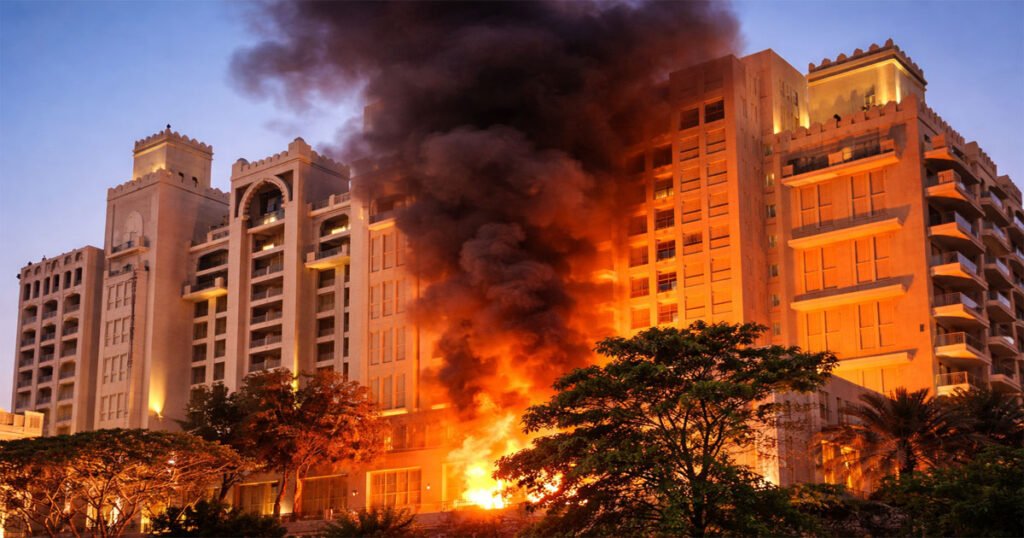
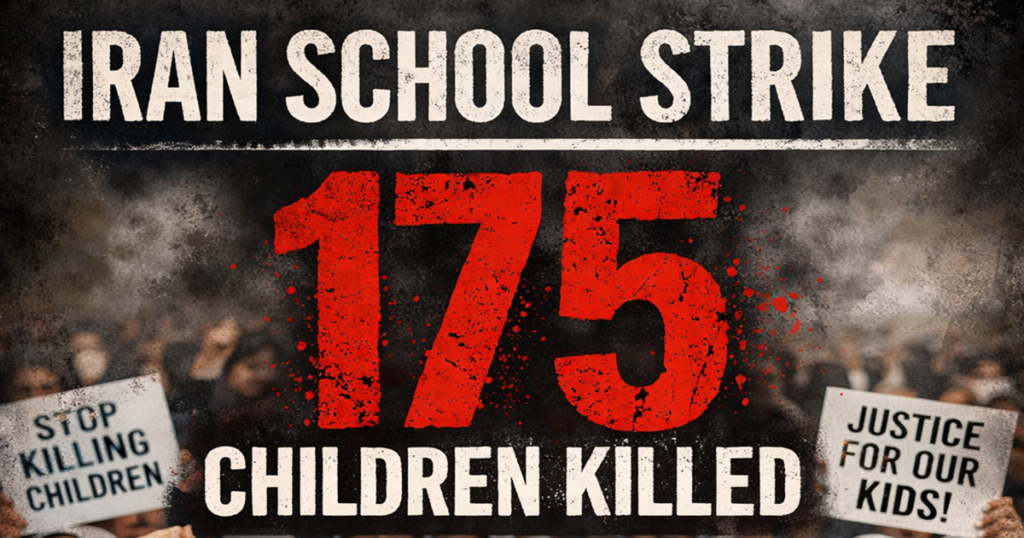
It was a Monday morning in Minab, a small town in Iran’s southern Hormozgan province. The Shajareh Tayyebeh girls’ elementary school — a two-storey building painted with pink flowers and green leaves — was full of children aged six to twelve when the war began. Parents received panicked phone calls and rushed to collect their daughters. Many were still on the way. Others had already arrived. Within less than an hour of the first airstrikes, a missile slammed into the building. The roof collapsed. A second strike followed as survivors sheltered in the hall. By the time rescuers reached the site, at least 175 people were dead — most of them children.
Moreover, what initially looked like a horrific but ambiguous tragedy has since become one of the most politically explosive incidents of the entire US-Iran war. Preliminary findings from the Pentagon’s own internal investigation, confirmed by multiple US officials to The Intercept, The New York Times, Reuters, NPR, and the Washington Post, point to one conclusion: the United States military struck the school. Furthermore, the strike was not an intentional targeting of children — it was the result of a catastrophic intelligence failure involving outdated coordinates provided by a US defence agency. As a result, the Minab school strike has generated a constitutional crisis, a congressional investigation, international condemnation, and a direct public conflict between the Pentagon’s emerging findings and the claims of President Trump.
What Happened on February 28: A Timeline
| Time | Event |
| ~10:00 AM local | Children in class at Shajareh Tayyebeh School, Minab. War has just begun — parents alerted to collect children. |
| ~10:45 AM | First missile strikes the school building directly. Roof collapses. Parents present at school killed alongside children. |
| Minutes later | Second strike hits as survivors shelter in the hall. A third strike also reported by witnesses. |
| Within hours | Iranian state media reports hundreds of casualties. First images emerge of collapsed building. |
| Feb 28 — afternoon | Trump publicly claims Iran struck the school: “In my opinion, based on what I’ve seen, that was done by Iran.” |
| March 3 | Aerial images show mass funeral for students and staff at Minab graveyard. |
| March 5 | Reuters reports two US military personnel involved in internal investigation believe US is likely responsible. Pentagon confirms investigation launched. |
| March 7 | Mehr News Agency (Iran) releases video showing cruise missile striking IRGC base beside the school. Smoke visible from school. |
| March 7 | Trump, asked about Tomahawk missile in video, says Tomahawks are “very generic” and claims Iran “also has some Tomahawks.” |
| March 11 | The Intercept publishes preliminary Pentagon findings: US at fault due to targeting error using outdated DIA coordinates. |
| March 11 | Washington Post reports school was on US target list — may have been mistaken for military site. AI targeting role raised. |
| March 12 | 120+ Democratic members of Congress write to Hegseth asking about AI targeting and whether strike will be investigated as war crime. |
| March 13 | Pentagon elevates the investigation, citing seriousness of preliminary findings. Hegseth refuses to comment pending inquiry. |
What the Pentagon Investigation Found
The preliminary findings of the US military’s internal investigation are stark. According to two US officials familiar with the inquiry who spoke to The Intercept, US Central Command attacked the Shajareh Tayyebeh elementary school based on long-outdated target coordinates for the adjacent IRGC naval base — coordinates that had been provided by the Defense Intelligence Agency. Moreover, while the school building was once physically connected to the IRGC base by roads, it had been completely partitioned off by 2016 — nearly a decade before the strike. The school grounds were cleared, converted into play areas, and painted in bright colours. Furthermore, the New York Times confirmed that CENTCOM officers created the strike coordinates using outdated data, and that it remains unknown why officials failed to verify the information before authorising the attack. As a result, the investigation’s initial conclusion is that this was a targeting error — not an intentional strike on a school — but one that was, as one current government official described it to The Intercept, “colossal negligence.”
The investigation was elevated by the Pentagon on March 13, citing the seriousness of the preliminary findings. Hegseth stated: “We’re not going to let reporting lead us or force our hand into indicating what happened.” The White House’s response was equally cautious — spokesperson Anna Kelly stated: “Unlike the terrorist Iranian regime, the United States does not target civilians,” while also confirming that Trump would accept the findings of the investigation.
The Evidence: Why Every Independent Investigation Points to the US
The evidence assembled by independent investigators is extensive, consistent, and mutually reinforcing across multiple organisations. Moreover, it directly contradicts Trump’s claim that Iran or another country was responsible.
The Tomahawk Missile — Identified by Eight Weapons Experts
Video released by Iran’s Mehr News Agency on March 7 showed a cruise missile striking the IRGC naval base compound immediately adjacent to the school. Eight independent munitions experts confirmed to the Washington Post and TIME that the missile was an American Tomahawk cruise missile. Moreover, John Gilbert, Senior Science Fellow at the Center for Arms Control and Non-Proliferation, told TIME: “The video taken on February 28, conclusively shows a Tomahawk cruise missile diving almost vertically into the area of the medical clinic adjacent to an IRGC facility. The black color, cruciform wings, and small tail fins match known imagery of Tomahawks.” Furthermore, N.R. Jenzen-Jones, director of Armament Research Services, told NPR: “Tomahawks are only used and operated by a very small number of nations.” Iran is not among them. As a result, the missile identification alone makes US responsibility overwhelmingly probable.
Geographic Division of Strikes
The US and Israel divided their strike operations geographically from the outset of Operation Epic Fury. Moreover, the CBC investigation concluded that the US was responsible for southern Iran — where Minab is located — while Israel focused on northern targets. Furthermore, US strikes had specifically targeted the Bandar Abbas Naval Base approximately 80 kilometres west of Minab and facilities in Konarak 400 kilometres to the southeast. As a result, Minab’s geographic location places it squarely within the US military’s confirmed area of operations — not Israel’s.
Satellite Imagery and the School’s Visible Identity
Perhaps the most disturbing element of the Reuters investigation is how clearly identifiable the school was from publicly available imagery. Satellite images of the compound from as early as 2018 showed coloured walls, playground markings, and the distinctive layout of a school separated from the adjacent military base by a painted wall. Moreover, the school had an active online presence — with a website archived in 2025 showing photographs of girls in identical pink and white uniforms, in class and at play. Furthermore, the school was listed in a local business directory and could be identified in multiple satellite images taken in the months immediately before the strike. As a result, a functioning elementary school full of children was visible to anyone using commercial satellite imagery — and apparently invisible to the targeting system that approved the strike.
Bellingcat and Forensic Confirmation
Investigative outlet Bellingcat confirmed through forensic analysis that the footage released by Iran directly contradicted Trump’s claim that an Iranian missile hit the school. Moreover, the analysis confirmed that the missile in the video did not match any known weapon in Iran’s arsenal. Furthermore, missile fragment photographs shared by Iran’s state broadcaster showed components consistent with Tomahawk components — not with any Iranian weapon system. As a result, the forensic record is comprehensive and consistent: no credible evidence supports Iranian responsibility.
The AI Targeting Question: Did Algorithms Select a School?
One of the most troubling dimensions of this story — and the one that has generated the most urgent congressional attention — is the potential role of artificial intelligence in the targeting process. The Washington Post first raised this question, reporting that the strike “has raised questions as to whether the military’s use of AI to identify targets was a factor.”
Moreover, in their letter to Hegseth, 120 Democratic members of Congress asked directly: “What role has artificial intelligence, including the use of Maven Smart System, played in the selection of targets, in assessing intelligence that has informed target selection, and in making legal determinations during the ongoing military operation? If artificial intelligence is used, is it subject to human review and at what point? Was artificial intelligence, including the use of Maven Smart System, used to identify the Shajareh Tayyebeh school as a target?” Furthermore, Maven Smart System is a Pentagon AI programme that uses machine learning to analyse imagery and identify potential military targets. As a result, the question is whether an AI system, trained on old data, flagged the school’s location as a military target without sufficient human review — and whether human commanders signed off on a strike without verifying that the coordinates still corresponded to a military installation.
Trump’s Claims vs. the Evidence: A Direct Comparison
| Trump’s Claim | The Evidence | Verdict |
| “In my opinion, that was done by Iran” (March 7) | Pentagon’s own preliminary investigation concludes US at fault | Contradicted by US military’s own findings |
| “Tomahawks are very generic — sold to other countries” | Tomahawks used and operated by a very small number of nations; Iran is not among them (NPR/Arms experts) | Factually incorrect — Iran does not operate Tomahawks |
| “Iran also has some Tomahawks” | No US official, arms expert, or intelligence assessment has ever attributed Tomahawk capability to Iran | No evidence — Senate Minority Leader Schumer called claim “beyond asinine” |
| “I just don’t know enough about it” | The Pentagon had already internally identified likely US responsibility when Trump made this statement | Contradicted by internal Pentagon timeline |
| White House: “US does not target civilians” | The targeting error resulted from outdated DIA coordinates — negligence, not intent | Technically consistent with finding — but negligence killed 175 people |
Congressional and International Reaction
Democratic Lawmakers: Accountability and War Crime Questions
The congressional reaction has been immediate and forceful. Ten US Democratic senators released a joint statement declaring they were “horrified” by analysis credibly suggesting the strike may have been conducted by US forces. Moreover, more than 120 Democratic members of Congress sent a formal letter to Hegseth demanding answers about targeting procedures, AI use, and whether the strike would be investigated as a possible war crime. Furthermore, Representative Sara Jacobs stated: “We should all feel deeply ashamed by the killing of 175 civilians, mostly little children, who have nothing to do with this awful, reckless war.” Senate Minority Leader Chuck Schumer called Trump’s claim that Iran might have Tomahawks “beyond asinine” and accused the president of “lying through his teeth.” As a result, the school strike has become a flashpoint for broader congressional opposition to the war’s conduct.
United Nations: International Humanitarian Law Violated
The international response was equally swift. UNESCO condemned the airstrike as “a grave violation of humanitarian law.” UN Secretary-General António Guterres condemned the strike. Moreover, a panel of 18 independent experts on the UN Committee on the Rights of the Child said it was “alarmed” and stated that children must be protected from war. Furthermore, the Euro-Mediterranean Human Rights Monitor described the attack as a “horrific crime and a consolidation of the collapse of civilian protection,” stating that any attack on protected persons such as children constitutes a serious violation of international humanitarian law. As a result, the Minab strike has generated the strongest international condemnation of any single incident in the US-Iran war.
The Hegseth Civilian Casualty Context
Multiple news organisations noted a specific context that made the strike particularly disturbing from a procedural standpoint. The attack came after a year-long effort by Defense Secretary Hegseth to dismantle programmes within the Pentagon designed to minimise civilian casualties — programmes mandated by Congress through a 2019 law following fatal strikes in Iraq and Afghanistan. Moreover, at a press conference shortly before the war began, Hegseth criticised what he called “stupid rules of engagement,” saying such rules interfere with winning. Furthermore, The Intercept confirmed that the Minab school strike killed more civilians than any other single strike in Trump’s Iran war — and that it occurred in the context of deliberately weakened civilian protection protocols. As a result, the school strike is not merely an isolated intelligence failure — it is the most lethal consequence of a deliberate policy decision.
What Happens Next: The Investigation and Its Limits
| Question | Current Status |
| Will the Pentagon confirm US responsibility? | Preliminary findings say yes — formal conclusion expected after months-long full investigation |
| Will anyone face accountability? | Unknown — Hegseth has not indicated any disciplinary action; investigation is ongoing |
| Will it be investigated as a war crime? | 120+ Congress members have formally requested this — Pentagon has not confirmed |
| What was the role of AI in targeting? | Under investigation — Congress has formally demanded answers from Hegseth |
| Why were 2016-era coordinates still in use in 2026? | Under investigation — DIA has not responded to press enquiries |
| Will Trump acknowledge US responsibility? | White House says Trump will accept investigation findings — he has not done so yet |
| What compensation will victims’ families receive? | No announcement — not yet addressed by US government |
| International legal consequences? | UN Human Rights Office called for thorough investigation — no formal proceedings announced |
Conclusion
The Minab school strike is the most devastating single incident of civilian casualties in the US-Iran war — and it was caused not by malice but by negligence: outdated intelligence coordinates that placed a functioning girls’ elementary school on a US military target list years after it had been separated from an adjacent Iranian military base. One hundred and seventy-five people died — at least 108 of them children between the ages of six and twelve — because no one in the targeting chain verified that the coordinates they were using still corresponded to a military installation.
Moreover, the political fallout has exposed deep fractures in how the United States wages war. Trump publicly denied US responsibility despite his own military’s preliminary findings. Hegseth had spent a year dismantling the very civilian casualty prevention programmes that Congress mandated precisely to prevent this kind of error. AI targeting systems may have flagged a school as a military site without sufficient human review. Furthermore, the school’s identity as a civilian institution was visible on commercial satellite imagery, business directories, and an active school website archived just months before the strike. As a result, the Minab school strike is not merely a tragic accident — it is a systemic failure of intelligence, oversight, technology, and accountability whose full consequences are still unfolding.
Frequently Asked Questions (FAQs)
Q1: What was the Minab school strike and when did it happen?
The Minab school strike occurred on February 28, 2026 — the first day of the US-Israeli war against Iran. A missile struck the Shajareh Tayyebeh girls’ elementary school in Minab, Hormozgan province, killing at least 175 people. Moreover, Iranian state media reported that 168 children were among the dead, with the total death toll including teachers and parents who had arrived to collect their children. Furthermore, the school — a two-storey building painted with pink flowers and green leaves — was completely destroyed. As a result, it became the deadliest single civilian casualty incident of the entire Iran war.
Q2: Who is responsible for the school strike — the US or Iran?
Preliminary findings from the Pentagon’s own internal investigation, confirmed by multiple US officials to The Intercept, NYT, Reuters, NPR, and the Washington Post, conclude that the United States military is responsible. Moreover, eight independent weapons experts confirmed the missile was an American Tomahawk cruise missile — a weapon Iran does not possess. Furthermore, the US and Israel had divided strike operations geographically, with the US responsible for southern Iran where Minab is located. As a result, while Trump publicly claimed Iran was responsible, his own military’s preliminary investigation contradicts that claim directly.
Q3: Why did the US military strike a school?
According to the Pentagon’s preliminary investigation, it was a targeting error. US Central Command used outdated coordinates provided by the Defense Intelligence Agency that placed the school’s location as part of an adjacent IRGC naval base. Moreover, while the school had been physically separated from the military base by 2016 — nearly a decade before the strike — the target coordinates were never updated. Furthermore, the school’s identity as a functioning civilian institution was clearly visible in satellite imagery, online listings, and archived school photographs dating to 2025. As a result, the strike represents a catastrophic intelligence failure rather than an intentional attack on civilians.
Q4: What is the role of AI in the Minab school strike?
The role of artificial intelligence remains under investigation. The Washington Post first raised the question of whether the Pentagon’s Maven Smart System — an AI programme that analyses imagery to identify military targets — may have identified the school’s location as a military site based on outdated data. Moreover, 120 Democratic members of Congress have formally asked Hegseth whether AI was used to select the Shajareh Tayyebeh school as a target, and whether AI-generated recommendations were subject to adequate human review. Furthermore, the broader question of AI use in targeting Iranian sites has not been publicly addressed by the Pentagon. As a result, the school strike has become a landmark case in the debate over AI use in military targeting decisions.
Q5: Could the school strike be prosecuted as a war crime?
More than 120 Democratic members of Congress have formally asked the Pentagon whether the strike will be investigated as a possible war crime. The Euro-Mediterranean Human Rights Monitor stated that any attack on protected persons such as children constitutes a serious violation of international humanitarian law. Moreover, under the laws of armed conflict, attacks must distinguish between civilian and military targets — and the failure to verify outdated coordinates before striking a location clearly identifiable as a school may constitute a violation of that principle. Furthermore, the UN Human Rights Office called for a prompt, impartial, and thorough investigation. As a result, while no formal war crimes proceedings have been announced, the legal question has been formally raised by lawmakers, human rights organisations, and UN bodies.