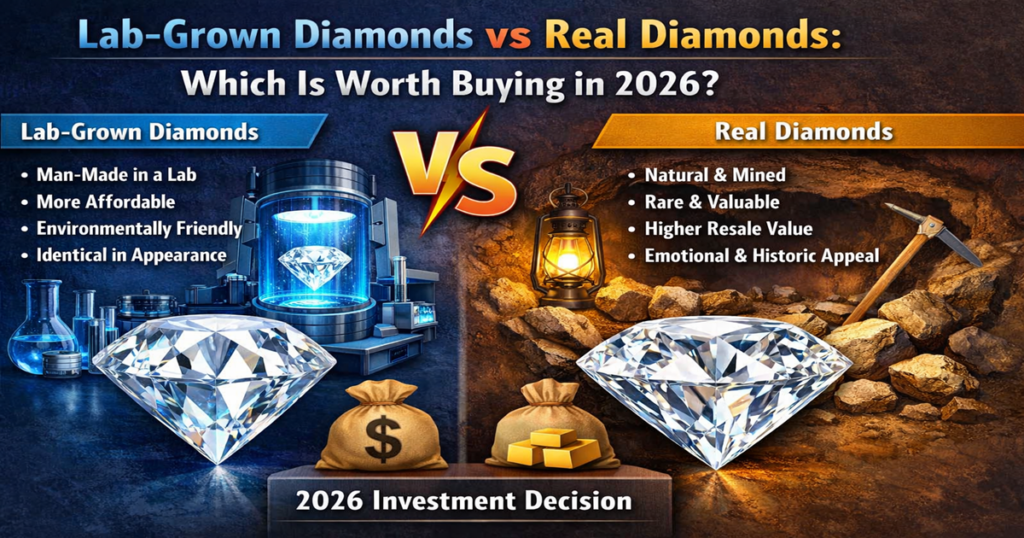
You are standing in a jewellery store. Two diamonds sit side by side in identical settings. Same cut, same carat, same brilliance — indistinguishable to the naked eye. The price tags, however, tell a completely different story. One costs $4,500. The other costs $650. Both are real diamonds. Both are certified by the same laboratories. Both will last forever. So which one should you buy? Moreover, this is not a trick question — it is the most important decision in the diamond market right now, and millions of shoppers are getting it wrong simply because they do not understand what they are actually comparing.
Furthermore, the lab-grown diamond market has undergone a dramatic transformation in the last five years. What was once a fringe alternative to mined diamonds now represents over 52% of all engagement ring centre stones sold in the United States. Prices have collapsed by as much as 90% from their peak. Meanwhile, natural diamonds have held their value — and in some categories, increased. As a result, the question of lab-grown versus natural diamonds in 2026 is not simply about price — it is about what you actually want from a diamond, and what you understand about what you are buying.
First: Are Lab-Grown Diamonds Real Diamonds?
Yes — completely and unambiguously. This is not a marketing claim. It is a scientific and legal fact. Lab-grown diamonds have the same chemical composition as mined diamonds: pure carbon arranged in a crystal structure. They have the same hardness — 10 on the Mohs scale, the hardest substance on earth. They have the same refractive index, the same thermal conductivity, and the same optical properties. They produce exactly the same sparkle, fire, and brilliance. Moreover, the US Federal Trade Commission made it official in 2018, formally recognising lab-grown diamonds as real diamonds and ruling that the term “synthetic” — which implied they were fake — was no longer accurate or appropriate. Furthermore, both lab-grown and natural diamonds are graded by the same internationally recognised laboratories — the Gemological Institute of America and the International Gemological Institute — using the same 4Cs system of cut, colour, clarity, and carat. As a result, a GIA-certified lab-grown diamond and a GIA-certified natural diamond are evaluated, classified, and certified by identical standards.
How Lab-Grown Diamonds Are Made
Understanding how lab diamonds are created is the key to understanding everything else about them — including why prices have fallen so dramatically. Two main methods are used.
HPHT — High Pressure, High Temperature
HPHT replicates the natural conditions under which diamonds form deep within the earth. A small diamond seed is placed in a chamber with carbon and subjected to temperatures exceeding 1,500 degrees Celsius and pressures of around 1.5 million pounds per square inch. Carbon atoms crystallise around the seed, forming a diamond. Moreover, HPHT is the older of the two methods and tends to produce diamonds with a slightly yellowish or brownish tint if not carefully controlled. Furthermore, HPHT diamonds are often identifiable under advanced spectroscopic analysis by specific growth patterns. As a result, HPHT is still widely used but has been largely displaced for gem-quality production by the second method.
CVD — Chemical Vapour Deposition
CVD is the method responsible for the price collapse. A diamond seed is placed in a sealed chamber and exposed to carbon-rich gases — typically methane and hydrogen — at lower pressures than HPHT. Microwaves or other energy sources ionise the gases, causing carbon atoms to rain down onto the seed and crystallise layer by layer. Moreover, CVD produces diamonds with fewer defects, more consistent colour, and increasingly large sizes — all at a fraction of the energy cost of HPHT. Furthermore, CVD technology has improved dramatically since 2018, allowing producers to grow larger, higher-quality diamonds faster and more cheaply than ever before. As a result, the cost of producing a one-carat CVD diamond has fallen by over 90% in less than a decade — and those cost reductions have passed directly to consumers.
The Price Comparison: 2026 Live Data
The price difference between lab-grown and natural diamonds in 2026 is not marginal — it is transformative. According to StoneAlgo’s live price index, updated daily from over 750,000 lab-grown diamonds across top online retailers, lab-grown diamonds currently cost approximately 82% less than comparable natural diamonds.
| Carat Weight | Natural Diamond (avg) | Lab-Grown Diamond (avg) | You Save |
| 0.5 carat (F/VS1/Excellent) | $1,800 – $2,500 | $250 – $400 | ~85% |
| 1.0 carat (F/VS1/Excellent) | $4,000 – $10,000 | $700 – $1,500 | ~82% |
| 1.5 carat (F/VS1/Excellent) | $9,000 – $18,000 | $1,200 – $2,500 | ~85% |
| 2.0 carat (VS1/Excellent) | $15,000 – $28,000 | $1,650 – $3,500 | ~88% |
| 3.0 carat (VS1/Excellent) | $35,000 – $65,000 | $2,400 – $6,000 | ~90% |
| 5.0 carat (VS1/Excellent) | $90,000 – $200,000+ | $6,000 – $15,000 | ~92% |
To put this in human terms: the budget for a 1-carat natural diamond engagement ring — roughly $5,000 to $8,000 — buys a 3-carat lab-grown diamond of equal or superior quality. Moreover, Liori Diamonds confirmed that in 2024, lab diamonds had reached price levels approximately 83% below natural equivalents — a figure that represents not just a discount but a fundamental market restructuring. Furthermore, in a recent price uptick of 3.32%, a 1-carat lab diamond now costs approximately $747, suggesting prices may be approaching the floor of production cost. As a result, buyers today are getting maximum diamond for minimum spend — but only if they understand what they are trading off.
The Critical Difference: Resale Value and Investment
This is where the conversation changes — and where many buyers make expensive mistakes by not understanding what they are purchasing. The price advantage of lab-grown diamonds comes with a significant and well-documented trade-off: they have essentially no resale value.
| Value Category | Natural Diamond | Lab-Grown Diamond |
| Purchase price | $4,000 – $10,000 (1 carat) | $700 – $1,500 (1 carat) |
| Resale value (immediate) | 25 – 50% of purchase price | Near zero — $50 to $200 typical |
| Resale value (10 years) | Generally stable or slight increase | Continues to decline as production costs fall |
| Resale market | Active — jewellers, auction houses, peer markets | Very thin — limited buyer demand |
| Price trend (2016–2026) | Steady or slight increase in top grades | Fell 90%+ from 2015 peak; slight uptick 2026 |
| Investment potential | Low-to-moderate — not a primary investment | None — not an investment asset |
| Heirloom value | High — scarcity preserves meaning | Low — replaceable at commodity prices |
Diamonds.pro confirmed the resale reality clearly: natural diamonds can be resold to a jeweller for at least 50% of the original price — and potentially much more for exceptional stones. Lab-created diamonds, however, “have very little to no resale value” and cannot be resold to a jeweller at a meaningful price. Moreover, a 1.5-carat lab diamond purchased for $10,300 in 2016 was worth only $3,975 by 2021 — a 61% decline while a comparable natural diamond barely moved. Furthermore, with CVD production technology still improving, the price of growing diamonds continues to fall — meaning a lab diamond bought today will likely be worth even less in future years relative to a natural diamond. As a result, if resale value, investment preservation, or heirloom transfer matters to you, natural diamonds retain a significant structural advantage.
Quality Comparison: Cut, Colour, Clarity and the 4Cs
On pure quality metrics, lab-grown and natural diamonds are genuinely identical — with one important market dynamic worth understanding.
The 4Cs Are the Same
Both lab-grown and natural diamonds are graded by IGI and GIA using identical criteria. A D-colour, VS1-clarity, Excellent-cut lab diamond and a D-colour, VS1-clarity, Excellent-cut natural diamond have the same optical performance. Moreover, nobody — not a trained jeweller, not even a gemologist with a loupe — can distinguish them visually. Only advanced spectroscopic equipment or specialised UV analysis can identify the difference. Furthermore, the FTC has ruled that both are categorically real diamonds. As a result, the idea that lab-grown diamonds are somehow inferior in quality is simply false.
The Budget Advantage: Buy Better for Less
The practical consequence of the price gap is that lab-grown diamonds allow buyers to significantly upgrade quality within any given budget. Moreover, Liori Diamonds data shows that the average engagement ring budget buys a 2.0-carat lab-grown diamond versus a 1.6-carat natural diamond — a 25% size advantage for the same spend. Furthermore, buyers can also use the savings to upgrade cut quality, choose a higher colour grade, or invest in a better setting. As a result, for buyers who prioritise size, quality, and visual impact over rarity and investment potential, lab-grown diamonds offer objectively better value-for-money at every price point.
Ethics and Environment: What Does the Science Actually Say?
One of the most common reasons buyers cite for choosing lab-grown diamonds is the ethical and environmental argument — avoiding the human rights abuses and environmental destruction historically associated with diamond mining. The reality is more nuanced than most marketing suggests.
The Mining Problem Is Real — But Has Changed
The 1990s and early 2000s saw genuine atrocities linked to “conflict diamonds” — stones mined in war zones and used to fund armed groups. The Kimberley Process Certification Scheme, established in 2003, significantly curtailed the trade in conflict diamonds. Moreover, the scheme has been criticised for loopholes and limited enforcement. However, certified ethical natural diamonds from Canada, Botswana, and Australia are now widely available — sourced from mines with regulated labour standards and environmental practices. Furthermore, natural diamond mining in countries like Botswana has been a significant driver of national economic development. As a result, the ethical picture for natural diamonds is complicated — not uniformly negative.
Lab-Grown Energy Use Is Not Trivial
Lab-grown diamonds are frequently marketed as environmentally friendly. Ken & Dana Design confirmed that the process uses half the energy of diamond mining — which is a genuine advantage. However, CVD diamond growth is still extremely energy-intensive: growing a single one-carat CVD diamond requires roughly 250 kilowatt-hours of electricity. Moreover, the environmental impact depends entirely on the energy source — a Chinese factory powered by coal produces a very different carbon footprint to a facility running on renewable energy. Furthermore, not all lab-grown diamond producers disclose their energy sources or emissions data. As a result, the environmental advantage of lab-grown diamonds is real in principle but variable in practice depending on where and how they are produced.
Who Should Buy Lab-Grown Diamonds?
| Your Situation | Best Choice | Why |
| Engagement ring — maximise size on a budget | Lab-Grown | Same quality, 80%+ cheaper, bigger stone for same spend |
| Fashion jewellery — earrings, pendants, bracelets | Lab-Grown | No sentimental resale need — pure visual value wins |
| Investment or store of value | Natural | Only diamonds with meaningful resale market |
| Family heirloom to pass down generations | Natural | Rarity and scarcity preserve symbolic and monetary value |
| Ethical concerns about mining | Lab-Grown (with caveats) | Avoids mining — but check producer’s energy source |
| Very large centre stone (3 carat+) on any budget | Lab-Grown | Price difference becomes hundreds of thousands at large sizes |
| Traditional buyer — values natural origin | Natural | For some buyers, the geological story is part of the meaning |
| Replacing lost jewellery — cost-conscious | Lab-Grown | Identical appearance at fraction of replacement cost |
| Celebrity-style statement pieces | Lab-Grown | 10-carat lab diamonds now accessible at mid-range budgets |
The Market Shift: How Buyers Have Voted With Their Wallets
The market data tells a clear story about where consumer preferences are heading. Moreover, the shift has been faster and more decisive than anyone in the industry predicted.
- 52% of centre stones in 2024 were lab-grown — up from just 12% in 2019. In five years, the market has reversed entirely. (Liori Diamonds / Brilliant Earth)
- Lab-grown market hit $24 billion in 2022 and could reach $59.2 billion by 2032 — despite, or because of, falling per-carat prices. (Liori Diamonds)
- More than 45% of all US engagement ring purchases now involve lab-grown diamonds. (Brilliant Earth)
- Millennials and Gen Z are the primary drivers — prioritising size, value, and ethics over traditional origin narratives. (Brilliant Earth)
- Prices may be stabilising: A recent 3.32% uptick suggests lab diamond prices are approaching production cost floor — which could mean the price collapse is nearly over. (Liori Diamonds)
Top Lab-Grown Diamond Retailers in 2026
| Retailer | Known For | Best For |
| James Allen | Largest selection, 360-degree viewing technology | First-time buyers wanting maximum choice |
| Brilliant Earth | Ethical sourcing focus, modern designs | Eco-conscious buyers, fashion-forward styles |
| With Clarity | Home try-on programme, custom settings | Buyers wanting to see diamond before committing |
| VRAI | Vertically integrated — grows own diamonds | Buyers wanting full supply chain transparency |
| Quince | Streamlined pricing, minimal markup | Budget-focused buyers wanting honest pricing |
| MiaDonna | Pioneer in lab-grown — 15+ years experience | Buyers wanting expertise and wide selection |
| Ritani | In-store preview at local jewellers | Buyers wanting online price with in-person experience |
Conclusion: Which Is Worth Buying in 2026?
The honest answer is: it depends entirely on what you want the diamond to be. Lab-grown and natural diamonds are chemically identical. They are visually indistinguishable. They are graded by the same standards. But they are fundamentally different products in terms of what they represent and what happens to their value over time.
Moreover, if you want the most diamond for your money — the biggest stone, the best cut, the highest clarity — lab-grown diamonds win the 2026 comparison without contest. An 82% price advantage translates to life-changing budget flexibility. A $5,000 budget buys a very different ring depending on which direction you go. Furthermore, if you want something whose monetary value holds, that carries geological history, and that can be passed down or resold with meaningful return, natural diamonds retain advantages that no amount of CVD technology can replicate — because what you are paying for is not the carbon, but the rarity. As a result, the best diamond to buy in 2026 is the one that matches what you actually value — not the one the jewellery industry has traditionally told you to want.
Frequently Asked Questions (FAQs)
Q1: Can anyone tell the difference between a lab-grown and natural diamond?
No — not with the naked eye, and not even with a standard jeweller’s loupe. Both lab-grown and natural diamonds are visually and optically identical. Moreover, even trained gemologists require specialised equipment — advanced spectroscopy, UV fluorescence analysis, or specific microscopic examination of growth patterns — to distinguish between them. Furthermore, standard diamond testers used by jewellers cannot differentiate lab-grown from natural diamonds, as both conduct heat identically. As a result, there is genuinely no visible or tactile difference between a lab-grown and natural diamond of equivalent quality.
Q2: Are lab-grown diamonds a good investment?
No — and neither are natural diamonds, though natural diamonds are significantly better. Lab-grown diamonds have essentially no resale value: a stone that cost $10,300 in 2016 was worth $3,975 by 2021 and continues to fall as production costs decline. Moreover, there is currently very little resale market for lab diamonds — jewellers do not buy them back at meaningful prices, and peer-to-peer sales attract little demand. Furthermore, natural diamonds retain 25-50% of their original value and have a more active resale market. As a result, if investment or value preservation is a priority, neither diamond type is optimal — but natural diamonds are considerably less harmful to hold.
Q3: Why have lab-grown diamond prices fallen so dramatically?
The price collapse is driven by production technology improvements — specifically in Chemical Vapour Deposition. CVD machines have become faster, cheaper to operate, and capable of producing larger stones with fewer defects. Moreover, the number of producers has increased dramatically, driving competition and compressing margins at every level of the supply chain. Furthermore, unlike natural diamonds — where supply is constrained by what is found underground — lab diamond supply scales with demand, eliminating the scarcity premium. As a result, Liori Diamonds confirmed that lab diamonds fell from roughly 10% cheaper than natural diamonds in 2015 to 90% cheaper by 2024 — a price freefall that has no historical parallel in the jewellery industry.
Q4: Are lab-grown diamonds ethically superior to mined diamonds?
Partially — but the picture is more complex than marketing suggests. Lab-grown diamonds do avoid the human rights abuses historically associated with artisanal conflict diamond mining. Moreover, they use approximately half the energy of diamond mining per carat. However, the environmental benefit depends on the energy source — a CVD facility powered by coal can have a larger carbon footprint than a responsibly run modern mine. Furthermore, certified ethical natural diamonds from Canada, Botswana, and Australia are now widely available. As a result, lab-grown diamonds are a reasonable ethical choice — but buyers should research their specific producer’s energy source rather than assuming all lab diamonds are equally green.
Q5: Should I buy a lab-grown or natural diamond for an engagement ring?
It depends on your priorities. If budget efficiency and stone size matter most, lab-grown is the clear 2026 winner — 80-90% lower prices mean dramatically more diamond for the same spend. Moreover, more than 52% of engagement ring centre stones sold in 2024 were lab-grown, meaning this is now the mainstream choice rather than the alternative. However, if you want something with long-term resale potential, traditional symbolic weight, or heirloom value to pass down, natural diamonds hold advantages that reflect genuine rarity rather than production cost. Furthermore, both are certified real diamonds — the choice is ultimately personal rather than objective. As a result, the right answer is the one that reflects what the diamond means to you, not what the industry has historically insisted it should mean.