
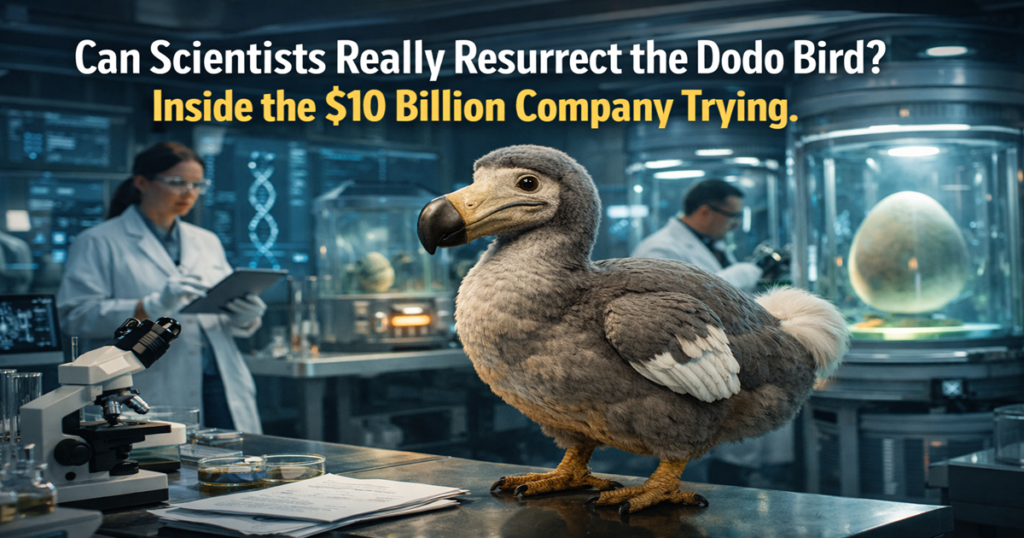
The dodo is the world’s most famous extinct animal. A plump, flightless pigeon that waddled across the forests of Mauritius for millions of years without a single natural predator, it had no instinct to run from danger and no reason to fear the humans who arrived on its island in the 1600s. Within eighty years of first contact, it was gone. The last widely accepted sighting was recorded in 1662. For more than three centuries, the dodo has been the universal symbol of extinction — the word people reach for when something is irreversibly, permanently lost.
Moreover, a Dallas-based biotechnology company called Colossal Biosciences believes that permanent is no longer the right word. In September 2025, Colossal announced a scientific breakthrough described by its chief science officer as “the really important step for the dodo project” — the world’s first successful cultivation of primordial germ cells from pigeons, the cellular building block that makes bird de-extinction possible. Furthermore, in February 2026, Colossal CEO Ben Lamm told the World Governments Summit in Dubai: “I think the most exciting thing in 2026 is bringing back extinct species.” The company has raised $555 million in total funding, carries a valuation of $10.32 billion, and counts Peter Jackson, Paris Hilton, Tom Brady, and Tiger Woods among its backers. As a result, the question of whether the dodo can truly be brought back is no longer science fiction — it is an active, funded, milestone-driven scientific programme with a projected timeline of five to seven years.
What Is Colossal Biosciences?
Colossal Biosciences was founded in September 2021 by Ben Lamm, a Dallas-based technology entrepreneur, and George Church, a Harvard geneticist widely regarded as one of the world’s foremost experts in genomics and gene editing. Moreover, the company’s core mission is de-extinction — using ancient DNA, gene editing, and reproductive biology to reconstruct extinct species from the genomes of their closest living relatives. Furthermore, Colossal explicitly does not aim to create perfect genetic copies of extinct animals. It aims to create functional equivalents — animals that carry enough of the extinct species’ key genetic traits to fill its original ecological role. As a result, the company frames its mission as “restoring lost ecological functions” rather than achieving perfect biological resurrection.
| Species | Status | Method | Timeline |
| Woolly Mammoth | Active — embryos targeted end 2026 | Gene-editing Asian elephant DNA (99.6% similar) | First calves: 2028 target |
| Dire Wolf | Completed April 2025 | Ancient DNA from 13,000-yr tooth + grey wolf base | Born: Remus, Romulus, Khaleesi |
| Dodo Bird | Active — PGC breakthrough Sept 2025 | Nicobar pigeon scaffold + chicken surrogates | First dodo: 2030-2032 est. |
| Tasmanian Tiger | Active — 99.9% genome Oct 2024 | Fat-tailed dunnart as base genome | Timeline TBD |
| Giant Moa | Announced July 2025 | Tinamou or emu base — NZ partnership | Early stage |
| Northern White Rhino | Conservation focus | 30 embryos into southern white rhino surrogates | Ongoing |
The Dodo: Why It Went Extinct and Why Its Return Matters
A Bird That Had No Reason to Fear
The dodo evolved on Mauritius — a volcanic island in the Indian Ocean roughly 900 kilometres east of Madagascar — in complete isolation from mainland predators. Over millions of years, it lost the ability to fly: wings that served no survival function became vestigial, while its body grew to weigh up to 23 kilograms. Moreover, because no land predator had ever reached Mauritius, the dodo developed no fear response to approaching animals — including humans. Furthermore, when Dutch sailors arrived in 1598, this evolutionary trustfulness proved fatal. Sailors, their dogs and cats, and invasive species including pigs and rats all attacked the dodo simultaneously. As a result, a bird that had survived for millions of years was eliminated in less than a century of human contact — the original man-made extinction.
The Ecological Loss Behind the Symbol
Mauritius lost more than a charismatic bird when the dodo disappeared. The dodo played a specific ecological role the island has not recovered from in 350 years. Most critically, it was the primary disperser of seeds of the tambalacoque tree — a species whose seeds required passage through the dodo’s digestive system to germinate. Moreover, without the dodo, tambalacoque trees could no longer reproduce naturally, and the species entered a long decline. Furthermore, Colossal’s rewilding ambitions are specifically framed around restoring this ecological function — not merely producing dodo-shaped birds, but returning a keystone species to an ecosystem that has been missing it for three and a half centuries. As a result, the dodo’s return would represent genuine ecological restoration rather than novelty.
The Science: How Do You Bring Back a Bird Extinct for 350 Years?
Why Birds Cannot Be Cloned Like Mammals
Traditional cloning — the technique used to create Dolly the sheep in 1996 — works by inserting a cell nucleus from the target animal into an enucleated egg from a donor, then implanting the resulting embryo into a surrogate. This process is impossible for birds. Moreover, avian eggs are large, opaque, and structured in ways that make nuclear transfer technically infeasible. Furthermore, bird embryos develop inside a hard shell with a fixed structure that cannot be easily manipulated after laying. As a result, an entirely different approach is required for bird de-extinction — one working through the bird’s own reproductive biology rather than around it.
Primordial Germ Cells: The Only Viable Pathway
The solution is primordial germ cells — PGCs — the precursor cells that eventually develop into eggs and sperm. In birds, PGCs circulate in the bloodstream of developing embryos before migrating to the gonads. Moreover, if PGCs from one species can be cultured in the laboratory, gene-edited to carry traits from an extinct relative, and injected into the embryo of a surrogate bird, the surrogate develops gonads producing eggs and sperm with the edited genetics. When two such surrogates mate, their offspring carry the edited traits. Furthermore, by repeating this across multiple generations — each time editing closer to the target genome — scientists can progressively reconstruct the extinct bird’s characteristics. As a result, PGC technology is the only currently viable pathway to bird de-extinction.
The September 2025 Breakthrough: World’s First Pigeon PGCs
Before Colossal’s announcement, successful PGC culture had only been achieved in two bird species anywhere on earth: chickens and geese. Colossal’s Avian Genetics Group achieved it for the third time — in the common pigeon — and did so within six months of establishing their avian colony. Moreover, Beth Shapiro, Colossal’s chief science officer, described it as “the really important step for the dodo project, but also for bird conservation, more broadly.” Furthermore, the announcement was accompanied by several additional milestones: a Nicobar pigeon breeding colony established in Texas, three new avian genomes sequenced, a flock of gene-edited sterile chickens created as surrogate hosts, and the Mauritius Dodo Advisory Committee formally launched. As a result, in a single announcement, Colossal cleared what its CEO called the greatest scientific hurdle in the entire dodo de-extinction project.
Step-by-Step Roadmap: From Lab to Mauritius
| Step | What It Involves | Status |
| 1. Complete dodo genome | Reconstruct full dodo DNA from museum specimens | Substantially complete |
| 2. Culture Nicobar pigeon PGCs | Grow PGCs from dodo’s closest living relative | In progress — colony in Texas |
| 3. Gene-edit Nicobar PGCs | Insert dodo-specific genes into Nicobar germ cells | Not yet begun |
| 4. Inject into sterile chicken embryos | Use gene-edited chickens as surrogate hosts | Surrogates ready |
| 5. Produce chimeric chickens | Hatch chickens whose gonads carry dodo-edited germ cells | Achieved Sept 2025 |
| 6. Breed chimeric birds | Mate chimeric birds to produce dodo-like offspring | Not yet begun |
| 7. Progressive refinement | Multiple generations to increase dodo trait percentage | Multi-year process |
| 8. First living dodo-like bird | Bird with sufficient dodo traits for functional equivalence | 2030-2032 estimated |
| 9. Population building | Scale from individual to breeding population | Years after first individual |
| 10. Rewild to Mauritius | Reintroduce with Mauritius Dodo Advisory Committee guidance | Depends on population scale |
The Nicobar Pigeon: The Living Bridge
The Nicobar pigeon is the dodo’s closest living relative — a strikingly beautiful bird with iridescent green and copper feathers, entirely unlike the grey, rotund dodo in appearance, yet its nearest surviving genetic cousin. Moreover, Colossal has established a breeding colony of Nicobar pigeons in Texas — a significant logistical achievement, since these birds are rarely kept outside specialist zoos. Furthermore, the Nicobar pigeon is itself listed as near-threatened by the IUCN, meaning Colossal’s work simultaneously serves conservation goals for a living endangered species. As a result, the science developed for dodo de-extinction may directly benefit the very bird being used to achieve it.
The Dire Wolf Precedent: Proof of Concept or Hype?
In April 2025, Colossal announced the birth of three dire wolf pups — Remus, Romulus, and Khaleesi — created by gene-editing grey wolf DNA with ancient DNA extracted from a 13,000-year-old tooth and a 72,000-year-old skull. The announcement generated global headlines and significant controversy simultaneously. Moreover, supporters argued it demonstrated the viability of Colossal’s core technology pipeline — ancient DNA plus gene editing plus surrogate reproduction — applicable directly to the dodo. Furthermore, critics argued the dire wolves were genetically modified grey wolves with some dire wolf traits — proxies rather than true resurrections. As a result, the dire wolf debate frames the central scientific controversy around all of Colossal’s work: what exactly counts as bringing a species back?
The Critics: Four Reasons Sceptics Are Unconvinced
- Incomplete genomes are unavoidable: No extinct species has a perfectly preserved, complete genome. Museum specimens and ancient bones degrade over centuries. The dodo genome reconstructed from specimens will have gaps and ambiguities that cannot be definitively resolved — producing a reconstructed approximation, not an original.
- Behaviour cannot be resurrected: A dodo’s genome codes for physical characteristics, not for the behaviours learned from parents and social groups over generations. A laboratory-hatched dodo will have no dodo elders, no dodo culture, and an entirely unknown behavioural profile.
- The proxy problem: Colossal explicitly agrees the result will be a dodo-like bird — editing only the dodo-unique genes into the Nicobar pigeon genome. Critics argue that “dodo-like” and “dodo” are categorically different things — the latter implying an identity that no gene-editing process can fully recreate.
- Conservation opportunity cost: The billions invested in de-extinction could fund protection of thousands of currently living endangered species. Critics argue the excitement around resurrection diverts resources from the more urgent and tractable problem of preventing further extinction in the first place.
Colossal’s Answer: It Is Not Either/Or
Colossal and its supporters have a direct response. Lamm stated at the World Governments Summit: “This is not an either-or; this is an and. We do need a de-extinction toolkit because we’re going to lose up to 50 per cent of all biodiversity between now and 2050.” Moreover, the same genomic tools and PGC technology used for extinct species are simultaneously applied to living endangered ones — the red wolf, the northern white rhino, the pink pigeon, and others. Furthermore, Colossal works with approximately 60 conservation partners globally and funds around 60 postdoctoral researchers. As a result, the boundary between de-extinction science and conservation science is significantly blurred in Colossal’s actual operations.
The Mauritius Question: Is the Island Ready?
Even if Colossal produces a functional dodo equivalent, returning it to Mauritius presents entirely separate challenges. The island has changed dramatically in 350 years. Invasive species — the same rats, dogs, cats, and pigs that contributed to the original extinction — are still present. Forest coverage has been severely reduced. The tambalacoque trees that depended on the dodo have declined significantly. Moreover, the Mauritius Dodo Advisory Committee is tasked with preparing the island’s ecosystem for reintroduction and addressing community concerns. Committee chair Dr. Devina Lobine stated: “This journey is more than reviving a lost species — it is about honouring our island’s unique heritage.” Furthermore, rewilding will require parallel tracks of scientific progress and ecosystem restoration. As a result, the return of the dodo to Mauritius — if it happens — may take longer than the de-extinction process itself.
Conclusion
The dodo will not walk out of a Colossal laboratory tomorrow. The science is real, the progress is genuine, and the September 2025 primordial germ cell breakthrough is a legitimate milestone that advances the entire field of avian reproductive biology. But the distance between that milestone and a living, ecologically functional dodo population on Mauritius remains large — and the critics who question whether the result will truly be a dodo rather than a dodo-shaped pigeon are raising questions that Colossal itself acknowledges rather than dismisses.
Moreover, what is beyond dispute is that Colossal has built something unprecedented: $555 million in funding, a $10.32 billion valuation, a functioning ancient DNA and gene-editing platform, and the demonstrated ability to produce animals carrying genetic traits of species extinct for thousands of years. Furthermore, Lamm’s assertion at the World Governments Summit carries both the ambition and the urgency: “I do not believe that people understand the extinction crisis we’re in. We are in the sixth mass extinction, which is being accelerated by man.” As a result, whether or not the dodo returns in exactly the form it left, the science being built to try will almost certainly change how humanity manages and potentially restores the biodiversity it has spent centuries destroying.
Frequently Asked Questions (FAQs)
Q1: Has Colossal actually brought back the dodo yet?
No — but they have cleared the most significant scientific hurdle. In September 2025, Colossal’s Avian Genetics Group successfully cultured primordial germ cells from pigeons — the world’s first such achievement outside chickens and geese. Moreover, chief science officer Beth Shapiro described it as “the really important step for the dodo project.” Furthermore, a Nicobar pigeon breeding colony is established in Texas and gene-edited chicken surrogates are in development. As a result, Colossal estimates a living dodo-like bird could be produced within five to seven years — placing the earliest realistic date around 2030 to 2032.
Q2: Is a de-extincted dodo a real dodo or a modified pigeon?
This is the central scientific debate. Colossal explicitly states its goal is a functional equivalent — not a perfect genetic copy — carrying enough dodo-specific traits to fill the ecological role. Moreover, since dodos and Nicobar pigeons share most of their genome, editing only the dodo-unique genes could produce an animal that is genuinely dodo-like in appearance and behaviour. Furthermore, Colossal argues the distinction between “real” and “functional” matters less than whether the animal can restore the ecological functions the dodo once provided. As a result, the answer depends on how you define species identity — a philosophical question as much as a scientific one.
Q3: Why is the dodo worth bringing back?
The dodo was a keystone species whose disappearance triggered cascading ecological effects. Most significantly, it was the primary seed disperser for the tambalacoque tree, whose seeds required passage through the dodo’s digestive system to germinate. Moreover, the tambalacoque has been declining since the dodo’s extinction and Mauritius’s ecosystem has never fully recovered. Furthermore, Colossal’s rewilding plan aims to restore genuine ecological function rather than produce a novelty. As a result, successful dodo de-extinction could reverse 350 years of ecological damage on a single island.
Q4: Who funds Colossal Biosciences?
Colossal has raised $555 million since its founding in September 2021, achieving a $10.32 billion valuation. The most recent Series C round raised $320 million, with contributions from the US Innovative Technology Fund, investor Bob Nelsen, and filmmaker Peter Jackson. Moreover, earlier celebrity backers include Paris Hilton, Tom Brady, and Tiger Woods. Furthermore, the company was co-founded by Harvard geneticist George Church and entrepreneur Ben Lamm. As a result, it ranks among only 75 companies worldwide valued above $10 billion.
Q5: What other extinct species is Colossal trying to resurrect?
Colossal is pursuing five simultaneous de-extinction projects. The woolly mammoth project uses gene-edited Asian elephant DNA, with embryos targeted by end of 2026 and calves potentially by 2028. The dire wolf project was completed in April 2025. The Tasmanian tiger project has a 99.9% complete genome. The giant moa project launched in July 2025 in partnership with New Zealand. Moreover, Colossal also runs conservation programmes for living endangered species including the red wolf and northern white rhinoceros. As a result, it operates the most ambitious species restoration programme in the history of biology.