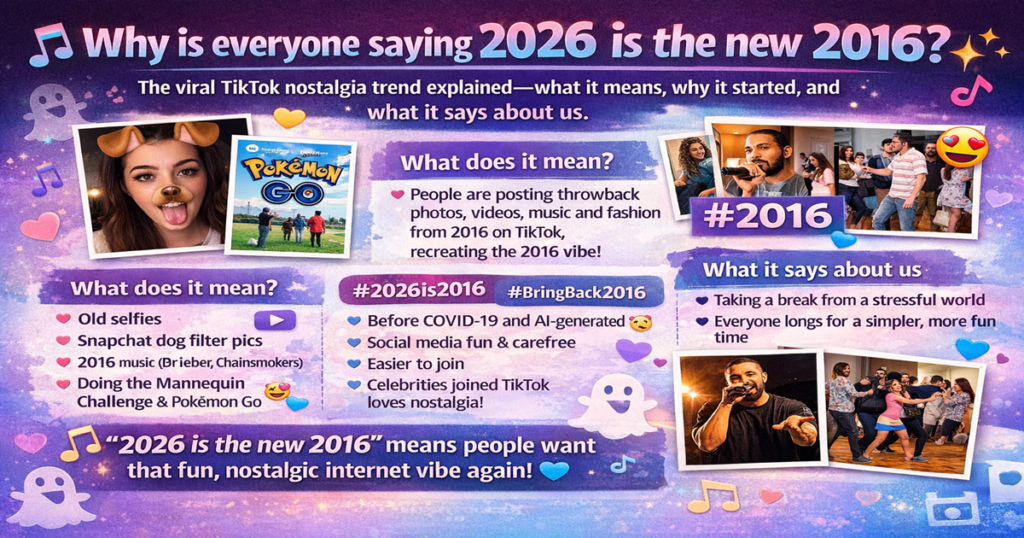
Open TikTok today. You will see flower crowns, Snapchat dog filters, and grainy photos soaked in oversaturated colour. You will hear Fetty Wap and One Direction. You will see people dancing in their kitchens to songs from a decade ago. The caption on every post says the same thing: “2026 is the new 2016.”
This viral nostalgia trend started in late 2025 and exploded on January 1, 2026. Moreover, it is not just Gen Z posting throwbacks for fun. The “2026 is the new 2016” trend carries something deeper — a protest against the internet as it exists today. Furthermore, the numbers confirm the scale: TikTok searches for “2016” jumped 450% in the first week of January alone. The #2016 hashtag crossed 2.3 million TikTok posts and 37 million Instagram posts. As a result, this is one of the biggest cultural moments the internet has produced in years.
What Is the “2026 Is the New 2016” Trend?
The trend asks a simple question: what if we went back? Users post throwback photos from 2016. They use the Rio de Janeiro Instagram filter. They apply Snapchat’s flower crown and puppy dog overlays. They share old Kylie Cosmetics looks, choker necklaces, and açai bowl photos. They listen to mid-2010s hits on loop.
Moreover, celebrities joined fast. Charlie Puth posted a rosy-hued video set to his 2016 hit “We Don’t Talk Anymore” with Selena Gomez, captioning it: “Heard it was 2016 again?” Lily Collins shared a slideshow of decade-old photos, writing: “I’m not sure why we decided 2016 is back, but wow, it really was a vibe.” Shay Mitchell posted throwbacks with her Pretty Little Liars castmates complete with Snapchat’s puppy dog filter. Furthermore, John Legend, Reese Witherspoon, Demi Lovato, Hailey Bieber, and Kylie Jenner all joined in. As a result, the trend crossed from user-generated content into mainstream celebrity culture within days.
Where Did It Start? The Great Meme Reset
The trend traces back to a specific origin point. The Week and Forbes both identified it: an “ironic Gen-Z joke that turned into a sincere movement” called the Great Meme Reset.
TikTokers began calling for a reset of internet culture in mid-2025. The idea was to post classic memes to drown out low-effort AI-generated content and revive forgotten trends. Moreover, 2016 became the target year because users identified it as the “golden age of memes” — the last moment before algorithms took over and turned social media into a performance. Furthermore, what started as irony became genuine sentiment fast. People who joined the trend as a joke found themselves actually feeling nostalgic. As a result, the ironic reset became a sincere cultural movement with real emotional weight.
Why 2016 Specifically? What Made That Year Special
The Internet Felt Different
Stylus trends editor Katie Devlin told Vogue: “We had just started to evolve past Tumblr-era cynicism. From a social media perspective, the algorithms were less aggressive, and surveillance was less of a concern. There is a whimsical and carefree nature associated with that era that people are really nostalgic for.”
Moreover, in 2016, social media still felt casual. People posted blurry selfies and random thoughts without a content strategy. Brands had not yet perfected their social media presence. Influencer culture existed but felt less high-stakes. Furthermore, viral trends swept through entire timelines in ways that felt collective — Harambe, the Mannequin Challenge, Pokemon Go. Everyone saw the same things at the same time. As a result, the internet felt like a shared space rather than a series of personalised echo chambers.
What Was Happening in 2016
| Category | 2016 Moments Everyone Remembers |
| Music | One Direction, Adele’s “Hello”, Drake’s “Hotline Bling”, Fetty Wap, Rihanna’s “Work”, The Weeknd, Justin Bieber’s “Love Yourself” |
| Social Media | Snapchat filters (flower crown, dog nose), VSCO girl aesthetic, Instagram Rio filter, Vine still alive, Musical.ly launch |
| Fashion | Choker necklaces, Kylie Jenner lip kits, Abercrombie & Fitch comeback, oversized hoodies, ripped jeans |
| Internet Trends | Mannequin Challenge, Pokemon Go, “In My Feelings” challenge, #BlackLivesMatter growth, Ice Bucket Challenge afterglow |
| TV and Film | Stranger Things season 1, Game of Thrones Battle of the Bastards, La La Land, Zootopia |
| Sport | Usain Bolt at Rio Olympics, Leicester City Premier League miracle, LeBron James Cleveland championship |
| Technology | iPhone 7 launch (no headphone jack), Samsung Galaxy Note 7 fires, Tesla Model 3 reveal, Snapchat Spectacles |
| World Events | Brexit vote, US presidential election, David Bowie and Prince deaths, Rio Summer Olympics |
The Real Reason Behind the Nostalgia
It Is Not Really About Snapchat Filters
Fortune’s analysis cuts deepest. The trend is not about aesthetics — it is economic and structural. Gen Z inherited the internet without the perks that came with it in 2016.
In 2016, Uber was cheap. Food delivery was underpriced. Rent was lower. Student debt was growing but not crushing. The cost-of-living crisis had not yet fully hit. Moreover, Fortune describes Gen Z as coming of age in a “fully mature internet economy” — where every platform has optimised for engagement and monetisation. Everything that felt free and fun in 2016 now costs more money or more attention. Furthermore, Casey Lewis, author of the creator-economy newsletter After School, put it plainly: Gen Z “inherited the platforms without the perks.” As a result, “2016 vibes” becomes a way to grieve a slightly easier world that slipped out of reach.
AI Fatigue and the Longing for Authentic Content
The timing of this trend is not accidental. It exploded in early 2026 — precisely as AI-generated content floods every platform. Wikipedia identifies this connection directly: the trend “looks back to the years before the COVID-19 pandemic, before false information spread widely on the internet, and before the use of AI to create content became common.”
In 2016, you knew that a photo of your friend at a party was actually your friend at a party. Memes spread because humans found them funny and chose to share them. Content went viral because people genuinely cared about it. Moreover, today, AI-generated images, AI-written captions, and algorithmically boosted engagement bait fill every feed. Furthermore, the Great Meme Reset explicitly called for flooding platforms with human-made content to push AI out. As a result, nostalgia for 2016 is partly a protest against what the internet has become.
The Psychology Behind It
Leah Faye Cooper, journalist and former Vogue editor, told ABC News: “People are really longing for a time that felt simpler, a time that felt really optimistic.” She added: “I think nostalgia is something that has been trending for a while now. You see it in fashion, you see it with reboots of TV shows and people remaking movies.”
Moreover, psychology researchers identify a pattern here. Every generation develops nostalgia for one specific year from their teenage years — the moment before adult complexity arrived. For Gen X, that year is 1994. For Millennials, it is 2004. For Gen Z, it is 2016. Furthermore, the nostalgia intensifies during periods of uncertainty. Global conflict, economic anxiety, rapid technological change, and political polarisation all push people toward comfort and familiarity. As a result, “2026 is the new 2016” is not just a TikTok trend — it is a symptom of collective stress.
Who Is Actually Driving This Trend?
The audience splits interestingly across generations. Fortune identifies it as “uniquely a millennial trend” in origin — but Gen Z is the audience making it go massively viral.
Millennials (now in their late 20s to early 40s) actually lived their prime young-adult years in 2016. They have the throwback photos. They feel genuine biographical nostalgia for that specific moment. Moreover, Gen Z — born between 1997 and 2012 — was between ages 4 and 19 in 2016. Many were too young to fully participate in the trends they now romanticise. Brand strategist Joel Marlinarson explained to Yahoo: “It’s not just about pretending to relive your Starbucks run nine years ago for Gen Z. 2016 meant being carefree with less performative social content and not being so chronically online.” Furthermore, Alpha generation users — born after 2013 — engage with the trend entirely through older family members’ content. As a result, three generations participate in the same trend but for completely different reasons.
The Backlash: Not Everyone Wants to Go Back
Every viral trend produces a counter-movement — and “2026 is the new 2016” is no exception.
Critics post videos arguing against the trend. They point out that 2016 was also the year of Brexit, a divisive US election, the Zika epidemic, and the deaths of David Bowie, Prince, and Carrie Fisher. Moreover, some critics note that the nostalgia selectively erases the political turmoil of the time — sanitising a complicated year into flower crowns and fun filters. Furthermore, some users find the trend ironic to the point of self-contradiction: people who claim to miss a less-curated internet are creating highly curated throwback content to express that longing. The Week noted that “some people posted videos denouncing the idea of making 2026 the new 2016.” As a result, the backlash itself became part of the trend’s momentum — driving further engagement and debate.
The Fashion Revival: What 2016 Trends Are Coming Back
| 2016 Trend | Status in 2026 | How to Wear It Now |
| Choker necklaces | Fully back — confirmed in SS26 fashion reports | Layer multiple over a clean white tee or slip dress |
| Oversaturated photo filters | Back as aesthetic choice — not embarrassing anymore | Use vintage filter apps — VSCO, Huji Cam |
| Flower crown accessories | Returning for festival season — more elevated versions | Dried flower versions replace plastic originals |
| Snapchat dog nose filter | Revived ironically — used in throwback content specifically | Used in “throwback mode” — not everyday posting |
| Skinny jeans | Complicated comeback — Gen Z resisted, now softening | Worn with chunky shoes to update the silhouette |
| Kylie Jenner lip era makeup | Bold liner + matte lip returning | Paired with clean skin rather than full-face contour |
| Abercrombie & Fitch aesthetic | Full commercial revival — brand already repositioned | Premium casual — oversized logo hoodies, straight jeans |
| VSCO girl aesthetic | Reframed as Y2K-adjacent — less earnest, more ironic | Scrunchies and oversized tees — now worn intentionally |
The Music Making a Comeback
Music drives the trend as much as visuals. TikTok users build videos around mid-2010s tracks that hit different in 2026 — whether through genuine nostalgia or deliberate retro positioning.
- Fetty Wap — “679” (technically 2015): The unofficial anthem of the trend. TikTokers dance to it in kitchen videos declaring 2026 the new 2016.
- Charlie Puth and Selena Gomez — “We Don’t Talk Anymore”: Charlie Puth’s own throwback post used this track. It resurged massively on streaming platforms in January 2026.
- Drake — “Hotline Bling”: The dance video that defined awkward-cool in 2016 returned as one of the trend’s most remixed references.
- One Direction’s catalogue: Searches for One Direction songs spiked 200% in January 2026. The band’s 2026 reunion tour announcement amplified the nostalgia significantly.
- Adele — “Hello”: Released in late 2015 but culturally peak 2016. Returned as a dramatic backdrop for before-and-after throwback montages.
What Happens Next: Is This a Lasting Shift?
Cultural analysts debate whether the trend signals something permanent or simply a January spike.
Kate Kennedy, author of “One in a Millennial: On Friendship, Feelings, Fangirls and Fitting In,” told The New York Times: “2016 sits at the intersection of nostalgia and structural change that we didn’t know was happening on the internet.” This framing suggests the trend is less about 2016 itself and more about the moment of change it represents.
Moreover, Our Healtho’s analysis frames the trend as part of a broader shift in how younger generations consume history — using emotional aesthetics rather than factual recall. Furthermore, the acceleration of nostalgia cycles matters here too. In previous generations, nostalgia for a decade took twenty years to fully develop. Social media has compressed that cycle dramatically — ten years now feels like enough distance. As a result, fashion, music, and digital culture all now operate on ten-year revival cycles rather than twenty-year ones.
Conclusion
“2026 is the new 2016” is a TikTok trend on the surface. Underneath, it is a document of collective exhaustion. People miss the internet before AI flooded every feed. They miss social media before every post became a performance. They miss economic conditions before a cost-of-living crisis made young adulthood feel precarious.
Moreover, the nostalgia is not accurate — 2016 had Brexit, a divisive election, and significant global anxiety. Nostalgia never produces accuracy. It produces the feeling of what we wish those years had been. Furthermore, that feeling — warmth, optimism, community, and the sense that the internet still belonged to regular people — is what millions of TikTok users are chasing when they post their flower crown throwbacks.
As a result, the trend will fade as trends always do. But the longing driving it will not. The internet changed, and a lot of people wish it had not. That is not a joke. That is a genuine cultural signal — and it deserves to be taken seriously.
Frequently Asked Questions (FAQs)
Q1: What does “2026 is the new 2016” mean?
The phrase declares a cultural reset — a collective decision to revisit the aesthetics, music, and online behaviour of 2016. Users post throwback photos with old Snapchat filters, share decade-old songs, and recreate 2016 fashion and meme culture. Moreover, it started as an ironic Gen-Z joke called the Great Meme Reset and became a sincere cultural movement. Furthermore, the #2016 hashtag crossed 2.3 million TikTok posts and 37 million Instagram posts. As a result, it became one of the biggest social media trends of early 2026.
Q2: Why did the 2026 is the new 2016 trend start?
Two forces drove it. The first is genuine nostalgia — 2016 now sits a decade in the past, far enough to romanticise but close enough to remember vividly. The second is protest. Moreover, the Great Meme Reset movement called for flooding platforms with human-made content to push out AI-generated material. Furthermore, Gen Z and Millennials both feel the internet changed for the worse — more curated, more commercial, more algorithmically controlled. As a result, 2016 became the symbolic last year before things shifted.
Q3: Which celebrities joined the 2026 is the new 2016 trend?
The celebrity list grew fast. Charlie Puth posted a throwback video set to “We Don’t Talk Anymore.” Lily Collins shared decade-old photos. Shay Mitchell posted Pretty Little Liars throwbacks with the Snapchat puppy filter. Moreover, John Legend, Reese Witherspoon, Demi Lovato, Hailey Bieber, and Kylie Jenner all joined. Furthermore, Selena Gomez, Karlie Kloss, and One Direction members shared throwback content. As a result, the trend crossed from user-generated content into A-list celebrity culture within the first two weeks of January.
Q4: Is the nostalgia for 2016 accurate — was it really a better time?
No — and most analysts acknowledge this. Nostalgia filters out the bad. 2016 also brought Brexit, a deeply divisive US election, the Zika epidemic, and the deaths of David Bowie, Prince, and Carrie Fisher. Moreover, the internet in 2016 was not perfect — cyberbullying existed, misinformation spread, and algorithm-driven feeds were already taking hold. Furthermore, The Week notes that participants “selectively focus on the fun cultural elements while ignoring the political weight of the year.” As a result, the trend is less about 2016 as it actually was and more about what people wish it had been.
Q5: What 2016 fashion trends are coming back in 2026?
Several 2016 fashion moments are genuinely back. Choker necklaces returned to the SS26 runways and high street simultaneously. Oversaturated photo filters are back as a deliberate aesthetic choice. Abercrombie and Fitch completed a full commercial revival — the brand already repositioned successfully. Moreover, Kylie Jenner’s bold lip era is influencing makeup trends again, paired with cleaner skin rather than heavy contour. Furthermore, VSCO girl aesthetic elements — scrunchies, oversized tees — reappear in ironic rather than earnest form. As a result, 2016 fashion revival is not cosplay — it is a genuine influence on what people buy and wear in 2026.