
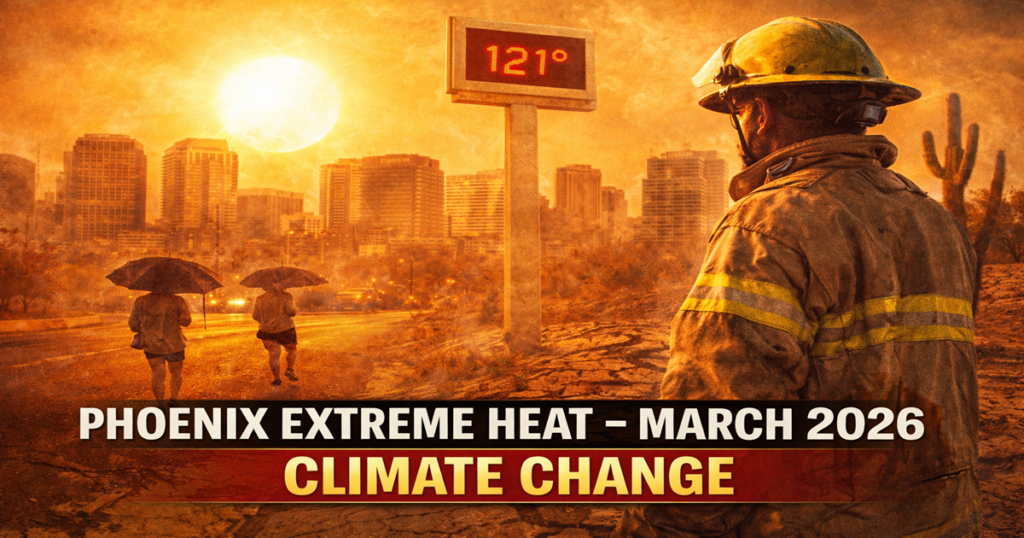
At 2:56 p.m. on Wednesday, March 18, Phoenix hit 100 degrees. The date shattered a record that stood for 38 years. Before 2026, Phoenix had reached triple digits in March exactly once — on March 26, 1988. This week, the city blew past that mark by more than a week. Then kept going. By Friday, the forecast read 107°F. The National Weather Service issued the first-ever Extreme Heat Warning for Arizona in March.
This is not a normal heat wave. Meteorologists describe it as “astonishing,” “genuinely startling,” and “mind-boggling.” Moreover, the extreme March heat wave of 2026 stretches across nearly the entire western United States — from San Francisco to Phoenix, from Las Vegas to Colorado and the Plains. Furthermore, Climate Central ranks this week’s temperatures at the highest level of its Climate Shift Index — meaning human-caused carbon pollution made these conditions at least five times more likely. As a result, the question is no longer whether this is connected to climate change. Scientists say it is. The question now is what it means for the future.
The Records Broken This Week
| Location | Record Broken | Previous Record | New Record |
| Phoenix, Arizona | Earliest 100°F day ever | March 26, 1988 | March 18, 2026 — broken by 8 days |
| Phoenix, Arizona | All-time March high temperature | 100°F (1988) | 107°F forecast March 20 — historic margin |
| Martinez Lake, Arizona | Highest March temperature in US history | Previous unknown | 110°F on Thursday March 19 |
| Las Vegas, Nevada | March high temperature record | Previous record | 95°F — broken Thursday March 19 |
| Boise, Idaho | Earliest 80°F day ever recorded | March 19, 1997 | Broken March 18, 2026 — only 2nd time ever in winter |
| Western US (multiple cities) | Daily high temperature records | Various | Broken by margins up to 10-11°F — not just marginal beats |
| Phoenix — all-time April record | April all-time high (105°F) | Set previously | Phoenix forecast to exceed April record while still in March |
| Colorado snowpack | Thinnest March snowpack | 1981 — thinnest prior record | 2026 thinnest since 1981 — disappearing 5 weeks early |
“We are going to shatter records,” NWS lead meteorologist Sean Benedict told KJZZ. Moreover, Benedict confirmed Phoenix typically does not hit 100 degrees until around May 2. Reaching it on March 18 — nearly seven weeks early — represents a shift of extraordinary scale. Furthermore, NWS meteorologist Tom Frieders told Arizona PBS: “We’re expected to shatter the record by 11 degrees.” As a result, this is not a record beaten by fractions. These are historically unprecedented margins.
What Is Causing It: The Heat Dome Explained
A stubborn ridge of high pressure locked itself over the American Southwest. It traps hot air beneath it like a lid on a pot. Temperatures across California and the desert Southwest run 20 to 30 degrees Fahrenheit above normal for this time of year.
NWS meteorologist Frieders calls it an “amplified pattern.” The jet stream moved so far north it left the West without the cold fronts that normally break up heat events in March. Moreover, the pattern was visible to forecasters more than 10 days in advance. It was not a surprise — it was a slow-motion record-breaking event that scientists watched approach. Furthermore, the West entered this heat wave after its hottest winter on record. Colorado’s snowpack hit its thinnest level since 1981. As a result, the heat dome arrived on already-parched, already-warm ground — amplifying its effects.
Climate Change: What Scientists Say
The Clear Connection
Scientists are careful about attributing any single event entirely to climate change. But the connection here is unusually direct. Climate Central’s Climate Shift Index rates this week’s temperatures at its highest level — meaning human-caused carbon pollution made conditions this extreme at least five times more likely.
Colorado state climatologist Russ Schumacher told CNN the heat dome is “astonishing” for March. He added: “With warming, you expect the warm conditions to be more likely and happen more frequently. When you get a heat wave, you expect it to be warmer or lasting longer.” Moreover, Schumacher confirmed directly: “These kinds of warm months and seasons are probably going to become more likely with future warming.” Furthermore, he stated understanding this heat wave is crucial for anticipating what lies ahead for the West. As a result, scientists are not hedging. They describe this event as climate change made visible.
The Eight-Day Shift in Phoenix’s Heat Season
The data behind Phoenix’s shifting heat season tells a long story. The National Weather Service tracks two benchmarks for the city’s average first 100-degree day. The long-term average — spanning 1896 to 2025 — sits at May 10. The more recent 30-year average — 1991 to 2020 — sits at May 2.
The difference between those two figures is eight days. Moreover, Shaun McKinnon, environment and climate editor, explained the significance: “This reveals a concerning trend — 100-degree days are now arriving, on average, eight days earlier than they did historically.” Furthermore, the 30-year rolling average updates every decade to reflect current “normal” temperatures. As a result, what counts as normal keeps shifting — and the shift consistently runs in one direction: hotter, earlier.
The West’s Hottest Winter on Record
This heat wave did not arrive without warning from the preceding months. The West just experienced its hottest winter on record. Moreover, Colorado recorded its thinnest snowpack since 1981. Schumacher noted: “March is when typically we would be seeing more snow storms and continuing to build up that snowpack in the mountains. And it looks like we’re going to be going in completely the opposite direction this week.”
In California’s Sierra Nevada, where snowfall ran closer to average this winter, the heat wave will erase the remaining snowpack completely — roughly five weeks earlier than normal. Furthermore, Phoenix recorded its hottest December in history in 2025, with an average temperature of 63.2 degrees. As a result, the March heat wave caps a winter season that itself broke records — suggesting a pattern rather than a single outlier event.
The Public Health Emergency
Extreme heat is the leading weather-related killer in the United States every year. An early-season heat wave carries a specific danger: the population is not yet acclimatised.
People who handle 110-degree heat in July without incident face serious health risks from 100-degree heat in March. Their bodies have not yet adapted to extreme temperatures after the cooler winter months. Moreover, Benedict urged Arizonans to take extra caution: “For March, it’s highly unusual and we’re not quite acclimatised yet. This is the time of year when people are really getting outdoors. We have spring training going on, there’s still probably a lot of people from out of town here that are not used to this type of heat.” Furthermore, the risk falls hardest on outdoor workers, elderly residents, children, and tourists who do not recognise the danger. As a result, public health officials and city governments across the West issued emergency heat safety guidance.
| Group | Risk Level | Specific Danger This Week |
| Outdoor workers — construction, agriculture | Extreme | Body not acclimated — heat illness risk dramatically higher than summer months |
| Elderly residents | Extreme | Poor heat regulation — less awareness of gradual overheating |
| Children | Very High | Higher surface-area-to-body-mass ratio — heat up faster |
| Tourists and out-of-towners | Very High | Benedict specifically flagged — not used to Arizona heat — no personal gauge |
| Spring training attendees | High | Extended sun exposure at stadium — drinks and shade critical |
| Pets | High | Ground temperature reaches 150°F+ at peak — paw burns from pavement |
| Hikers and trail users | Very High | Trails typically safe in March — NOT safe this week — multiple rescue calls expected |
| Homeless populations | Extreme | No access to air conditioning — highest heat mortality risk group |
The Wildfire Risk
Extreme heat does not arrive alone. The National Weather Service warned that heat combined with gusty winds and low humidity sharply raised wildfire danger across Colorado and the Plains.
Colorado’s thinnest snowpack since 1981 left vegetation unusually dry for March. Moreover, record temperatures accelerate evaporation from soil and plant material — reducing moisture content in grass and brush to fire-season levels two months ahead of schedule. Furthermore, strong winds — part of the same high-pressure pattern driving the heat — spread any ignition rapidly. As a result, fire weather conditions across parts of the West in mid-March 2026 match conditions that would normally occur in late May or early June.
The Ripple Effects: Baseball, Water, and Energy
Spring Training Disruptions
The Cactus League shifted 11 games to earlier start times as a safety precaution. Spring training runs across the Phoenix metropolitan area every March — drawing hundreds of thousands of visitors. The extreme heat warning directly affected game scheduling, attendance, and player safety protocols across every stadium.
Water Supply Threat
Lake Powell — a critical Colorado River reservoir — already sat at only a third of its capacity going into this week. The heat wave now accelerates snowmelt and evaporation simultaneously. Moreover, the Colorado River supplies water to 40 million people across seven US states and Mexico. Furthermore, with snowpack disappearing five weeks ahead of schedule in the Sierra Nevada, the spring runoff that refills reservoirs arrives too fast and too early to be stored effectively. As a result, water managers across the West face a supply problem that compounds every year these heat waves arrive earlier.
Energy Grid Stress
Air conditioning demand across Phoenix, Las Vegas, Los Angeles, and the broader Southwest spiked sharply as the heat dome settled in. March is outside the traditional peak energy demand season. Grid operators run reduced generating capacity and carry less backup reserve than in July or August. Moreover, the sudden extraordinary demand caught utilities managing a March-scale grid with June-scale temperatures. Furthermore, the pattern of extreme early-season heat events stresses infrastructure designed around historical seasonal norms that no longer hold. As a result, energy grid resilience in an era of shifting climate baselines has become a direct infrastructure challenge.
Is This the New Normal? What Scientists Project
| Projection | Scientific Consensus | Timeframe |
| Heat waves become more frequent | Confirmed — already occurring | Ongoing — accelerating |
| Heat waves become more intense | Confirmed — this week demonstrates it | Ongoing — each degree of global warming amplifies peaks |
| Heat season extends earlier and later | Confirmed — Phoenix data shows 8-day shift already | Ongoing — will continue without emissions reductions |
| 100-degree days arrive before May in Phoenix | Projected to become routine | Within 2-3 decades under current emissions trajectory |
| Snowpack declines continue across West | Confirmed — 2026 thinnest since 1981 | Ongoing — threatens Colorado River water supply |
| March heat emergencies become regular events | Projected — this week is likely a preview | Depends on pace of global action on emissions |
| Overnight low temperatures rise | Confirmed — bodies get no overnight recovery period | Already occurring — extends heat stress duration |
Schumacher’s conclusion frames it clearly: “These kinds of warm months and seasons are probably going to become more likely with future warming.” Moreover, the NWS Climate Prediction Center gave a higher probability of warmer-than-average temperatures across most of the United States through at least March 27, 2026. Furthermore, Benedict added a small note of counterintuitive optimism: the early heat — combined with dry conditions — could actually improve the odds for normal rather than below-average summer precipitation in Phoenix. As a result, not every consequence of this extraordinary event is entirely negative — but the baseline trajectory is undeniable.
Conclusion
Phoenix hit 100 degrees on March 18 — eight days earlier than any date in its recorded history. Martinez Lake, Arizona hit 110 degrees the next day — the highest March temperature ever recorded in the United States. Las Vegas broke its March record. Boise set its earliest 80-degree mark. Colorado’s snowpack hit a 45-year low. The NWS issued its first-ever Extreme Heat Warning for Arizona in the month of March.
Moreover, scientists do not describe this as a freak event disconnected from the broader climate picture. Climate Central rates this week’s conditions at the top of its climate attribution scale — at least five times more likely because of human-caused carbon pollution. Furthermore, Colorado’s state climatologist says directly that these kinds of warm months will become more likely as warming continues.
As a result, the March 2026 heat wave is not just a record-breaking weather story. It is a data point in a trend line — one that points consistently, clearly, and uncomfortably toward a hotter future arriving faster than most historical models predicted.
Frequently Asked Questions (FAQs)
Q1: What records did Phoenix break during the March 2026 heat wave?
Phoenix broke the record for the earliest 100-degree day in its history on March 18 — shattering the previous record set on March 26, 1988 by more than a week. The city then continued climbing, reaching a forecast high of 107 degrees on March 20 — which would also break the all-time April record of 105 degrees while still technically in March. Moreover, NWS issued its first-ever Extreme Heat Warning for Arizona in March. Furthermore, temperatures ran 20 to 30 degrees above average for the time of year. As a result, these records broke not by small margins but by historically unprecedented amounts.
Q2: Is the March 2026 heat wave caused by climate change?
Scientists draw a direct connection. Climate Central’s Climate Shift Index rates this week’s temperatures at its highest level — meaning human-caused carbon pollution made conditions this extreme at least five times more likely. Moreover, Colorado state climatologist Russ Schumacher confirmed that warm conditions will become more frequent and intense as global warming continues. Furthermore, the West’s hottest winter on record in 2025-2026 provided the warm baseline that amplified this heat dome. As a result, while a specific weather pattern triggered the event, climate change made it far more severe and far more likely than it would have been otherwise.
Q3: What is a heat dome and how does it work?
A heat dome forms when a stubborn ridge of high pressure parks over a region and traps hot air beneath it like a lid on a pot. Air sinking under high pressure compresses and heats further. The jet stream shifts north, cutting off the cold fronts that would normally break the pattern. Moreover, NWS meteorologist Tom Frieders called this an “amplified pattern” that forecasters identified more than 10 days in advance. Furthermore, the dome over the Southwest pushed temperatures 20 to 30 degrees Fahrenheit above average across California, Arizona, Nevada, and parts of the Plains. As a result, areas that normally see March temperatures in the 70s and 80s recorded temperatures equivalent to June or July.
Q4: How does early-season heat pose a different risk than summer heat?
Early-season heat kills because human bodies have not yet acclimatised. People who handle 110 degrees in July without major incident face serious medical risk at 100 degrees in March. The cardiovascular and cooling systems build seasonal tolerance gradually. Moreover, NWS meteorologist Sean Benedict specifically warned about out-of-towners and spring training visitors who are not used to Arizona heat and have no personal gauge for the danger. Furthermore, outdoor activities that are routine in March — hiking, open-air events, spring training games — become dangerous faster than people expect. As a result, early-season heat emergencies historically produce higher per-degree mortality than peak summer events.
Q5: What does the March 2026 heat wave mean for Western water supplies?
The implications for water are serious and long-lasting. Colorado’s snowpack hit its thinnest level since 1981 going into this event. The heat wave accelerates snowmelt in the Sierra Nevada by roughly five weeks ahead of normal. Moreover, when snowpack disappears too early, spring runoff arrives faster than reservoirs can capture and store it — producing floods followed by shortages. Furthermore, Lake Powell already sat at one-third capacity before this week. The Colorado River supplies water to 40 million people across seven states and Mexico. As a result, the combination of record early heat, thin snowpack, and already-depleted reservoirs creates a compounding water supply stress that water managers across the West will manage for the rest of 2026.