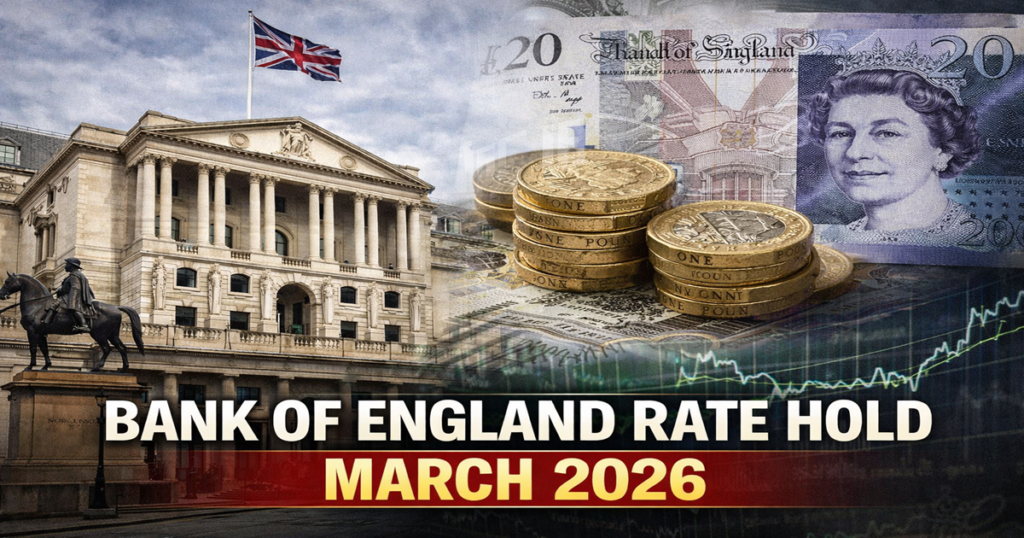
The Bank of England held interest rates at 3.75% on Thursday, March 19. The vote was unanimous. Just weeks ago, markets treated a cut as a near certainty. The Iran war changed everything. Oil prices surged 50% since February 28. Gas prices spiked 20% in a single morning. Inflation — falling toward 2% before the conflict — now heads back toward 3.5%. The Bank of England rate hold 3.75% was the only credible option.
For millions of UK households, this decision carries real consequences. Tracker mortgage holders stay on current rates. Fixed-rate borrowers preparing to remortgage face a more expensive market than they expected six weeks ago. Savers see rates hold. Moreover, the MPC’s language shifted hawkishly — two members floated the possibility of rate rises rather than cuts. Furthermore, markets now price a possible hike later in 2026. As a result, the path that looked like gradual cuts through the year has closed — at least for now.
The Decision: What the MPC Voted and Why
The Monetary Policy Committee voted unanimously — 9 to 0 — to hold the Bank Rate at 3.75% on March 19. This follows a February meeting where the vote was 5 to 4 to hold, with four members pushing for an immediate cut to 3.5%.
That shift — from near-divided to unanimous — tells the full story. The MPC cited the Middle East conflict as a significant shock causing a major increase in global energy and commodity prices, which will affect households’ fuel and utility prices and have indirect effects via business costs. Moreover, the Bank confirmed that prior to the war there had been continued disinflation in domestic prices and wages. Furthermore, it stated that monetary policy cannot influence global energy prices — but must ensure the economic adjustment achieves the 2% inflation target sustainably. As a result, the hold was not a choice between good options. It was a choice between inflation risk and recession risk, with the MPC opting to fight inflation first.
The Iran War: Why It Derailed the Rate Cut
Three weeks ago, financial markets priced a March rate cut as almost certain. Deutsche Bank, ING, and most major forecasters expected 3.5% by the end of March. Then Operation Epic Fury began on February 28.
| Economic Indicator | Before War (Feb 26) | After War (March 19) | Direction |
| Brent Crude Oil | ~$65-70/barrel | $116/barrel | Up ~70% |
| UK Natural Gas (Intraday March 19) | EUR30/MWh baseline | Up 20%+ on Thursday alone | Surging |
| UK CPI Inflation (latest reading) | 3.0% — falling toward 2% | Forecast to hit 3.5% Q3 2026 | Rising |
| Deutsche Bank UK Inflation forecast | Below 3% trajectory | Up to 4% by end 2026 | Doubled |
| Market-priced rate cuts in 2026 | 2-3 cuts expected | 0-1 cuts — some pricing hikes | Reversed |
| 2-year gilt yields (rate expectations) | Falling | Jumped 0.3pp to 4.39% on Thursday | Sharply higher |
| 10-year gilt yields | Falling | Rose to 4.77% — near 2008 high | Multi-year high |
| UK GDP growth Q1 2026 | 0.1-0.2% expected | Unchanged — flat January GDP | Stagnant |
| UK unemployment rate | 5.2% | 5.2% — 10-year high | Elevated |
Bloomberg confirmed the Bank of England skipped a rate cut that markets once saw as a near certainty, as officials paused to assess the disruption unleashed by the Middle East conflict. Moreover, with UK CPI at 3.0% in January and forecast to climb back toward 4% by end 2026, the MPC could not risk cutting rates while inflation was accelerating. Furthermore, GDP registered zero growth in January and unemployment hit a 10-year high at 5.2% — leaving the MPC trapped between inflation risk and recession risk. As a result, analysts described the hold as the only credible option in the circumstances.
The Hawkish Surprise: Could Rates Actually Rise?
The hold was expected. What surprised markets was the language. Several MPC members shifted their positions significantly — not toward cuts, but toward hikes.
Catherine Mann said her view had shifted away from considering a rate cut and toward a longer hold, “or even a hike at some point to lean against inflation persistence.” Moreover, Swati Dhingra — the MPC’s most consistent vote for rate cuts — said the UK’s economic outlook was at a “crossroads” but that rates may need to be increased if oil and gas supply disruption proved prolonged. Furthermore, Rob Wood of Pantheon Macroeconomics stated: “Our call is Bank Rate on hold in 2026, but the surge in oil and especially natural gas prices this morning tilts the risks further towards hikes.” As a result, financial markets started pricing in the potential for an actual rate increase later in 2026 — a scenario that seemed unthinkable just four weeks ago.
What It Means for Your Mortgage
Tracker and Variable Rate Mortgages
Tracker mortgages move directly with the Bank Rate. The hold at 3.75% means no immediate change in monthly payments for tracker holders. This provides short-term relief for approximately 800,000 UK households on tracker deals.
However, the hawkish MPC tone changes the outlook. Mark Harris, chief executive of SPF Private Clients, said: “With so much volatility on pricing currently, borrowers should consider taking action and securing a rate now if they will need a mortgage in the next six months.” Moreover, if the MPC moves toward a hike rather than a cut, tracker holders face rising payments. As a result, the advice from mortgage brokers this week is to lock in a fixed rate sooner rather than later.
Fixed Rate Mortgages — Remortgaging
The position is most difficult for households approaching the end of a fixed rate deal. Those who fixed at 1.5% to 2% in 2020 and 2021 now face remortgaging into a 4.5% to 5.5% market.
The Iran war has already pushed some lenders to raise their fixed mortgage rates. Some mortgage lenders increased the interest rates quoted on new mortgage products as a result of Term Overnight Indexed Swap rates rising to levels seen in early 2025. Moreover, Aaron Shinwell of Nottingham Building Society warned: “Lenders have already begun adjusting mortgage rates in response to heightened market volatility.” Furthermore, the outlook for further cuts — which would bring fixed rates down — has pushed back significantly. As a result, anyone due to remortgage in the next six months faces a harder market than the one anticipated at the start of the year.
First-Time Buyers
First-time buyers face a doubly difficult market. Affordability — already stretched — deteriorates further if fixed rates rise. House prices in the South East and London remain elevated even as broader market activity slows.
Tom Bill, head of UK residential research at Knight Frank, confirmed: “A prolonged conflict in the Middle East would dampen sentiment and delay rate cuts due to rising inflation, which would put downwards pressure on prices.” Moreover, lower house prices help affordability in theory — but rising mortgage rates can cancel out that benefit entirely. As a result, first-time buyers now face extended uncertainty on both the price and rate sides of the affordability equation.
What It Means for Your Savings
For savers, the rate hold brings a mixed picture. Banks and building societies typically offer savings rates linked to the Bank Rate. A hold prevents the immediate erosion of savings rates that a cut would trigger.
However, savers who anticipated locking in higher rates before an anticipated cut cycle now face a more complex calculation. Moreover, with inflation heading back toward 3.5%, any savings account paying below that rate still produces a negative real return — meaning the purchasing power of savings continues to fall. Furthermore, the possibility of rate hikes later in 2026 could push savings rates higher. As a result, savers in the short term benefit from the hold — but real returns remain negative until inflation returns to target.
The Inflation Forecast: A Moving Target
| Period | CPI Inflation Forecast (Before War) | CPI Inflation Forecast (After War) | Key Driver |
| Q1 2026 (now) | Falling toward 2% | ~3.0% — rising | Energy price shock hitting economy |
| Q2 2026 | 2.1% — near target | ~3.0% — elevated | Iran war energy premium sustained |
| Q3 2026 | Near 2% target | Up to 3.5% | Ofgem energy price cap rises July — adds ~0.75pp |
| Q4 2026 | 2% — target achieved | Up to 4% (Deutsche Bank) | If war continues — full energy pass-through |
| Full year 2026 | 2 rate cuts expected | 0-1 cuts — possible hikes | Depends entirely on conflict duration |
The Bank now expects inflation at around 3% in Q2 2026, up from the 2.1% forecast in February. Higher wholesale gas prices could feed through into a higher Ofgem energy price cap from July — adding around 0.75 percentage points to inflation over Q3. Moreover, the MPC confirmed that even a short-lived conflict likely leaves energy prices elevated for a sustained period. Furthermore, Deutsche Bank’s Sanjay Raja outlined three scenarios: a quick war resolution brings two rate cuts; sustained high energy prices bring two cuts but the second only at year-end; oil above $100 means just one cut, not until H2 2026. As a result, the single largest variable in UK monetary policy for 2026 is not domestic data — it is the trajectory of the Iran war.
The Stagflation Risk
The combination of rising inflation and stagnant growth has a name: stagflation. It is the economic condition central banks fear most — because the standard tool for fighting inflation (raising rates) makes the growth problem worse, and the standard tool for supporting growth (cutting rates) makes inflation worse.
One analyst described the MPC’s position directly: “The MPC is now trapped between a rock and a hard place. The data on growth and unemployment screams for a rate cut, but the renewed inflationary threat makes such a move untenable.” Moreover, UK GDP showed zero growth in January. Unemployment sits at 5.2% — a 10-year high. Furthermore, energy price surges hit businesses and consumers simultaneously — compressing corporate margins and household spending power at the same time. As a result, the UK economy enters Q2 2026 with the characteristics of stagflation: inflation rising, growth stalling, and monetary policy unable to address both problems simultaneously.
When Is the Next Rate Decision?
The next MPC meeting concludes on April 30, 2026. After that, meetings follow on June 18 and July 30.
| Meeting Date | Market Expectation (as of March 19) | Key Condition for a Cut |
| April 30, 2026 | Hold most likely — cut possible if war de-escalates fast | Oil below $90 + CPI trajectory clearly falling |
| June 18, 2026 | First realistic cut window if conflict stabilises | Sustained energy price decline + inflation peaking confirmed |
| July 30, 2026 | Cut more likely if Q2 data shows inflation peaking | Ofgem cap impact must be smaller than feared |
| End 2026 | 1 cut (base case) — 0 cuts or hike if war escalates | Depends entirely on conflict duration and energy trajectory |
ING’s James Smith forecast: “UK inflation could peak at 3.5% this year if energy prices stay around current levels into Q2. We now expect the next Bank of England cut in April, though March was still a possibility if Middle Eastern tensions rapidly de-escalate.” Moreover, Bloomberg confirmed markets started pricing in potential rate hikes following the Bank’s hawkish language on Thursday. As a result, the April meeting is live — but a cut requires significant de-escalation in the Middle East before then.
What Experts Say You Should Do Now
| Your Situation | Expert Recommendation | Urgency |
| On a tracker mortgage | Consider switching to fixed — rates may rise not fall | High — act within weeks |
| Fixed rate expiring in next 6 months | Lock in a new fixed rate now — do not wait for cuts | High — rates already rising on new products |
| Fixed rate expiring 6-12 months away | Monitor — secure a rate offer now, switch if cheaper later | Medium — watch monthly |
| On a standard variable rate | Review immediately — SVRs are expensive — switch now | High — SVRs already elevated |
| First-time buyer saving a deposit | Continue saving — market uncertainty may soften prices | Low — stay the course |
| Savings in easy access account | Stay flexible — rate hike possibility benefits savers | Low — current rates acceptable |
| Savings in fixed-term bond | Consider shorter terms — don’t lock in long if hikes come | Medium — watch April meeting |
| Buy-to-let investor | Stress-test at 6% mortgage rate — war risk is real | High — review lending margins now |
Conclusion
The Bank of England rate hold at 3.75% on March 19 marks a turning point — not just for interest rates, but for the entire economic outlook Britain entered 2026 with. The rate cuts that were almost certain in February now look uncertain. A rate rise later in 2026 — unthinkable a month ago — now sits on the table.
Moreover, the Iran war has done what domestic data could not: it forced the MPC into a unanimous hold when four members were ready to cut just three weeks earlier. Gas prices up 20% in a morning. Oil at $116 a barrel. Inflation heading back toward 3.5% and potentially 4%.
Furthermore, the MPC’s message to households and businesses is clear: do not plan around rate cuts this year. Plan around current rates — and consider what a hike would mean for your finances. As a result, the Bank of England rate hold at 3.75% is not just a pause in a cutting cycle. It may mark the end of one.
Frequently Asked Questions (FAQs)
Q1: Why did the Bank of England hold rates at 3.75% in March 2026?
The MPC voted unanimously to hold because the Iran war triggered a major energy price shock. Oil hit $116 per barrel. UK gas prices spiked 20% in a single morning on March 19. CPI inflation — falling toward 2% before the conflict — now heads toward 3.5% by Q3 2026. Moreover, cutting rates while inflation rises would damage the Bank’s credibility and risk entrenching a wage-price spiral. Furthermore, hiking rates to fight inflation risks tipping an already stagnant economy into recession. As a result, a hold was the only credible option in what analysts called a stagflation trap.
Q2: Could the Bank of England actually raise rates in 2026?
Yes — this possibility has moved from theoretical to realistic after Thursday’s meeting. MPC member Catherine Mann said her view shifted toward “a hike at some point to lean against inflation persistence.” Swati Dhingra — the committee’s most consistent rate-cut advocate — acknowledged rates may need to rise if supply disruption proves prolonged. Moreover, Rob Wood of Pantheon Macroeconomics stated the surge in oil and gas prices tilts risks “further towards hikes.” Furthermore, financial markets started pricing in potential hikes following the MPC’s hawkish guidance. As a result, borrowers should stress-test their finances against a rate above 3.75%.
Q3: What does the rate hold mean for my mortgage?
Tracker mortgage holders see no immediate change in monthly payments. However, the hawkish MPC tone and rising swap rates mean some lenders have already raised fixed mortgage rates this week. Moreover, Mark Harris of SPF Private Clients urged borrowers to secure a rate now if they need a mortgage in the next six months — warning that waiting for cuts may prove costly if rates rise instead. Furthermore, anyone remortgaging from a 2020-21 low fixed rate still faces a significant payment increase regardless of the hold. As a result, the key action is to review your mortgage situation now — not to wait for a cut that may not come this year.
Q4: When is the next Bank of England rate decision?
The next MPC meeting concludes on April 30, 2026. Subsequent meetings follow on June 18 and July 30. Markets currently price a cut at April as possible but not certain — it depends on whether the Iran war de-escalates and energy prices fall meaningfully before then. Moreover, ING expects the next cut in April if Middle Eastern tensions ease. Furthermore, Deutsche Bank forecasts only one cut in all of 2026 if oil stays above $100. As a result, the April 30 meeting is the next key date — and its outcome depends more on geopolitics than on domestic economic data.
Q5: What does the rate hold mean for UK inflation?
The Bank of England now forecasts inflation at around 3% in Q2 2026 — up from its February forecast of 2.1%. Higher wholesale gas prices feed into an Ofgem energy price cap rise expected in July, adding approximately 0.75 percentage points to Q3 inflation. Moreover, if energy prices stay elevated, Deutsche Bank forecasts UK inflation could hit 4% by end 2026 — double the Bank’s 2% target. Furthermore, even if the war ends quickly, energy prices typically remain elevated for a sustained period after supply disruption. As a result, UK inflation is unlikely to return to the 2% target until 2027 at the earliest under current conditions.