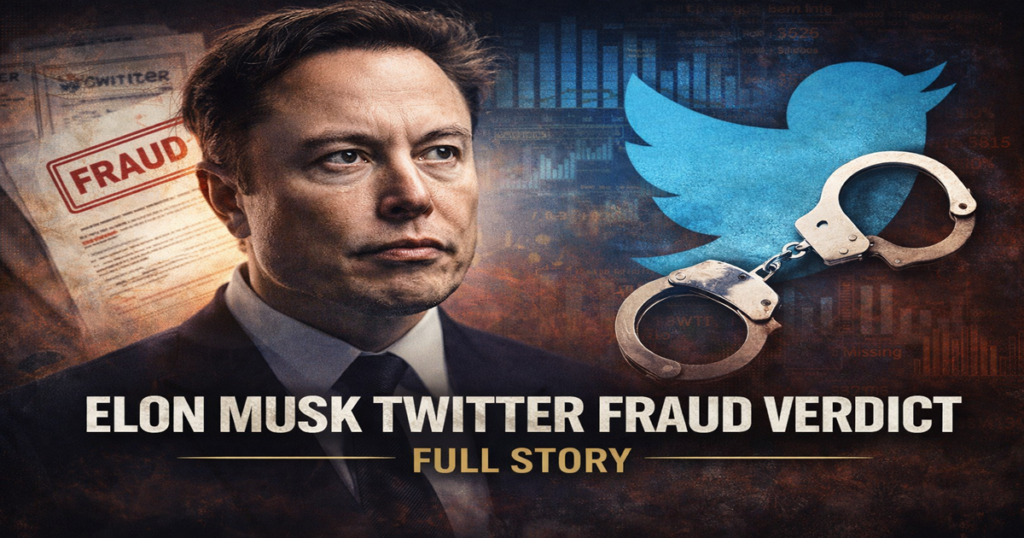
On Friday, March 20, a nine-person jury in San Francisco delivered its verdict in one of the most anticipated corporate fraud trials of the decade. Elon Musk misled Twitter investors with two tweets in May 2022 — the jury found him liable. The case, Pampena v. Musk, took nearly three weeks of testimony and four days of deliberation. Damages could reach $2.6 billion. Musk plans to appeal.
The Elon Musk Twitter fraud verdict marks a rare legal defeat for the world’s richest man — a figure Fortune magazine dubbed “Teflon Elon” for his track record of winning high-stakes lawsuits most expected him to lose. Moreover, the jury did not find he ran a deliberate fraud scheme. It found something more specific: two tweets misled investors who sold their shares at a loss. Furthermore, plaintiffs’ attorney Mark Molumphy declared it “the largest securities jury verdict in United States history.” As a result, the verdict reshapes the legal landscape around how billionaires communicate on social media.
The Verdict: What the Jury Found
| Legal Question | Jury Finding |
| Did Musk’s May 13 tweet mislead investors? | YES — found materially false and misleading |
| Did Musk’s May 17 tweet mislead investors? | YES — found materially false and misleading |
| Did Musk’s podcast statement mislead investors? | NO — found to be an opinion, not a false statement |
| Did Musk engage in a deliberate scheme to defraud? | NO — jury absolved him of scheming |
| Were investors harmed by the tweets? | YES — shareholders who sold lost money they would otherwise have made |
| Total liability for damages | $2.1 billion to $2.6 billion — exact amount determined when shareholders file claims |
| Musk’s response | Plans to appeal — lawyers called verdict “a bump in the road” |
“This is a great example of what you cannot do to the average investor — people that have 401ks, kids, pension funds, teachers, firemen, nurses,” said Joseph Cotchett, attorney for the plaintiffs, outside the San Francisco courthouse. Moreover, Musk’s legal team at Quinn Emanuel immediately signalled an appeal. Furthermore, they pointed to recent victories — including what they called “the largest appellate victory in this country’s history” — as signals of confidence on appeal. As a result, this verdict is the beginning of a legal battle, not its end.
Background: The $44 Billion Twitter Deal
How It Started
In April 2022, Elon Musk made an unsolicited offer to buy Twitter for $54.20 per share — valuing the company at approximately $44 billion. Twitter’s board initially resisted. Then it accepted. Then something shifted.
In the weeks that followed, Musk’s enthusiasm visibly cooled. He raised concerns about the number of fake accounts and bots on the platform. Moreover, he claimed Twitter had significantly underreported its bot problem — filing SEC disclosures saying fake accounts represented only 5% of users. Furthermore, Musk argued the real figure was much higher and that Twitter withheld information about how it calculated the number. As a result, he used the bot controversy as the basis for trying to exit the deal.
The Two Tweets That Changed Everything
On May 13, 2022, Musk posted: “Twitter deal temporarily on hold pending details supporting calculation that spam/fake accounts do indeed represent less than 5% of users.” Twitter shares dropped 8% in a single session.
Four days later, on May 17, he posted a follow-up tweet claiming the deal could not move forward until he received more information about bot accounts. Moreover, shares continued to slide. Investors who feared the deal would collapse sold their stock — missing out when Musk ultimately completed the acquisition in October 2022 at the original $54.20 price. Furthermore, shareholder Giuseppe Pampena filed a class action lawsuit on behalf of all Twitter investors who sold between May 13 and October 4 — the period when Musk’s statements depressed the stock. As a result, thousands of retail investors suffered measurable financial losses from decisions made based on Musk’s public statements.
The Delaware Battle
After Musk tried to withdraw from the deal, Twitter’s board sued him in Delaware Chancery Court to force him to complete the acquisition. The case exposed a rich vein of internal communications — text messages, emails, and negotiations — that revealed the chaotic behind-the-scenes reality of the deal.
Just before the Delaware trial was scheduled to begin, Musk reversed course entirely. He agreed to pay the original $54.20 per share. He completed the acquisition in October 2022. He renamed the company X. Moreover, he subsequently merged it with his artificial intelligence company xAI, and then with SpaceX. Furthermore, the Delaware reversal did not end the legal exposure — it simply transferred the battlefield from corporate contract law to federal securities law. As a result, the Pampena class action continued to pursue Musk for the losses investors suffered during the five months of uncertainty.
The Trial: Three Weeks in San Francisco
Who Testified
The trial ran for nearly three weeks in the Northern District of California federal court in San Francisco. It began on March 2 and concluded with the verdict on March 20. The witness list included some of the most prominent names in recent tech history.
| Witness | Role | Key Testimony |
| Elon Musk | Defendant — Tesla CEO, xAI founder | Testified his tweets were based on genuine bot concerns — “if this was a trial about stupid tweets, I’m guilty” — but denied material intent |
| Parag Agrawal | Former Twitter CEO | Testified about bot calculations and company’s disclosure process — central to whether Musk’s claims were well-founded |
| Ned Segal | Former Twitter CFO | Testified on financial disclosures and the accuracy of the 5% bot figure |
| Giuseppe Pampena | Lead plaintiff — investor | Testified about losses suffered after selling Twitter shares based on Musk’s statements |
| Expert witnesses (plaintiffs) | Financial and securities experts | Quantified stock price impact of Musk’s statements — $3 to $8 per share per trading day over five months |
Musk’s Defence Argument
Musk’s legal team at Quinn Emanuel built their defence around two pillars. First, they argued his concerns about bot accounts were genuine and well-founded — not manufactured to drive down the stock price. Second, they argued the tweets did not constitute a deliberate scheme to defraud investors.
Musk himself testified: “Twitter deal temporarily on hold” was an honest statement of his position at the time. Moreover, he maintained that Twitter’s leadership lied about the number of bots and withheld information about how the figure was calculated. Furthermore, his lawyers sought a mistrial multiple times — arguing Musk could not receive a fair trial in San Francisco due to public hostility toward him. As a result, the defence framed the entire case as a misunderstanding of a legitimate business dispute rather than securities fraud.
The Plaintiffs’ Argument
Mark Molumphy, lead attorney for the investors, delivered a sharper narrative. In closing arguments he told the jury that Musk’s tweets were not innocent mistakes or careless posts. They were intentional, deliberate, and designed to create the impression that Twitter was overrun with spam.
Molumphy argued Musk wanted to purchase Twitter at a lower price than $54.20 per share. The bot controversy gave him a pretext to try to renegotiate. By publicly casting doubt on Twitter’s value, he drove down the stock — benefiting any renegotiation attempt. Moreover, investors who sold during the five-month window suffered real, measurable losses. Furthermore, attorney Joseph Cotchett framed the stakes broadly: “This case goes right to the heart of Wall Street and what’s been going on in recent years.” As a result, the plaintiffs argued this was not a dispute about bots but about market manipulation using social media.
The Jury’s Nuanced Decision
The nine-person jury deliberated for nearly four days before returning a verdict that was neither a full victory nor a full defeat for either side.
The jury found Musk liable on two of the four fraud claims — the two specific tweets. It absolved him on the podcast statement, ruling it was an expression of opinion rather than a false statement of fact. Moreover, it rejected the allegation that he ran a deliberate scheme to defraud — the most serious charge. Furthermore, it calculated damages at $3 to $8 per share per trading day over approximately five months — a formula that plaintiffs’ lawyers say produces total damages of $2.1 billion to $2.6 billion. As a result, the verdict lands between full vindication and full condemnation — a nuanced legal outcome that both sides can partially claim.
The Damages: $2.6 Billion in Context
| Damages Figure | Source | Context |
| $2.1 billion | AP / Washington Times estimate | Based on $3-8 per share per trading day formula |
| $2.5 billion | CNN estimate | Depending on number of claimants |
| $2.6 billion | Molumphy (plaintiffs’ attorney) | Upper estimate — “largest securities jury verdict in US history” |
| Musk’s net worth (March 20) | $661-814 billion (Bloomberg Billionaires Index) | Damages = approximately 0.3-0.4% of total net worth |
| Tesla 2018 “funding secured” case | $0 — Musk won | Previous securities fraud trial — acquitted |
| SEC lawsuit (Jan 2025) | Pending — Musk filed to dismiss | Separate case — late disclosure of Twitter stake acquisition |
“Even an award that high wouldn’t dent Musk’s net worth,” Fortune confirmed. At $661 billion on the day of the verdict, $2.6 billion represents less than half of one percent of his total wealth. Moreover, the damages are not yet finalised — individual shareholders must submit claims before the precise figure is set. Furthermore, Musk plans to appeal — and his lawyers pointed to recent appellate victories as grounds for optimism. As a result, the financial impact on Musk personally may ultimately be far smaller than the headline figure suggests.
The SEC Case: A Separate But Related Story
The Pampena civil case is not the only legal jeopardy Musk faces over the 2022 Twitter acquisition. The US Securities and Exchange Commission filed a separate lawsuit against Musk in January 2025.
The SEC alleged Musk failed to disclose that he owned more than 5% of Twitter’s common stock within the legally required 10-day window. This late disclosure allegedly allowed Musk to continue buying Twitter shares at artificially low prices — before the market knew a major buyer was accumulating a stake. Moreover, Musk filed to dismiss the SEC lawsuit in August 2025, calling it “constitutionally infirm.” Furthermore, the SEC case remains pending separately from the Pampena verdict. As a result, Musk faces two distinct legal fronts arising from the same 2022 acquisition.
What This Means for Social Media and Securities Law
Beyond Musk himself, the verdict carries significant implications for how courts treat billionaire communications on social media platforms.
- Tweets are securities communications: The verdict confirms that public statements by major shareholders or executives on social media carry the same legal weight as formal press releases and SEC filings. Casual framing does not eliminate legal liability.
- “I didn’t mean it seriously” is not a defence: Musk’s own testimony — “if this was a trial about stupid tweets, I’m guilty” — became a liability rather than an asset. The jury found intent behind the specific tweets regardless of his characterisation of them.
- Retail investor protection matters: The plaintiffs’ framing — 401k holders, teachers, nurses, pension funds — resonated. The verdict signals that courts take seriously the harm caused to ordinary investors by powerful individuals’ public statements.
- Wealthy defendants face San Francisco juries: Musk’s lawyers argued repeatedly he could not get a fair trial in San Francisco. The court rejected every mistrial motion. The venue argument failed — and the precedent is noted by legal observers.
Conclusion
The Elon Musk Twitter fraud verdict is one of the most consequential legal decisions in the history of American technology. A nine-person jury found the world’s richest man liable for misleading investors with two tweets. Damages could reach $2.6 billion — described by plaintiffs’ lawyers as the largest securities jury verdict in US history.
Moreover, the verdict is nuanced. The jury did not find Musk ran a deliberate fraud scheme. It found specific statements were materially false and harmful. Furthermore, Musk plans to appeal — and his track record on appeal gives his lawyers grounds for confidence. The exact damages remain to be calculated as shareholders submit claims.
As a result, the most important takeaway from this verdict extends beyond Musk. It establishes clearly that social media posts by major market participants are securities communications — subject to the same legal standards as any other public statement affecting investors. In an era where billionaires run their own platforms and shape markets with single tweets, that principle matters enormously.
Frequently Asked Questions (FAQs)
Q1: What did the jury find Elon Musk guilty of?
The nine-person jury found Musk liable for two specific tweets in May 2022 that misled Twitter investors. The May 13 tweet stated the Twitter deal was “temporarily on hold” and the May 17 tweet said the deal could not proceed without more information about bot accounts. Moreover, the jury found both tweets were materially false or misleading. Furthermore, the jury rejected the most serious allegation — that Musk ran a deliberate scheme to defraud investors. As a result, the verdict found liability for specific misleading statements rather than a broader fraud conspiracy.
Q2: How much does Elon Musk have to pay?
The exact damages figure is not yet finalised. Plaintiffs’ attorney Mark Molumphy estimated total damages at $2.6 billion — which he described as the largest securities jury verdict in US history. CNN estimated approximately $2.5 billion depending on the number of claimants. Moreover, the jury calculated $3 to $8 per share per trading day over approximately five months. Furthermore, the precise amount depends on how many investors file claims. As a result, the final figure will be determined after a claims process — and may differ significantly from initial estimates.
Q3: Will Elon Musk appeal the verdict?
Yes — Musk plans to appeal. His legal team at Quinn Emanuel confirmed this immediately after the verdict. They characterised the result as “a bump in the road” and expressed confidence based on recent appellate victories. Moreover, they cited what they called “the largest appellate victory in this country’s history” — a separate case where Musk recently won on appeal after an adverse trial outcome. Furthermore, Musk won a similar securities fraud trial in 2023 over his “funding secured” Tesla tweets. As a result, the appeals process could significantly reduce or eliminate the damages awarded.
Q4: Who filed the lawsuit against Musk?
Investor Giuseppe Pampena filed the original class action lawsuit — Pampena v. Musk — in October 2022, shortly after Musk completed his Twitter acquisition. The lawsuit covered all Twitter shareholders who sold their stock between May 13, 2022 — the date of the first tweet — and October 4, 2022. Moreover, the case was argued by attorneys Mark Molumphy and Joseph Cotchett of Cotchett, Pitre and McCarthy LLP. Furthermore, the class potentially includes thousands of retail investors who sold at a loss during the period of uncertainty. As a result, the case represented ordinary investors rather than large institutional players.
Q5: Does this verdict affect Elon Musk’s other companies?
Not directly — the verdict relates specifically to Musk’s personal conduct during the Twitter acquisition, not to Tesla, SpaceX, or xAI. However, the verdict has broader implications. The SEC filed a separate lawsuit against Musk in January 2025 over his failure to disclose his Twitter stake acquisition on time — that case remains pending. Moreover, the verdict reinforces the principle that Musk’s social media statements carry legal weight as securities communications. Furthermore, Tesla shareholders have previously sued over Musk’s tweets — and the precedent this verdict sets strengthens future plaintiffs. As a result, the verdict signals that courts will continue scrutinising Musk’s public communications carefully.