Iran had a plan. Close the Strait of Hormuz. Watch oil prices explode. Make the war so economically painful that America stops. It nearly worked. Three weeks into Operation Epic Fury, Brent crude hit $119 per barrel. US gas prices jumped nearly a dollar per gallon. Stanford economists estimated American households would pay an extra $740 on fuel this year alone. Iran’s oil weapon was landing its blows.
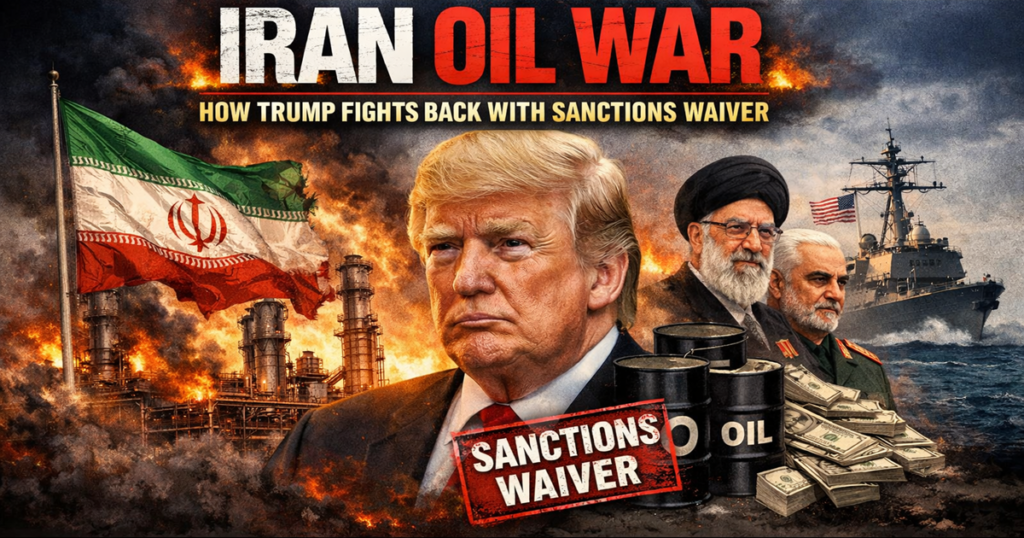
Then Trump fired back — with Iran’s own oil. On March 20, the Treasury Department issued General License U — a 30-day sanctions waiver allowing the sale of 140 million barrels of Iranian crude already sitting on tankers at sea. Moreover, Treasury Secretary Scott Bessent framed it precisely: “In essence, we will be using the Iranian barrels against Tehran to keep the price down as we continue Operation Epic Fury.” Furthermore, the move shocked Washington, confused allies, and split analysts. As a result, the Iran oil war now has two fronts — military and economic — and both sides are fighting with the same weapon: Iranian oil.
Iran’s Oil Weapon: The Strategy That Shook Global Markets
The Hormuz Masterstroke
Iran’s strategic calculation was precise. The Strait of Hormuz carries 20% of the world’s oil and 20% of all global LNG every single day. Iran cannot beat America militarily. But it can make America’s war unbearably expensive for the American public — and therefore politically unsustainable.
The IRGC did not need a naval blockade. A handful of drone strikes near the waterway removed war-risk insurance from commercial shipping. Ship owners stopped transiting. Over 150 tankers anchored outside. Traffic fell to near zero. Moreover, 20 million barrels per day disappeared from global markets — not through seizure, but through commercial risk calculation. For the full history and strategic significance of this chokepoint, read our detailed analysis: Strait of Hormuz: History, Geopolitics and the 2026 Crisis. Furthermore, Iran simultaneously struck Qatar’s Ras Laffan LNG facility, Kuwait’s two largest refineries, UAE gas plants, and Saudi infrastructure. As a result, supply pressure compounded from every direction simultaneously.
The Economic Damage Iran Achieved
| Economic Impact | Before War (Feb 26) | After 3 Weeks (March 19) | Change |
| Brent Crude price | $65-70/barrel | $112-119/barrel | Up 70%+ |
| US regular gas price | ~$2.90/gallon | ~$3.80/gallon | Up ~90 cents |
| European natural gas (TTF) | EUR30/MWh | EUR66-68/MWh | Up 120% |
| US household annual fuel cost | Baseline | +$740 per year extra | Stanford economists estimate |
| LNG tanker freight rates | Baseline | Up 40%+ | Massive premium |
| War-risk insurance (Hormuz) | Available | Cancelled entirely | Tankers won’t sail |
| Qatar LNG production | 100% | Halted — Ras Laffan damaged | 20% global LNG gone |
| Iraq oil exports | Normal | Shutting down — no export route | #2 OPEC producer affected |
| Consumer spending hit | Baseline | -$1.5B annually per cent of gas rise | Every penny counts |
When Iran struck Kuwait’s Mina Al-Ahmadi refinery and Qatar’s Ras Laffan on March 18-19, Brent crude surged to $116 per barrel in a single session — up 8% in one day. For a full breakdown of those attacks and their immediate market impact, see: Oil Hits $116: Kuwait and Qatar Energy Attacks Explained.
Iran’s oil ministry spokesperson Saman Ghoddoosi denied that any Iranian oil sits stranded at sea — posting on X that Iran has “no surplus crude oil left on the water or for supply in other international markets.” Iran disputes the entire premise of the US waiver. Moreover, even if the 140 million barrel figure is accurate, it covers only seven days of what Hormuz normally carries. Furthermore, Iran allowed its own oil to transit the strait while blocking others — building a parallel yuan-denominated payment corridor through its own territorial waters. As a result, Iran constructed a system where it continues selling oil while denying that supply to the rest of the world.
Trump’s Counter-Strike: Using Iran’s Oil Against Iran
General License U — The Economic Weapon
General License U — GL U — is the US Treasury’s counter-move. It authorises all transactions “ordinarily incident and necessary to the sale, delivery, or offloading” of Iranian crude oil loaded onto vessels on or before March 20, 2026. The license runs until April 19.
The logic is elegant in theory. That Iranian oil was already heading to China at discounted prices in defiance of existing sanctions. By lifting the waiver, the US redirects that supply toward allies — Thailand, Vietnam, South Korea, Japan, India — at market price. Moreover, “Iran was going to sell those barrels anyway,” one administration official told CNN. “Instead of going to China, we make it sellable to Thailand or Vietnam.” Furthermore, Energy Secretary Chris Wright estimated supplies could reach Asia within three to four days. As a result, the administration frames GL U not as helping Iran, but as weaponising Iran’s own stranded supply against its economic interests.
The Problems With the Plan
Critics identify multiple fundamental flaws in the GL U strategy. The Foundation for Defense of Democracies — one of Washington’s most hawkish Iran policy institutes — praised the move but simultaneously identified its most dangerous gap.
GL U contains no reporting requirements. Buyers need not disclose how they use the license. Moreover, GL U contains no escrow mechanism and no obvious restrictions on payment channels — meaning Bessent’s claim that Iran “will have difficulty accessing revenue” relies entirely on other existing sanctions rather than anything built into GL U itself. Furthermore, the FDD warned that Iran may be simultaneously constructing a yuan-denominated transit regime through the strait — meaning GL U could inadvertently accelerate Chinese financial influence in the world’s most critical energy chokepoint. As a result, the very weapon designed to fight Iran’s economic strategy may partly advance it.
Iran Says the Oil Doesn’t Exist
Iran’s official denial adds a further complication. Oil ministry spokesperson Saman Ghoddoosi explicitly stated on X that Iran has no surplus crude on the water. If accurate, GL U unlocks nothing — the 140 million barrels do not exist in accessible form.
Moreover, Gregory Brew of Eurasia Group warned: “If they pursue this strategy and allow buyers to buy off this oil on the water, it’ll go quickly. Then we’ll be faced with the interesting proposal of dropping sanctions on Iranian oil generally.” Furthermore, Cornell University sanctions expert Nicholas Mulder stated directly: “The US has to dial back sanctions to offset the second order effect of war.” As a result, GL U forces a question the administration has not fully answered: what happens on April 19 when the waiver expires, if oil prices are still above $100?
The Bigger Contradiction: Funding a War Against Itself
| Trump’s Previous Position | Trump’s Current Action | The Contradiction |
| Called Obama “insane” for sending Iran $400M+ in 2016 | Lifted sanctions allowing Iran to sell $10B+ in oil | Now allows Iran to earn far more than Obama ever sent |
| “Maximum pressure” on Iran — signature foreign policy | GL U temporarily removes oil sanctions during active war | Maximum pressure paused at exact moment of maximum conflict |
| Spent presidency 1 imposing toughest ever Iran sanctions | Issued GL U without reporting requirements or escrow | No mechanism to verify Iran cannot access revenue |
| Criticised “pallets of cash” to Iran for years | Allows Iran oil sales with no guaranteed revenue block | Critics call it “biggest dumbest concession ever given to Iran” |
| Struck Kharg Island — Iran’s main oil terminal | Simultaneously lifted sanctions on Iranian oil at sea | Bombing Iran’s oil infrastructure while buying its oil |
Former CIA Director John Brennan captured the contradiction plainly: “It’s very clear that the Trump administration is trying to alleviate some of these global energy and oil market pressures, but at the same time, what they’re doing is allowing Iran to be able to benefit from that relaxation of sanctions. It shows the inconsistencies in these policies.” Moreover, former NSC spokesman Tommy Vietor called it “the biggest, dumbest concession ever given to Iran by the US.” Furthermore, Sen. Richard Blumenthal labelled it “sickeningly, shamefully stupid — lifting sanctions on oil sales by Russia and Iran, fueling their war machines with windfall cash.” As a result, GL U generates as much political heat domestically as any single decision of the Iran war.
The Expected Outcomes: What Actually Happens Now
| Scenario | Probability | Oil Price Impact | Political Impact |
| 140M barrels reach market — prices ease 10-14 days | Moderate (40%) | Brent falls $10-15 temporarily — gas prices ease marginally | Trump claims win — pressure reduces briefly |
| Iran denies oil exists — waiver delivers little supply | Possible (30%) | Prices stay above $100 — waiver seen as failed gambit | Political embarrassment — critics vindicated |
| China benefits most — buys oil through GL U mechanism | Likely regardless of above | Yuan-denominated corridor deepens — Beijing gains influence | Long-term strategic cost exceeds short-term price gain |
| April 19 expires — prices spike again | High unless Hormuz reopens (60%) | Prices return to $110+ immediately | Forces bigger decision — full sanctions lift or escalate |
| War winds down before April 19 | Possible if Trump “winding down” is real (25%) | Prices fall rapidly — potentially below pre-war levels | Trump declares victory — economic pressure eases |
| Iran uses revenue to fund proxy attacks | Ongoing regardless | No oil price impact | US military costs increase — war extends |
What Iran’s Oil Weapon Achieved — A Scorecard
Three weeks into the war, Iran’s oil strategy has produced measurable results — even as the military campaign inflicted massive damage on Iranian infrastructure.
- Oil price: Iran drove Brent from $65 to $119 — a 70%+ surge that costs American consumers hundreds of dollars per household annually. Every day of Hormuz closure compounds this damage.
- Political pressure: The White House now privately estimates higher prices could linger for months. Fortune confirmed the fuel price surge threatens Republican control of Congress in November midterms — precisely Iran’s intended effect.
- Sanctions reversal: Iran forced the US to lift its own maximum pressure sanctions during an active war. This is a significant strategic victory regardless of how the administration frames it.
- China positioning: Iran’s yuan-denominated corridor and GL U’s absence of restrictions combine to potentially deepen Chinese financial influence in the Strait of Hormuz — a long-term strategic outcome.
- Military losses: Against these economic gains, Iran suffered devastating military damage — nuclear facilities struck, leadership killed, infrastructure destroyed, air defences degraded. The military balance is sharply negative for Iran.
The Verdict: Who Is Winning the Economic Battle?
The honest answer is: Iran is winning the economic battle while losing the military one. The Hormuz closure succeeded in driving prices to multi-year highs, forcing maximum pressure sanctions to reverse, and creating domestic political pressure inside the United States that threatens Republican electoral prospects.
Moreover, Trump’s GL U counter-move — using Iranian oil against Iran — is tactically clever but strategically limited. It provides days rather than weeks of relief. It contains no enforcement mechanism. It may benefit China more than US allies. Furthermore, the fundamental problem has not changed: 20 million barrels per day remain blocked by the Hormuz closure, and no combination of SPR releases, sanctions waivers, and pipeline alternatives comes close to filling that gap. As a result, the economic war between Iran and the United States will ultimately be decided not by GL U but by whether military objectives succeed fast enough to reopen the strait before the domestic political cost becomes unbearable.
Conclusion
Iran’s oil weapon was simple, effective, and — so far — partially successful. Close the strait, drive prices to levels that hurt American voters, and wait for political pressure to do what military resistance cannot. The strategy cost Iran enormously in military terms. But economically, it forced the world’s most powerful country to lift its own signature sanctions on the adversary it is simultaneously fighting.
Moreover, Trump’s sanctions waiver counter-move — GL U — demonstrates strategic creativity under pressure. Using Iran’s own oil to fight Iran’s oil weapon is an elegant concept. But elegant concepts require execution. The 140 million barrels may not all exist. The revenue restrictions have no enforcement mechanism. The April 19 expiry arrives regardless of whether anything has structurally changed.
Furthermore, Nicholas Mulder’s assessment from Cornell captures the dynamic most precisely: “The US has to dial back sanctions to offset the second order effect of war.” As a result, the Iran oil war teaches a lesson that applies far beyond this conflict: in modern warfare, the economic battlefield matters as much as the military one — and Iran understood that long before Washington did.
Frequently Asked Questions (FAQs)
Q1: What is Iran’s oil weapon and how did it work?
Iran’s oil weapon is the deliberate closure of the Strait of Hormuz — removing 20 million barrels per day of oil and 20% of global LNG from world markets. Iran achieved this not through a naval blockade but through targeted drone strikes near the waterway. These strikes caused war-risk insurers to withdraw coverage. Without insurance, ship owners stopped transiting commercially. Moreover, Iran simultaneously struck Gulf energy infrastructure — Qatar’s LNG hub, Kuwait’s refineries, UAE gas plants. Furthermore, this drove Brent crude from $65 to $119 per barrel — a 70%+ surge — and US gas prices up nearly a dollar per gallon. As a result, Iran inflicted serious economic damage on the United States and its allies without firing a single shot at American soil.
Q2: What is General License U and what does it actually do?
General License U is a 30-day sanctions waiver issued by the US Treasury on March 20, valid until April 19. It authorises the sale of Iranian crude oil and petroleum products already loaded onto vessels at sea before March 20. Moreover, it covers approximately 140 million barrels — oil that was previously stranded because sanctioned buyers could not legally purchase it. Furthermore, the license contains no reporting requirements and no escrow mechanism. As a result, it theoretically redirects Iranian oil from China toward US allies — but critics note no mechanism prevents Iran from accessing the revenue or China from benefiting.
Q3: Does the sanctions waiver actually help Iran financially?
This is genuinely disputed. Treasury Secretary Bessent says Iran will have difficulty accessing revenue because financial sanctions remain in place. Critics including former CIA Director John Brennan say Iran benefits regardless of how the administration frames it. Moreover, GL U contains no escrow mechanism and no payment channel restrictions — meaning the revenue blockade relies on separate existing sanctions rather than anything in GL U itself. Furthermore, Iran’s own oil ministry denies the 140 million barrels exist at all. As a result, whether Iran financially benefits depends on facts — shipping locations, payment structures, sanctions enforcement — that are not fully public.
Q4: Why did Trump lift sanctions on Iranian oil while the war was ongoing?
The administration ran out of other options. All go-to policy levers were already deployed — the Strategic Petroleum Reserve released 172 million barrels, the Jones Act was lifted, Russian oil sanctions were waived, OPEC+ was pressured. None of these closed the fundamental supply gap. Moreover, Fortune confirmed the fuel price surge threatens Republican control of Congress in the November midterm elections — creating direct political pressure on Trump. Furthermore, Bessent framed GL U as “using Iranian barrels against Tehran” — redirecting oil China would buy regardless toward US allies instead. As a result, the waiver was simultaneously an economic emergency measure and a political calculation about electoral consequences.
Q5: What happens when General License U expires on April 19?
Unless the Strait of Hormuz reopens before April 19, the administration faces a stark choice. Let GL U expire — and watch oil prices spike immediately back above $100 as the temporary supply relief ends. Or extend GL U — effectively making the sanctions waiver permanent and abandoning the maximum pressure framework entirely. Moreover, if the 140 million barrels sold quickly, Gregory Brew of Eurasia Group warned the administration would face “the interesting proposal of dropping sanctions on Iranian oil generally.” Furthermore, Trump’s signal about “winding down” military operations suggests the administration hopes military objectives are met before April 19 forces this decision. As a result, April 19 is the next major decision point — and its outcome depends entirely on the military situation on the ground.