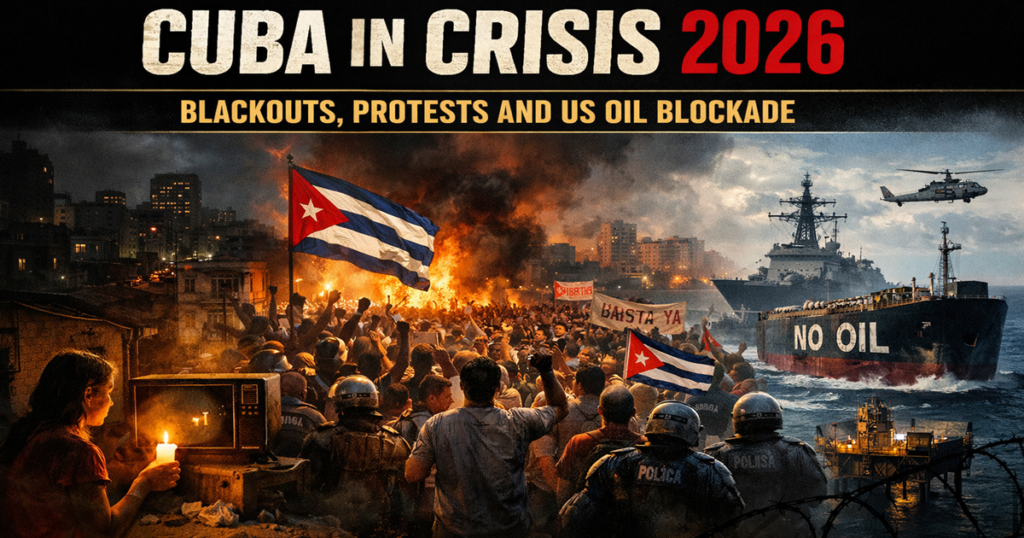
Havana goes dark at sunset. Not because the city sleeps — but because there is no electricity. Cubans queue for bread before dawn. Hospitals run on generators that break down. Fuel-powered vehicles sit idle because there is no petrol to fill them. Families burn wood to cook. Children study by candlelight. This is Cuba in 2026 — and it is the worst crisis the island has faced since the Soviet Union collapsed in 1991.
Cuba’s crisis in 2026 stems from multiple simultaneous failures. The US trade embargo tightened further under Trump. Venezuela — Cuba’s primary oil supplier — descended into its own political upheaval after Maduro’s capture in January. The Iran war drove global oil prices above $110 per barrel. And Cuba’s own Soviet-era power grid finally gave way under decades of neglect. Moreover, protests erupted across the island in March — including crowds who burned Communist Party headquarters in at least one province. Furthermore, the Cuban government arrested hundreds of protesters. As a result, an island nation of 11 million people now faces an existential crisis with no clear exit.
The Blackout Crisis: A Nation Without Power
How Bad Is It?
Cuba’s electricity crisis is not a rolling outage. It is a near-total collapse of the national grid for large parts of the day. The New Humanitarian confirmed that power cuts across Cuba now last up to 20 hours per day in some provinces. Havana — the capital — experiences cuts of 12 to 16 hours daily.
The national grid runs on ageing Soviet-era thermoelectric power plants. Most were built in the 1960s and 1970s. Cuba never modernised them. Moreover, they run on heavy fuel oil — a resource Cuba no longer receives in adequate quantities. Furthermore, the plants break down constantly — and Cuba lacks the spare parts, foreign currency, and technical expertise to repair them quickly. As a result, the grid operates at a fraction of its designed capacity — and the gap widens every month.
The Human Consequences
| Sector | Impact of Blackouts | Scale |
| Hospitals | Generators run for surgery — but break down — patients at risk | All public hospitals affected |
| Food refrigeration | Food spoils — shortage compounds shortage | Nationwide |
| Water supply | Electric pumps fail — no running water for hours | Most urban areas |
| Schools | Children study by candlelight or not at all | Widespread school disruption |
| Small businesses | Cannot operate without power — income collapses | Informal economy devastated |
| Agriculture | Irrigation pumps fail — crop yields fall | Rural provinces worst affected |
| Internet and communications | Connections drop during outages — information blackout | Government restricts access during protests |
| Mental health | Suicide rates rising — hopelessness spreading | Human Rights Watch documented surge |
Human Rights Watch documented a direct link between the electricity crisis and rising suicide rates. Moreover, The New Humanitarian confirmed that food insecurity reached levels not seen since the “Special Period” of the early 1990s — when the Soviet collapse left Cuba without fuel, food, or economic support. Furthermore, Amnesty International reported that the crisis pushes more Cubans than ever to attempt the dangerous sea crossing to Florida. As a result, the US Coast Guard intercepted record numbers of Cuban migrants in early 2026 — a visible symptom of the desperation the crisis creates.
The Root Causes: Why Cuba Reached This Point
Cause 1 — The US Embargo Tightened Again
The United States has maintained a trade embargo on Cuba since 1962. Under Trump’s second term, that embargo tightened significantly. The Trump administration re-listed Cuba as a State Sponsor of Terrorism in January 2025 — a designation that restricts financial transactions, banking access, and third-party trade far beyond the embargo itself.
Moreover, the State Sponsor of Terrorism listing discourages even non-American companies from doing business with Cuba — for fear of US secondary sanctions. Furthermore, Trump’s administration blocked remittance transfers from Cuban-Americans to family members on the island — cutting off a financial lifeline that previously supported millions of Cuban households. As a result, Cuba’s access to foreign currency, credit, and even basic trade collapsed further under the tightened sanctions regime.
Cause 2 — Venezuela Cut Off Cuba’s Oil
For decades, Venezuela supplied Cuba with heavily discounted oil — sometimes at prices 40 to 50% below market rate — in exchange for Cuban doctors, military advisers, and political support. At its peak, Venezuela sent Cuba approximately 100,000 barrels per day. That arrangement sustained Cuba’s economy and its power grid.
In January 2026, US special operations forces captured Venezuelan President Nicolás Maduro. The resulting political upheaval in Caracas disrupted Venezuelan oil production and export arrangements across the board. Moreover, acting President Delcy Rodríguez — focused on surviving politically and negotiating with Washington — had little capacity to maintain Cuba’s preferential oil supply. Furthermore, Trump’s Venezuela deal prioritised oil access for the US and its allies — not for Cuba, which Washington views with hostility. As a result, Cuba lost its primary energy lifeline at the precise moment global oil prices surged to multi-year highs.
Cause 3 — The Iran War Drove Oil Prices Beyond Cuba’s Reach
Even if Cuba could purchase oil on international markets, it cannot afford to do so at current prices. Brent crude above $110 per barrel — driven by the Iran war and Strait of Hormuz closure — places market-rate oil completely beyond the reach of a country with no hard currency reserves and no access to international credit markets.
The global oil price shock caused by Operation Epic Fury has cascading effects far beyond the immediate conflict zone. For a detailed breakdown of how the Iran war sanctions and oil prices interact globally, read our analysis:Iran Oil Sanctions Lifted: Trump’s Plan to Cut Oil Prices. Moreover, Cuba sits at the extreme end of oil price vulnerability — a country that imports almost all its energy, possesses no foreign currency reserves, and cannot access international financial markets. Furthermore, the 30-day US sanctions waiver on Iranian oil explicitly excludes Cuba — listed alongside North Korea and Russian-occupied Ukraine as ineligible buyers. As a result, the same waiver that provides brief price relief to Thailand, Vietnam, and South Korea specifically locks Cuba out.
Cause 4 — Decades of Economic Mismanagement
The structural causes run deeper than any single external shock. Cuba’s command economy has suppressed private enterprise, agricultural productivity, and technological modernisation for six decades. The state controls almost all economic activity — and manages it badly.
Agricultural land lies fallow because farmers lack fertiliser, fuel, and machinery. Sugar production — once Cuba’s primary export — collapsed from 8 million tonnes annually in the 1980s to under 500,000 tonnes today. Moreover, the dual currency system introduced in the 1990s distorted prices and incentives for decades before a botched monetary reform in 2021 triggered a hyperinflationary episode that destroyed household savings. Furthermore, the state payroll employs approximately 70% of workers at wages that average $30 per month — insufficient to purchase food at current prices. As a result, the Cuban economy entered the 2026 global crisis in a structurally weakened condition that made every external shock exponentially more damaging.
The March Protests: Cuba’s Powder Keg Explodes
On March 17, 2026, protesters in Palma Soriano — a city in Santiago de Cuba province — set fire to the local Communist Party headquarters. Footage spread rapidly on social media before authorities restricted internet access. Other protests erupted across Holguín, Camagüey, and parts of Havana.
The trigger was simple: a neighbourhood had experienced 22 consecutive hours without electricity. People were hungry, hot, and exhausted. The Communist Party office represented everything that had failed them. They burned it. Moreover, these protests marked the most significant public unrest since the July 2021 protests — when thousands of Cubans took to the streets shouting “Libertad” in scenes that shocked a government accustomed to public compliance. Furthermore, the government responded with mass arrests — detaining hundreds of protesters across provinces. As a result, human rights organisations confirmed the arrests within days, with families reporting that detained relatives had simply disappeared into the prison system.
| Date | Event | Location | Government Response |
| March 17 | Communist Party HQ set on fire after 22-hour blackout | Palma Soriano, Santiago de Cuba | Internet restricted — security forces deployed |
| March 17-18 | Protests spread — crowds demand electricity and food | Holguín, Camagüey, Havana | Mass arrests — hundreds detained |
| March 18 | Government blames “counterrevolutionary elements” and US | National broadcast | State media frames as foreign interference |
| March 18-19 | Social media restricted — footage suppressed | Nationwide | VPN usage surges among Cubans |
| March 19 | Human rights organisations confirm mass arrests | Multiple provinces | Families cannot locate detained relatives |
| March 20 | Cuban government denies systematic repression | Official statement | International condemnation follows |
The Government’s Response: Blame, Arrest, and Silence
Cuba’s government — led by President Miguel Díaz-Canel — responded to the protests with its standard playbook. It blamed the United States. It labelled protesters as paid agents of imperialism. It restricted internet access to prevent footage spreading. And it arrested hundreds of people.
Díaz-Canel appeared on state television to declare the protests were organised by “counterrevolutionary” groups funded from abroad. Moreover, the government announced increased electricity rationing — framing it as a necessary sacrifice — rather than acknowledging the structural failures that caused the crisis. Furthermore, it appealed to Cubans to demonstrate revolutionary loyalty in the face of American aggression. As a result, the government’s response satisfied no one — least of all the Cubans still sitting in the dark.
Cuba’s Crisis vs Other Global Crises — A Comparison
| Country | Primary Crisis | External Help Available | Outlook |
| Cuba | Power grid collapse + fuel shortage + food insecurity | None — US embargo blocks most aid | Very poor — no exit visible |
| Venezuela (pre-Jan 2026) | Economic collapse under Maduro | Russia + China + Cuba support | Changed after Maduro capture |
| Venezuela (post-Jan 2026) | Political transition | US sanctions relief being negotiated | Improving — US deal in progress |
| Gaza | War + blockade + humanitarian crisis | UN aid — severely restricted | Critical — ongoing conflict |
| Haiti | State collapse + gang control | International mission — limited | Dire — no state function |
| North Korea | Sanctions + famine risk | China — limited support | Chronic — decades-long crisis |
| Yemen | War + famine + infrastructure collapse | UN aid — partially blocked | Critical — war ongoing |
Cuba’s specific predicament combines the worst of multiple crisis types simultaneously. Unlike Venezuela, it has no powerful patron willing to negotiate its recovery. Unlike North Korea, it lacks a nuclear deterrent that forces great powers to manage rather than ignore it. Unlike Hamas-controlled Gaza, it cannot attract the attention that active conflict generates. Moreover, Cuba is small, strategically secondary to Washington’s current priorities, and governed by a regime that Washington views with ideological hostility. As a result, Cuba’s crisis deepens largely in silence — generating less international attention than its severity deserves.
The Emigration Explosion
When life becomes unbearable, Cubans leave. The numbers in 2025 and 2026 are staggering. The US Customs and Border Protection recorded over 300,000 Cuban encounters at the US border in 2024 — the highest single-year figure in history. The numbers in early 2026 are tracking even higher.
The coast guard regularly intercepts makeshift rafts and boats in the Florida Strait. Cubans also travel overland — through Ecuador, Colombia, and Central America — in a weeks-long journey to reach the US southern border. Moreover, many do not survive the attempt. The New Humanitarian confirmed that the sea crossing remains one of the most dangerous migration routes in the Western Hemisphere. Furthermore, those who reach the US encounter an asylum system that processes Cuban claims slowly and inconsistently. As a result, Cuba is losing exactly the working-age population — the engineers, teachers, doctors, and farmers — whose skills the island most needs to recover.
Is There Any Way Out? The Possible Scenarios
| Scenario | Likelihood | What It Would Require | Timeline |
| US lifts embargo — diplomatic normalisation | Very low (5%) | Congress approval + political will — neither exists | Years if ever |
| Venezuela resumes oil supply under new government | Possible (25%) | Rodriguez govt stabilises — oil deal with US includes Cuba provision | 6-18 months |
| China deepens support — replaces Venezuela | Ongoing but limited (40%) | Beijing already Cuba’s largest creditor — political cost of deeper support | Immediate but insufficient |
| Russia resumes oil supply | Possible but limited (20%) | Russia-Cuba ties historic — but Russia under its own sanctions pressure | Uncertain |
| Internal reform — private sector liberalisation | Possible (30%) | Government allows genuine economic reform — politically difficult | 1-3 years if started now |
| Regime change — collapse of Communist government | Low (10%) | Sustained mass protest + military defection — no sign of either yet | Unknown |
| Crisis deepens — humanitarian catastrophe | Most likely without intervention (50%) | No action = continued deterioration | Already underway |
Conclusion
Cuba in 2026 represents something the world rarely sees: a crisis caused by the simultaneous failure of everything at once. The Soviet-era power grid collapsed. The Venezuelan oil lifeline cut off. Global oil prices surged beyond any level Cuba could afford. The US tightened its embargo to its harshest level in decades. And a government that has never learned to trust its own people responded to desperation with arrests and silence.
Moreover, the March protests — people burning Communist Party headquarters after 22 hours without electricity — signal that the social contract between the Cuban government and Cuban people is fracturing. An entire generation has grown up knowing nothing but shortage, darkness, and the choice between staying and suffering or leaving and surviving. Furthermore, the international community watches with limited attention. Cuba’s crisis generates fewer headlines than conflicts with higher geopolitical stakes.
As a result, the most honest assessment of Cuba’s situation in 2026 is the most uncomfortable one: without a dramatic change in US policy, Venezuelan oil supply, or Cuban government willingness to reform its economy, the crisis will deepen. The lights will stay off longer. More people will leave. And the island that survived the fall of the Soviet Union may finally reach a breaking point it cannot recover from.
Frequently Asked Questions (FAQs)
Q1: Why is Cuba experiencing such severe blackouts in 2026?
Cuba’s blackout crisis stems from four compounding causes. The national grid relies on Soviet-era thermoelectric plants built in the 1960s and 1970s — they are obsolete, constantly breaking down, and Cuba lacks foreign currency to repair or replace them. Moreover, Venezuela — Cuba’s primary oil supplier — drastically reduced its subsidised oil shipments after Maduro’s capture in January 2026. Furthermore, the Iran war drove global oil prices above $110 per barrel — completely beyond Cuba’s purchasing capacity. As a result, the grid now operates at a fraction of its capacity, causing outages of up to 20 hours per day in some provinces.
Q2: Why did protesters burn the Communist Party headquarters in Cuba?
Protesters in Palma Soriano, Santiago de Cuba province, burned the local Communist Party headquarters on March 17 after their neighbourhood experienced 22 consecutive hours without electricity. The act expressed accumulated fury at six decades of economic mismanagement, food shortages, and political repression under a government that responds to genuine suffering with propaganda and arrests. Moreover, these protests represented the most significant public unrest since July 2021. Furthermore, the government responded with mass arrests and internet restrictions. As a result, hundreds of protesters disappeared into the prison system while the government blamed “counterrevolutionary” foreign interference.
Q3: How does the US embargo affect Cuba’s crisis?
The US trade embargo — in place since 1962 — prevents Cuba from accessing American goods, financial services, and markets. Under Trump’s second term, the embargo tightened further after Cuba was re-listed as a State Sponsor of Terrorism in January 2025. Moreover, this listing discourages even non-American companies from trading with Cuba for fear of US secondary sanctions. Furthermore, Trump blocked remittance transfers from Cuban-Americans to family on the island. As a result, Cuba lost both formal trade access and a crucial informal financial lifeline simultaneously — at the worst possible moment.
Q4: Does the US sanctions waiver on Iranian oil help Cuba?
No — explicitly not. The US Treasury’s General License U — which temporarily lifted sanctions on Iranian crude oil at sea — specifically lists Cuba alongside North Korea and Russian-occupied Ukraine as ineligible buyers. Cuba cannot benefit from the waiver that provides brief price relief to Thailand, Vietnam, South Korea, and other US-aligned nations. Moreover, Cuba has no hard currency reserves to purchase oil at market prices regardless. Furthermore, Cuba’s State Sponsor of Terrorism designation blocks access to the international financial system needed to execute any oil purchase. As a result, every measure the US takes to ease the global oil price shock explicitly excludes Cuba.
Q5: Could Cuba’s Communist government collapse under this pressure?
Most analysts assess the collapse scenario as unlikely in the short term — but not impossible. The Cuban military remains loyal to the government, and no credible organised opposition exists inside the island. Moreover, the government retains control of food distribution, telecommunications, and all major institutions — giving it powerful tools to suppress dissent. Furthermore, the mass emigration of the most frustrated and capable Cubans paradoxically reduces internal pressure on the regime. As a result, the most likely near-term scenario is continued deterioration rather than sudden collapse — a slow-motion crisis that the government manages through repression and the emigration safety valve until something fundamental changes.