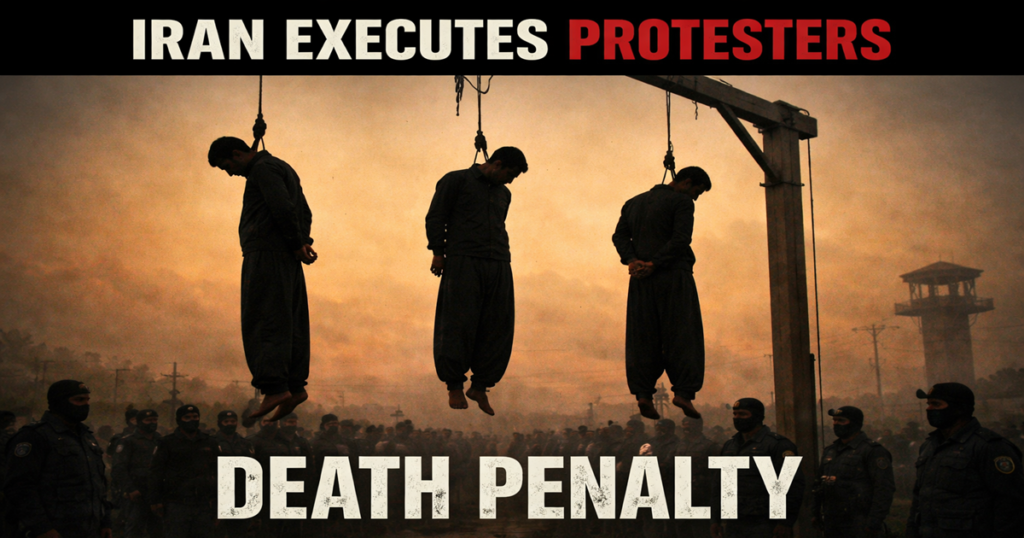
A teenage girl attends a protest. She chants slogans against the government. She refuses — under duress — to sign a confession for acts she did not commit. The state prosecutor requests the death penalty. This is not a hypothetical — it is a documented pattern. The Islamic Republic of Iran systematically uses its judicial system as a weapon against citizens who dare to speak.
In 2026, as Iran fights a military war with the United States and Israel, it simultaneously wages a judicial war against its own young people. Amnesty International confirmed Iran carried out at least 853 executions in 2023 — the highest in 15 years. Moreover, Iran Human Rights documented that the country executed more people in 2024 than any year since 1988. Furthermore, the pattern is consistent: arrest, torture, forced confession, show trial, execution. As a result, the Islamic Republic has built a system where protest itself carries the death penalty — and the world is only now paying full attention.
The Crime of Chanting: What Protesters Are Actually Charged With
The Islamic Republic prosecutes protesters under a broad range of charges that carry the death penalty. Understanding these charges is essential — because they reveal how the regime criminalises speech, assembly, and resistance.
| Charge | Farsi Term | What It Actually Means | Penalty |
| Enmity against God | Moharebeh | Broadly applied to any act deemed threatening to the Islamic order | Death |
| Corruption on Earth | Efsad-e fel-arz | Used against protesters accused of leading or organising dissent | Death |
| Armed rebellion | Baghi | Applied even when no weapons are involved — chanting qualifies | Death or imprisonment |
| Insulting the Supreme Leader | Toheen be Rahbar | Any public criticism of Khamenei — online or in person | 2-5 years minimum |
| Spreading prostitution and immorality | Various | Used against women who removed hijab in protest | Imprisonment + flogging |
| National security crimes | Amniati | Catch-all for any protest activity — used freely | 1-15 years |
The charges of moharebeh and efsad-e fel-arz are particularly significant. Both carry mandatory death sentences. Moreover, Iran’s judiciary applies them to protesters who committed no violence — individuals who shouted slogans, filmed police, or simply stood in a public square. Furthermore, Amnesty International confirmed that courts accept confessions extracted under torture as primary evidence without independent corroboration. As a result, a teenager who chants “Death to the Dictator” in a street protest can legally face execution under Iranian law.
The Faces of Iran’s Judicial Crackdown
Saleh Mohammadi — The Wrestling Champion Executed at 19
Saleh Mohammadi was a champion wrestler. He was 19 years old when Iranian authorities arrested him during the 2022 Mahsa Amini protests. He had no prior criminal record. His family says he attended the protests peacefully.
The Iranian judiciary charged him with moharebeh — enmity against God — based on a confession his family and lawyers said authorities extracted through torture. Moreover, his lawyers were denied access to him during critical periods of pre-trial detention. Furthermore, his trial lasted less than 30 minutes. As a result, a 19-year-old national sports champion went from protest to execution in a judicial process that Amnesty International described as a “sham trial.”
Mohammad Ghobadlou — Executed Despite Mental Illness
Mohammad Ghobadlou was executed in May 2023 despite documented evidence of severe mental illness. Human rights organisations, his family, and independent psychiatrists all submitted evidence that he suffered from bipolar disorder and was not mentally competent to stand trial.
Moreover, UN human rights experts formally called for his execution to be halted. Furthermore, his confession — the primary evidence against him — was obtained while he was in a state of acute psychiatric crisis without access to medication or mental health support. As a result, Iran executed a mentally ill young man over the objections of the United Nations, international human rights organisations, and his own medical history.
Majid Kazemi and Saleh Mirhashemi — Executed on the Same Day
On May 19, 2023, Iran executed Majid Kazemi and Saleh Mirhashemi — two protesters from Isfahan — on the same day, hours apart. A third man, Saeed Yaqoubi, was executed simultaneously. All three had been arrested in connection with the 2022 protests.
The three men’s families maintained their innocence throughout. Kazemi’s mother told reporters her son was tortured into confessing. Moreover, Amnesty International confirmed it had evidence that confessions in all three cases were extracted under duress. Furthermore, international appeals including from the European Union, United Nations, and multiple governments failed to halt the executions. As a result, three young men were killed in a single morning — and their families were not informed in advance.
The Women on Death Row
Women face a specific dimension of Iran’s judicial crackdown. Several women arrested during the 2022-2023 protests remain on death row. Varisheh Moradi, a Kurdish civil rights activist, faces execution charges related to her alleged membership in a banned political organisation — charges her lawyers say rest entirely on a coerced confession.
Moreover, women who publicly removed their hijabs during protests — an act of civil disobedience that spread widely after Mahsa Amini’s death — face charges of “spreading corruption” and “immorality.” Furthermore, female minors arrested during protests have faced beatings, sexual violence, and psychological torture in detention — documented by the UN Special Rapporteur on Iran. As a result, women and girls bear a disproportionate share of the regime’s judicial violence.
How Iran Extracts Confessions: The Documented Methods
The forced confession is the cornerstone of Iran’s protest prosecution system. Without it, most cases would collapse — because the actual evidence of violence is thin or nonexistent. Understanding how confessions are extracted exposes the system’s foundation.
| Method | How It Works | Documentation |
| Sleep deprivation | Prisoners kept awake for days — cognitive function collapses — they sign anything | UN Special Rapporteur confirmed — multiple survivor accounts |
| Solitary confinement | Extended isolation in dark cells — psychological breakdown within weeks | Amnesty International documented — Evin Prison reports |
| Physical beatings | Systematic beatings on arrest and during interrogation — injuries documented | Iranian lawyers smuggled evidence out — medical reports confirmed |
| Threats against family | Interrogators threaten to arrest parents, siblings, or children if prisoner refuses | Survivor testimony — Human Rights Watch confirmed pattern |
| Denial of legal counsel | Lawyers blocked from access during confession phase — prisoner has no advice | Iran Human Rights Monitor confirmed systematically |
| Televised “confessions” | Prisoners placed on state TV to confess publicly — often visibly traumatised | IRIB broadcasts archived — UN condemned practice |
| Mock executions | Prisoners told they will be executed — then brought back — cycle repeated | Survivor accounts — corroborated by independent investigators |
| Medical neglect | Injured or ill prisoners denied treatment until they cooperate | Multiple deaths in custody documented by Amnesty |
The UN Special Rapporteur on the situation of human rights in Iran, Javaid Rehman, confirmed in his 2024 report that “torture and ill-treatment of detainees, including to extract confessions, remains systematic and widespread.” Moreover, the Special Rapporteur specifically noted that confessions extracted under torture are routinely admitted as evidence in Iranian courts without challenge. Furthermore, defence lawyers who raise torture allegations risk arrest themselves — creating a system where the truth has no legal advocate. As a result, the confession is not evidence of guilt. It is evidence of what the regime can make a person say when it controls their body, their sleep, their family, and their future.
The 2022 Mahsa Amini Protests: The Crackdown That Changed Everything
The mass protests that followed Mahsa Amini’s death in September 2022 — killed in morality police custody for allegedly wearing her hijab improperly — produced the largest wave of protest executions in Iran in decades. The slogan “Woman, Life, Freedom” spread across the country and around the world.
Iran Human Rights confirmed that the Islamic Republic executed at least 22 people directly in connection with the Mahsa Amini protests. Moreover, hundreds more remain on death row — their cases moving slowly through a judicial system deliberately designed to maintain maximum fear. Furthermore, the crackdown arrested over 18,000 people — including children as young as 12. As a result, the Mahsa Amini protests became both a turning point in Iranian civil society and a trigger for the most severe judicial repression the country had seen since the 1988 mass executions of political prisoners.
Children and Teenagers on Death Row
One of the most disturbing dimensions of Iran’s protest crackdown is its treatment of minors. Iran is one of only a handful of countries in the world that executes juvenile offenders — individuals who committed alleged crimes before the age of 18.
| Name | Age at Arrest | Charge | Current Status |
| Hamidreza Azari | 17 | Moharebeh — attended protest | Death row — execution pending |
| Mehdi Hassani | 16 | Moharebeh — alleged Molotov cocktail | Death row — conviction upheld |
| Ali Abbasi | 17 | Baghi — armed rebellion | Death row — UN appeal rejected by Iran |
| Mohammad Khanalizadeh | 17 | Efsad-e fel-arz — corruption on earth | Executed 2023 — family not informed |
| Multiple unnamed minors | Under 18 | Various protest charges | Held in juvenile detention — charges pending |
The United Nations Convention on the Rights of the Child — which Iran has ratified — explicitly prohibits the execution of individuals for crimes committed before the age of 18. Moreover, the UN Committee on the Rights of the Child has formally condemned Iran’s practice of executing juvenile offenders on multiple occasions. Furthermore, Iran’s own domestic law technically prohibits executing individuals for crimes committed as minors — yet the judiciary routinely bypasses this protection through legal technicalities. As a result, teenagers who attended protests now sit on death row for crimes that international law and Iran’s own statutes should protect them from.
The Context: Iran’s Judicial War Alongside Its Military War
The judicial crackdown against protesters continues even as Iran fights a military conflict with the United States and Israel. The two wars run simultaneously — one on the battlefield, one in the courtroom.
While the world focuses on Iran’s military actions — missile strikes, Hormuz closure, and energy infrastructure attacks — the regime simultaneously sentences teenagers to death for chanting slogans. The military confrontation has generated global headlines. The judicial executions continue in relative silence. For context on the broader Iran conflict and its civilian consequences, read our detailed analysis of 175 children killed in Iran school strike — a story that illustrates how both sides of this conflict impose devastating costs on civilians who had no say in starting it.
Moreover, the appointment of Mojtaba Khamenei as Iran’s new Supreme Leader following his father’s death has raised fears about whether the judicial crackdown will intensify. Read our full profile: Mojtaba Khamenei: Iran’s New Supreme Leader. Furthermore, Mojtaba Khamenei’s career was built on running the Basij paramilitary — the force that leads crackdowns on protesters — and suppressing the 2009 Green Movement. As a result, human rights organisations express deep concern that the new Supreme Leader’s background makes a softening of the judicial crackdown extremely unlikely.
For context on how the Iran war’s economic consequences compare to the judicial crackdown — and how both reflect the regime’s willingness to impose massive costs on civilian populations — read our analysis: Iran Oil Weapon: How Trump Fights Back With Sanctions Waiver.
International Response: Words Without Consequences
The international response to Iran’s execution of protesters has been consistent in its condemnation and largely ineffective in its impact.
| Body / Country | Response | Impact |
| United Nations Human Rights Council | Established fact-finding mission — confirmed systematic torture and executions | Iran ignored findings — expelled UN investigators |
| UN Special Rapporteur on Iran | Annual reports documenting torture, forced confessions, juvenile executions | Iran does not cooperate — refuses access |
| European Union | Sanctioned individual judges and prosecutors responsible for executions | Limited — Iran not economically dependent on EU access |
| United States | Added judges to sanctions list — issued statements condemning executions | Symbolic — no enforcement mechanism |
| Amnesty International | Documented cases — published names — ran urgent action campaigns | Saved some lives through public pressure — not systemic |
| Nobel Peace Prize 2023 | Awarded to Narges Mohammadi — human rights defender imprisoned in Iran | Iran kept Mohammadi in prison — ignored award |
| Mahsa Amini protests worldwide | Millions marched globally in solidarity | No policy change inside Iran |
The pattern is consistent: condemnation without consequence. Moreover, Iran’s response to international criticism is equally consistent: it dismisses foreign statements as interference in sovereign judicial processes, labels international organisations as instruments of Western imperialism, and continues executions regardless. Furthermore, the Islamic Republic has calculated — correctly so far — that no international pressure will impose costs severe enough to change its domestic judicial behaviour. As a result, the protesters on death row depend not on diplomatic pressure but on public awareness, legal challenges within Iran’s own system, and the slim chance that sufficient international noise creates enough political cost to pause individual executions.
What the Numbers Say: Iran’s Execution Record
| Year | Total Executions | Protest-Related | Iran’s Global Rank | Key Context |
| 2019 | 251 confirmed | 0 | 2nd globally | Pre-protest baseline |
| 2020 | 246 confirmed | 0 | 2nd globally | COVID period |
| 2021 | 290 confirmed | 0 | 2nd globally | Economy worsening |
| 2022 | 582 confirmed | 0 (arrests began) | 2nd globally | Mahsa Amini protests — arrests only |
| 2023 | 853 confirmed | 22+ confirmed | 2nd globally | Highest in 15 years — protest executions begin |
| 2024 | 900+ documented | 30+ confirmed | 2nd globally | Highest since 1988 — escalation continues |
| 2026 (to date) | Ongoing — data incomplete | Multiple pending | Ongoing | War context — crackdown intensifies |
Conclusion
The Islamic Republic of Iran executes people for chanting. It sentences teenagers to death for attending protests. It extracts confessions through documented torture and presents them as justice. It executes the mentally ill over UN objections. It imprisons Nobel Peace Prize winners. And it does all of this while simultaneously fighting a military war — as though domestic repression and foreign aggression are simply two expressions of the same governing philosophy.
Moreover, the individuals on Iran’s death row for protest activity did not commit violence in most documented cases. They chanted slogans. They filmed police. They stood in public squares and said, in words or presence, that they wanted something different. Furthermore, the regime’s response to that — torture, show trials, forced confessions, and execution — reveals more about the nature of the Islamic Republic than any military strike or diplomatic statement ever could.
As a result, the young people on Iran’s death rows are not criminals. They are the most honest measure of what the regime actually is — and what it fears most. A government that executes teenagers for speaking is a government that knows it cannot survive being heard.
Frequently Asked Questions (FAQs)
Q1: How many protesters has Iran executed since 2022?
Iran Human Rights confirmed Iran executed at least 22 people directly in connection with the 2022 Mahsa Amini protests. Moreover, Amnesty International documented 853 total executions in 2023 — the highest in 15 years — with protest-related cases forming a significant portion. Furthermore, in 2024 the number exceeded 900 documented executions — the highest since the 1988 mass political executions. As a result, Iran now executes more people annually than any country except China — and its rate of execution for political and protest activity is unmatched anywhere in the world.
Q2: What charges does Iran use to sentence protesters to death?
The two most common capital charges used against protesters are moharebeh — enmity against God — and efsad-e fel-arz — corruption on earth. Both carry mandatory death sentences under Iranian law. Moreover, these charges are applied to individuals who committed no violence — people who chanted slogans, attended protests, or filmed security forces. Furthermore, the charge of baghi — armed rebellion — is also used, even in cases where the accused carried no weapons. As a result, Iran’s legal framework effectively makes peaceful protest a capital offence.
Q3: Are confessions in Iran protest cases obtained freely?
No — human rights organisations have extensively documented that confessions in protest cases are routinely extracted through torture. The UN Special Rapporteur on Iran confirmed that “torture and ill-treatment of detainees, including to extract confessions, remains systematic and widespread.” Moreover, methods include sleep deprivation, beatings, solitary confinement, threats against family members, and denial of legal counsel. Furthermore, Iranian courts accept these confessions as primary evidence without independent corroboration. As a result, the confession is not evidence of what a person did — it is evidence of what the regime can force a person to say.
Q4: Does Iran execute juvenile offenders?
Yes — Iran is one of a tiny handful of countries that executes individuals for crimes allegedly committed before the age of 18. This directly violates the UN Convention on the Rights of the Child, which Iran has ratified. Moreover, the UN Committee on the Rights of the Child has formally condemned Iran’s practice of executing juvenile offenders multiple times. Furthermore, multiple teenagers arrested during the 2022 protests currently sit on death row for alleged crimes committed as minors. As a result, Iran violates both international law and its own domestic statutes that technically prohibit juvenile execution.
Q5: What can individuals and organisations do to help protesters on Iran’s death row?
Several actions have proven effective in individual cases. Public pressure campaigns — specifically those that generate significant international media coverage of a named individual — have historically caused Iran to pause or commute specific executions. Amnesty International’s Urgent Action network has documented cases where mass public action saved lives. Moreover, contacting elected representatives in the UK, US, EU, and other countries to demand they raise specific cases in diplomatic channels adds governmental pressure. Furthermore, supporting organisations including Iran Human Rights, Amnesty International, and the Committee to Protect Journalists provides resources for documentation and advocacy. As a result, while no single action guarantees safety for any individual, sustained public attention on named cases represents the most effective available tool.