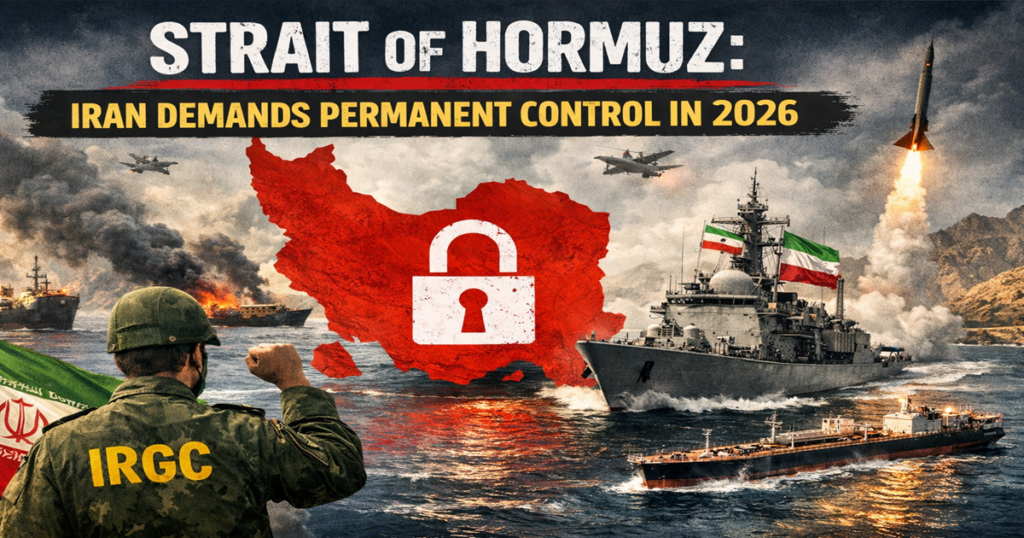
Iran rejected Trump’s ceasefire plan on March 25. But it did not simply say no. It sent back a counter-proposal. And buried inside that counter-proposal is a demand that changes everything: permanent Iranian sovereignty over the Strait of Hormuz.
This is the most consequential single demand in the Iran war negotiations. The Strait of Hormuz carries 20% of the world’s oil every single day. Whoever controls it controls the global energy supply. Moreover, Iran already proved it can close the strait with drone strikes alone. Furthermore, its counter-proposal asks the world to legally recognise that control permanently. As a result, the ceasefire negotiation has become a negotiation about who runs the most important piece of water on earth.
What Iran’s Counter-Proposal Actually Says
Iran sent its counter-proposal to Omani mediators on March 25. It contains several elements. The most explosive is the Hormuz sovereignty clause.
Iran demands formal international recognition that the Strait of Hormuz falls under Iranian sovereign jurisdiction. It wants the right to regulate — and if necessary close — shipping through the strait without legal challenge. Moreover, the proposal includes a demand that no foreign military vessels transit the strait without Iranian permission. Furthermore, Iran wants written guarantees against future US or Israeli military action on Iranian soil. As a result, Iran is not asking for a ceasefire. It is asking for a permanent strategic victory.
| Iran’s Demand | What It Means | US Position |
| Formal sovereignty over Strait of Hormuz | Iran legally controls 20% of world’s oil transit | Rejected — would surrender global energy security |
| No foreign military vessels without Iranian permission | US Navy cannot freely operate in Gulf | Non-starter — US 5th Fleet based in Bahrain |
| Guarantee against future attacks on Iran | US and Israel cannot strike Iran again | US will not bind itself or Israel permanently |
| Full sanctions removal | All US sanctions lifted — not just waived | US wants sanctions as future leverage |
| Compensation for war damage | Iran wants financial reparations | Congress would never approve |
| Nuclear enrichment rights | Iran keeps enrichment up to 20% | US position is zero enrichment above 5% |
| Recognition of Rodríguez Venezuela deal as model | Iran wants similar US non-interference guarantee | US may accept this element only |
The Legal Reality: Who Actually Owns the Strait of Hormuz?
The strait is 33 kilometres wide at its narrowest point. Iran sits on the northern shore. Oman sits on the southern shore. Both countries own territorial waters extending 12 nautical miles from their coastlines.
The navigable shipping channel runs through both Iranian and Omani territorial waters. Under international law — specifically the UN Convention on the Law of the Sea — all ships enjoy the right of “transit passage” through international straits. This right cannot be suspended even in wartime under UNCLOS provisions. Moreover, Iran signed UNCLOS. Furthermore, 152 other nations also signed it. As a result, Iran’s demand for sovereign control directly contradicts the international law it previously agreed to follow.
| Legal Framework | What It Says | Iran’s Position |
| UNCLOS Article 37 | All ships have right of transit passage through international straits | Iran argues strait is not “international” — it is Iranian-Omani bilateral |
| UNCLOS Article 38 | Transit passage cannot be suspended or hampered | Iran claims security exceptions override this right |
| UN Charter Article 2(4) | Prohibits threat or use of force against territorial integrity | Iran argues US strikes violated this first |
| Customary International Law | Straits used for international navigation are open to all | Iran rejects this as Western-imposed framework |
| Iran’s 1988 precedent | ICJ ruled against Iran mining Gulf in US v. Iran | Iran never accepted that ruling as binding |
Iran’s argument rests on a specific legal theory. It claims the strait is not an “international strait” under UNCLOS because alternative routes exist — specifically the Khor Abdullah waterway near Iraq. Moreover, it argues that UNCLOS transit passage rights do not override sovereign security rights when a state faces existential military threats. Furthermore, no international court has ever accepted this interpretation. As a result, Iran’s legal position is rejected by virtually every maritime law expert — but legal rejection does not change military reality.
The Military Reality: Iran Already Controls the Strait
Here is the uncomfortable truth. Iran does not need legal recognition to control the Strait of Hormuz. It already controls it — through military force and commercial insurance withdrawal.
The IRGC proved this in the first week of the war. A few drone strikes near the waterway caused war-risk insurers to withdraw coverage. Ships stopped moving. 20 million barrels per day disappeared from markets — not because Iran physically blocked every tanker, but because the commercial risk made transit economically impossible. Moreover, Iran has anti-ship missiles, fast attack boats, underwater mines, and drone swarms positioned along the northern coastline. Furthermore, any ship attempting transit does so at genuine physical risk. As a result, the legal question of who “owns” the strait matters far less than the military question of who can keep it open — and right now, that answer is: only Iran can guarantee safe transit.
Why This Demand Is a Game-Changer for Negotiations
Trump Cannot Accept It
Accepting Iranian sovereignty over the Strait of Hormuz is politically impossible for Trump. It would mean surrendering control of 20% of global oil supply to an adversary. Every Gulf ally — Saudi Arabia, UAE, Kuwait, Qatar, Bahrain — would view it as an American betrayal.
Moreover, the US 5th Fleet is based in Bahrain. Accepting Iranian veto power over naval transit directly threatens US military operations across the entire region. Furthermore, Congress would never ratify any agreement containing this clause. As a result, the Hormuz sovereignty demand may be deliberately maximalist — designed to give Iran something to concede later in exchange for real gains elsewhere.
Iran Cannot Afford to Drop It Entirely
The Hormuz closure is Iran’s most powerful remaining weapon. It drove oil above $100. It created economic pressure inside the United States. It forced the US to lift its own maximum pressure sanctions.
Iran will not permanently and unconditionally surrender this weapon. Moreover, any Iranian leader who gave up Hormuz leverage without receiving major concessions would face massive internal political pressure. Furthermore, Mojtaba Khamenei — the new Supreme Leader — built his career on hardline resistance. As a result, Iran needs to walk away from any deal with something real — and Hormuz control, in some form, is the most concrete thing it has.
For a full profile on how Mojtaba Khamenei’s background shapes Iran’s negotiating position, read our detailed analysis: Mojtaba Khamenei: Iran’s New Supreme Leader. Moreover, for context on week 4 of negotiations between Vance, Rubio and Iranian intermediaries, see: Iran War Week 4: Trump Talks Peace While Bombs Keep Falling.
Historical Precedent: Has Any Country Ever Controlled a Major Strait?
| Strait | Countries | Historical Control | Outcome |
| Strait of Hormuz | Iran / Oman | Iran asserts control — never formally recognised | Current dispute — no resolution |
| Strait of Malacca | Malaysia / Indonesia / Singapore | Joint management — no single sovereign controls | Cooperative model — works well |
| Turkish Straits (Bosphorus) | Turkey | Turkey controls under Montreux Convention 1936 | Formal legal framework — accepted by major powers |
| Strait of Gibraltar | UK (Gibraltar) / Spain / Morocco | UK effectively controls — Spain disputes | Unresolved sovereignty — transit remains open |
| Suez Canal | Egypt | Egypt nationalised canal 1956 — controls it completely | Crisis then acceptance — Egypt runs it under international law |
| Panama Canal | Panama | US built it — Panama took control 1999 | Peaceful transfer — international treaty framework |
The Turkish Straits offer the most relevant precedent. The 1936 Montreux Convention gave Turkey legal authority to regulate military vessel transit through the Bosphorus and Dardanelles. In 2022, Turkey used this authority to close the straits to Russian and Ukrainian warships after the Ukraine war began. Moreover, this action was internationally accepted — even by parties who disagreed with it — because a formal legal framework existed. Furthermore, Iran may be seeking a similar Montreux-style arrangement for Hormuz. As a result, the precedent suggests a negotiated regulatory framework — not full sovereignty — is the most achievable outcome Iran could realistically secure.
The Possible Compromise: A Hormuz Regulatory Framework
Pure Iranian sovereignty is unacceptable to the US and its allies. Complete US control is unacceptable to Iran. But there may be a middle path.
Several analysts have floated the idea of a Hormuz Convention — modelled on the Montreux Convention — that gives Iran formal regulatory authority over the strait while guaranteeing transit rights for all commercial vessels. Military vessels would require advance notification. A joint monitoring body would oversee compliance.
| Framework Element | Iran Gets | World Gets | Likelihood |
| Formal regulatory authority | Legal recognition of Iran’s role in Hormuz management | Guaranteed commercial transit rights — oil flows freely | Medium — both sides could claim victory |
| Military vessel notification | Advance notice of US and allied naval movements | No full veto — Iran informed but cannot block | Low — US resists any naval restriction |
| Joint monitoring body | International legitimacy — seat at the table | Transparency — prevents unilateral closure | Medium — requires Iran to accept outside observers |
| Sanctions relief | Major economic recovery begins | Iran back in global economy — stability returns | High — US willing if nuclear issue resolved |
| No-first-strike agreement | Guarantee against future US-Israeli attacks | Iran commits to no proxy attacks on Gulf states | Low — verification impossible |
What Happens If No Deal Is Reached
The Hormuz question has no comfortable middle ground. If negotiations fail, the strait stays closed. Iran continues to control it through military threat rather than legal framework.
Every day of closure costs the global economy billions. Oil stays above $100. Food prices rise — analysts confirm the Iran war will hit global food security harder than the Ukraine war did. Moreover, 20,000 seafarers remain stranded in the Gulf on vessels that cannot safely move. Furthermore, countries like Pakistan, Bangladesh, and Japan face genuine energy supply crises that deepen every week. As a result, the cost of no deal is not abstract — it falls on hundreds of millions of people who have no stake in this conflict.
Conclusion
Iran’s demand for permanent Hormuz sovereignty is the single most important element of the ceasefire counter-proposal. It is legally unjustifiable under international law. It is politically unacceptable to the United States. And it is militarily unnecessary — because Iran already controls the strait through force.
Yet the demand is not irrational. Iran proved it can close the world’s most important waterway. It wants legal recognition of something it can do anyway. Moreover, the Montreux Convention shows that formalising control of a strategic strait is not without precedent. Furthermore, a creative diplomatic solution — a Hormuz Convention that gives Iran regulatory authority without full sovereignty — could give both sides something to claim as victory.
As a result, the question is not whether Iran will permanently control the Strait of Hormuz. The question is whether the world will acknowledge — in law, not just in fact — what Iran has already demonstrated in the past four weeks: that no ship passes through that 33-kilometre channel unless Iran allows it.
Frequently Asked Questions (FAQs)
Q1: What is Iran demanding about the Strait of Hormuz?
Iran’s ceasefire counter-proposal includes a demand for formal international recognition of Iranian sovereign jurisdiction over the Strait of Hormuz. This means Iran wants the legal right to regulate all shipping — including military vessels — through the strait. Moreover, the proposal demands that no foreign warship transits without Iranian permission. Furthermore, Iran wants written guarantees against future US or Israeli military action. As a result, Iran is seeking permanent strategic control, not just a temporary ceasefire.
Q2: Does Iran legally own the Strait of Hormuz?
Partially — and this is disputed. Iran owns the northern shore and territorial waters extending 12 nautical miles. Oman owns the southern shore. The navigable channel runs through both countries’ waters. Moreover, under UNCLOS — which Iran signed — all ships enjoy the right of transit passage through international straits that cannot be suspended. Furthermore, Iran argues the strait is not fully “international” and that security exceptions override transit rights. As a result, Iran’s legal claim is rejected by virtually all international maritime law experts — but military reality differs from legal theory.
Q3: Can Iran actually keep the Strait of Hormuz closed permanently?
Iran has demonstrated it can close the strait through military threat alone — without physically blocking every ship. Drone strikes near the waterway caused war-risk insurers to withdraw coverage. Ships stopped transiting commercially. Moreover, Iran possesses anti-ship missiles, fast attack boats, mines, and drone swarms along the northern coastline. Furthermore, reopening the strait by force would require a massive naval and air operation that risks significant casualties and escalation. As a result, Iran can maintain effective closure indefinitely — the practical question is what price it pays to do so.
Q4: What is the Montreux Convention and why is it relevant?
The Montreux Convention of 1936 is an international treaty that gives Turkey formal authority to regulate military vessel transit through the Bosphorus and Dardanelles straits. Turkey used this authority in 2022 to close the straits to Russian and Ukrainian warships — and the action was internationally accepted. Moreover, analysts suggest Iran may seek a similar Hormuz Convention — a formal legal framework giving Iran regulatory authority while guaranteeing commercial transit rights. Furthermore, this model could give both Iran and the US something to claim as a victory. As a result, the Montreux precedent is the most realistic diplomatic template for resolving the Hormuz sovereignty dispute.
Q5: What happens to oil prices if Iran permanently controls the Strait of Hormuz?
If Iran gains recognised regulatory authority over Hormuz, oil markets face permanent structural uncertainty. Any political dispute between Iran and a major oil buyer could trigger closure threats. Moreover, markets would price in an “Iran risk premium” on every barrel of Gulf oil — likely adding $5-15 per barrel permanently to global prices. Furthermore, major consuming nations — Japan, South Korea, India, China — would accelerate alternative supply and energy independence investments to reduce Hormuz exposure. As a result, Iranian Hormuz control would permanently reshape global energy markets, supply chains, and geopolitical alignments across Asia and Europe.