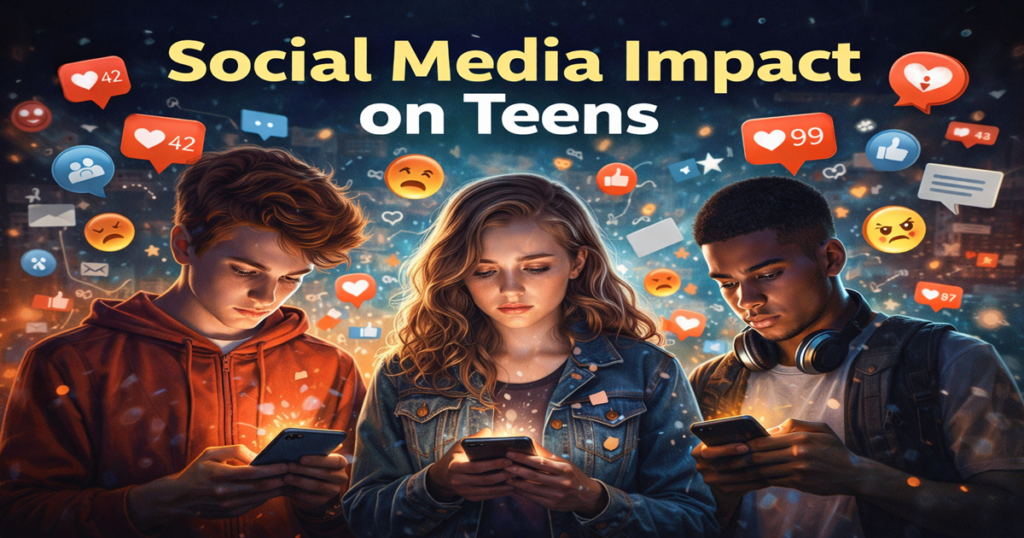
The social media impact on teens has become one of the most intensely researched, debated, and legislated questions in public health, education, and child development. Up to 95% of young people aged 13 to 17 report using at least one social media platform, and nearly one third report using social media almost constantly. Yet the evidence that these platforms cause measurable harm to adolescent mental health has grown steadily more compelling — reaching the point where the US Surgeon General, the UK government, the World Happiness Report, and researchers across multiple continents have described adolescent social media use as a public health crisis.
Moreover, the policy response to this crisis has accelerated dramatically in 2026. Australia introduced a nationwide social media ban for under-16s in December 2025, removing 4.7 million accounts in its first month. The UK government launched a national consultation in March 2026 on whether to ban social media for children — including trials of curfews, time caps, and app removal with 300 teenagers. In the United States, state-level age verification laws are multiplying rapidly. Understanding what the evidence says about how social media affects teenagers — and what parents, schools, and governments can reasonably do about it — has never been more urgent.
This guide presents a comprehensive, evidence-based analysis of the social media impact on teens: the mental health data, the neurological mechanisms, the gender and race differences, the positive dimensions that research also documents, the policy landscape in the UK and USA, and the practical strategies that families and schools can implement today.
How Big Is the Problem? Key Statistics on Social Media and Teen Mental Health
| Metric | Figure | Source |
| Teens (13-17) using at least one social media platform | Up to 95% | HHS / US Surgeon General |
| Teens using social media ‘almost constantly’ | Nearly 1 in 3 | Pew Research 2024 |
| Teens spending 3.5 hours/day on social media (avg) | 3.5 hours daily | HHS Surgeon General Advisory |
| Risk of depression/anxiety at 3+ hrs/day | Double the baseline risk | HHS / Riehm et al. 2019 |
| Teens who say social media negatively affects peers | 48% (up from 32% in 2022) | Pew Research, April 2025 |
| Teens who say they spend too much time on social media | 45% (up from 36% in 2022) | Pew Research, April 2025 |
| Teen girls: social media harms their mental health | 25% | Pew Research / World Happiness Report 2026 |
| Teen girls: social media hurts their confidence | 20% | World Happiness Report 2026 |
| Teen girls: social media negatively affects sleep | 50% | World Happiness Report 2026 |
| Teen girls and boys: social media makes them feel worse about their lives | 34% girls, 20% boys | Pew / World Happiness Report 2026 |
| Adolescents: social media makes them feel worse about body image | 46% (aged 13-17) | HHS Advisory |
| UK parents: social media is the top negative influence on teen mental health | Top response in More in Common 2025 survey | World Happiness Report 2026 |
| US parents: social media is the single most negative influence on teen mental health | 44% | Pew Research 2025 |
| UK young people (16-24): social media does more harm than good for under-16s | 62% (66% among Gen Z women) | More in Common / World Happiness Report 2026 |
The Science: How Social Media Affects the Teenage Brain
The social media impact on teens is not merely a matter of opinion or parental anxiety. It is rooted in measurable neurological and psychological mechanisms that researchers have documented with increasing precision. Adolescence is a period of intense neurological development — the brain’s prefrontal cortex, which governs impulse control and long-term decision-making, does not fully mature until the mid-twenties. This developmental vulnerability makes teenagers uniquely susceptible to the psychological effects of platforms specifically designed to maximise engagement.
Peer-reviewed research published in the Journal of Psychiatry and Psychiatric Disorders in 2025 confirmed that the neurobiological similarities between substance addiction and compulsive social media use are striking — particularly in terms of prefrontal cortex dysfunction, which is critical for impulse control and decision-making. The dopamine reward cycle triggered by likes, comments, and notifications activates the same neural pathways involved in substance dependence. Furthermore, research identified that serotonin imbalances — commonly observed in depression and anxiety — are exacerbated by online interactions, and that short allelic variants of the serotonin transporter gene may be associated with internet addiction, meaning some teenagers are neurologically more vulnerable to compulsive social media use than others.
Social comparison is the central psychological mechanism linking social media to poor mental health outcomes. Social media platforms curate idealised portrayals of reality, leading users to compare their lives, bodies, and social status unfavourably with content that has been selected, filtered, and edited specifically to appear enviable. Research published in PMC confirmed that this constant exposure to idealised content is linked to increased symptoms of depression — particularly among female adolescents who are more vulnerable to body image concerns. Moreover, appearance-focused content exacerbates self-consciousness, social withdrawal, and anxiety in social situations. While social comparison affects all genders, adolescent males experience distress specifically linked to perceived success, social status, and physical fitness.
Sleep disruption represents another well-documented biological pathway. The CDC’s National Health Interview Survey data confirms that teenagers with higher daily non-schoolwork screen time — defined as four or more hours daily — are significantly more likely to have irregular sleep routines and to be infrequently well-rested. Sleep loss impairs cognitive ability, academic performance, and socio-emotional functioning — creating a cascade of secondary consequences that extend far beyond the hours spent on social media itself. Furthermore, device use in bed and the stimulating nature of social media content before sleep suppresses melatonin production, extending the time taken to fall asleep and reducing sleep quality even when total hours remain adequate.
Gender Differences: Why Girls Are More Vulnerable
The gender dimension of the social media impact on teens is one of the most consistently documented findings in the research literature. Girls experience significantly stronger negative effects than boys across nearly every measured outcome — from depression and anxiety to body image, sleep quality, and self-confidence. Moreover, these gender differences appear to have intensified alongside the rise of image-centred platforms like Instagram and TikTok, which place appearance, social validation, and social comparison at the centre of user experience.
Among teenage girls, 25% say social media harms their mental health, 20% report it hurts their confidence, and 50% report it negatively affects their sleep, according to Pew Research and the World Happiness Report 2026. By contrast, these figures are consistently lower for teen boys, though boys are not unaffected — 20% of teen boys report that social media makes them feel worse about their own lives. Furthermore, girls are more likely than boys to engage in appearance-focused content consumption, to participate in social comparison around physical beauty standards, and to be targeted by the algorithmic amplification of content promoting unrealistic body ideals and disordered eating.
Pew Research’s April 2025 report found that concern about teen mental health also differs by gender even among teenagers themselves: 42% of teen girls report being highly concerned about teen mental health in general, compared to 28% of teen boys — suggesting that girls are more aware of the collective harm as well as experiencing it more acutely. Mothers are more likely than fathers to express high concern about their children’s social media use, and parents of girls are more likely to be worried than parents of boys. Furthermore, girls are significantly more comfortable discussing mental health with friends and therapists than boys — a difference in help-seeking behaviour that has important implications for how support should be offered.
The Positive Side: What Social Media Does Well for Teens
A balanced account of the social media impact on teens must acknowledge what the research consistently shows about benefits alongside harms. Social media is not uniformly damaging for all teenagers in all contexts. For many young people — particularly those who are socially isolated, belong to minority groups, or have limited access to in-person peer communities — social media provides genuine, meaningful, and sometimes life-changing connection.
Pew Research 2025 found that the most commonly cited benefits by teenagers include feeling more connected to what is happening in their friends’ lives (74%), having a creative outlet (63%), and feeling more accepted or supported through tough times (52%). These are not trivial benefits — for teenagers navigating identity formation, social belonging, and emotional development, these forms of digital connection can be genuinely protective. Moreover, teenagers with physical disabilities, chronic illness, geographic isolation, or minority identities — including LGBTQ+ youth — often report that social media provides community, information, and affirmation that is simply unavailable to them in their immediate physical environment.
Social media platforms have also emerged as important channels for mental health information. Pew’s 2025 survey found that statistically similar shares of girls (64%) and boys (60%) say social media is an important way they access mental health information. Platforms like TikTok have become spaces where influencers, therapists, and peer advocates share experiences of anxiety, depression, and therapy — normalising help-seeking in ways that formal public health campaigns have historically struggled to achieve. Furthermore, Mayo Clinic’s 2025 analysis noted that social media can help teens who are prone to depression stay connected to others, and that humorous or distracting content can help a struggling teenager cope with a challenging day.
The key distinction the evidence supports is not between social media use and no social media use, but between passive, appearance-focused, comparison-driven consumption and active, creative, community-building engagement. Teenagers who use social media to create, connect, and communicate tend to experience better outcomes than those who primarily scroll, compare, and passively consume.
| Dimension | Documented Harm | Documented Benefit |
| Mental Health | 2x depression/anxiety risk at 3+ hrs/day | Community for isolated or minority teens |
| Body Image | 46% feel worse about their bodies | Creative self-expression and identity exploration |
| Sleep | 50% of teen girls report disrupted sleep | Flexible timing allows connection across time zones |
| Social Connection | Cyberbullying, social comparison, exclusion | 74% feel more connected to friends’ lives |
| Information Access | Misinformation, harmful content algorithms | 64% use it for mental health information |
| Academic Performance | Distraction, sleep loss, reduced focus | Collaborative study groups, educational content |
| Self-Esteem | 20% of teen girls: hurts confidence | 52% feel more accepted and supported |
| Identity Formation | Unrealistic beauty standards, FOMO | Safe space for LGBTQ+ and minority identity exploration |
Cyberbullying and Online Harms: The Hidden Crisis
Cyberbullying is among the most damaging specific harms associated with social media’s impact on teens. Unlike traditional bullying, which is bounded by physical space and school hours, cyberbullying follows teenagers into their homes, their bedrooms, and their most private digital spaces — making escape virtually impossible and the psychological impact correspondingly more severe. Research confirms that exposure to discrimination, hate, or cyberbullying on social media significantly raises the risk of anxiety and depression, with effects that can persist long after the specific incidents have ended.
Furthermore, the phenomenon of stress posting — where teenagers post content impulsively when angry or upset and subsequently face bullying, harassment, or blackmail — reflects the particular vulnerability created by the adolescent brain’s tendency to act before fully thinking through consequences. Teenagers who share sexual images or highly personal information on social media face severe and sometimes lasting social and psychological consequences. Moreover, the algorithmic structure of most social media platforms amplifies conflict, controversy, and emotionally charged content — meaning that bullying incidents that might previously have been contained to a small peer group can rapidly escalate to involve hundreds or thousands of viewers.
In the UK, Ofcom’s 2025 statistics found that 95% of 13 to 15-year-olds have their own social media profiles, and 37% of those aged just three to five already use social media — with 60% of that age group having their own social media profile. These figures indicate that children are accessing social media platforms years before the minimum age requirements that platforms nominally impose, and that existing age verification mechanisms are ineffective at preventing access. Furthermore, the content children encounter at these ages — including material promoting unhealthy body image, eating disorders, self-harm, and suicide — is not adequately filtered by current platform safety measures.
The Addiction Design: How Platforms Are Built to Hook Teenagers
One of the most significant findings in the research on social media’s impact on teens relates not to individual behaviour but to the deliberate design choices made by platform companies. Internal documents revealed through US litigation in November 2025 showed that Meta ran a reduction experiment in 2020 — code-named Project Mercury — in which randomly selected users deactivated their Facebook accounts for one week. Meta’s own summary of the results concluded that people who stopped using Facebook reported lower feelings of depression, anxiety, loneliness, and social comparison. An internal researcher noted a causal impact on social comparison. The World Happiness Report 2026, which cited this evidence, observed that Meta was aware its platform was causing these harms and chose not to act on this knowledge.
Addictive design features — infinite scrolling, notification systems, streak mechanics, like counts, and algorithmically curated content feeds — are not accidental byproducts of social media platforms. They are deliberate design choices intended to maximise time-on-platform and therefore advertising revenue. These features exploit the same neurological vulnerabilities that make teenagers uniquely susceptible to social media’s harms. Furthermore, the European Union’s Digital Services Act cited TikTok in February 2026 for implementing an addictive design that could breach Europe’s content rules — confirming that regulators are increasingly prepared to treat addictive platform design as a legal rather than merely ethical concern.
Moreover, the World Happiness Report 2026 presented compelling evidence that sustained reduction in social media use — a week or longer — does improve adolescent mental health, especially for anxiety and depression. This finding, consistent across multiple properly designed studies, directly challenges claims that social media use and adolescent wellbeing are merely correlated rather than causally connected. When teenagers use social media less, they feel better. This is among the clearest causal signals the social science literature has produced on this topic.
The Policy Response: UK, USA, and Global Action in 2026
United Kingdom: Trial, Consultation, and Legislative Battle
The UK’s response to social media’s impact on teens has intensified dramatically in 2026. On 21 January 2026, the House of Lords voted 261 to 150 to amend the Children’s Wellbeing and Schools Bill, requiring platforms to implement effective age assurance measures blocking under-16s within 12 months. The same day, Technology Secretary Liz Kendall launched a three-month national consultation on children’s social media use — covering potential bans, overnight curfews, mandatory breaks to address doom-scrolling, restrictions on addictive design features such as infinite scrolling and streaks, and raising the digital age of consent from 13 to 16. The consultation closes on 26 May 2026, with the government’s response expected by summer 2026.
When the bill returned to the House of Commons on 9 March 2026, the Lords’ blanket ban amendment was defeated, and government amendments in lieu were agreed — reflecting the government’s preference for a consultation-led approach over immediate legislation. On 25 March 2026, the UK government announced a six-week pilot with 300 teenagers, testing four types of intervention: complete removal of selected apps, a one-hour daily cap on the most popular platforms including Instagram, TikTok, and Snapchat, overnight curfews, and parental control tools. The pilot forms part of the broader digital wellbeing consultation, which has already received over 30,000 responses from parents and children.
The Online Safety Act 2023, meanwhile, is already being enforced. Age verification requirements for adult content sites have been in force since July 2025, with Ofcom reporting millions of daily age checks and significant reductions in visitor numbers to regulated sites — though VPN downloads surged dramatically on the first day of enforcement. A Discord data breach in October 2025 exposed tens of thousands of government ID images collected through age verification, illustrating the privacy risks that mandatory age verification creates. The UK’s ICO (Information Commissioner’s Office) has called on social media firms to adopt better age verification technologies, while digital rights groups warn that blanket age bans risk driving teenagers toward less regulated online spaces.
Australia: The World’s First National Under-16 Ban
Australia became the world’s first country to implement a comprehensive national social media ban for under-16s when the Online Safety Amendment Act came into force in December 2025. Within the first month, platforms removed 4.7 million accounts — with Meta alone removing 544,000. Two High Court challenges are proceeding: Reddit argues it should be exempt as an adult-oriented discussion forum, while the Digital Freedom Project contends the law unconstitutionally burdens implied freedom of political communication. The Australian experience is being closely monitored by UK, US, and European policymakers as the most advanced real-world experiment in social media age restriction currently available.
United States: State-Level Action and Federal Debate
In the United States, no federal social media restriction for minors has been enacted, but state-level age verification and social media restriction laws are multiplying rapidly. Multiple proposals were introduced across state legislatures in 2025, with legal challenges proceeding on First Amendment grounds in several jurisdictions. Discord began rolling out mandatory age verification in February 2026, generating significant public debate. The Electronic Frontier Foundation has consistently argued that age verification mandates violate minors’ First Amendment rights, create mass surveillance infrastructure, and actively harm teenagers who rely on the internet to find community and support — particularly LGBTQ+ youth and other marginalised groups.
Furthermore, the US Surgeon General’s Advisory on Social Media and Youth Mental Health remains the most prominent federal-level statement on the issue. The advisory concluded that children and adolescents who spend more than three hours a day on social media face double the risk of mental health problems, and explicitly stated that we cannot conclude that social media is sufficiently safe for children and adolescents. Former Surgeon General Vivek Murthy named social media as a major threat to teenagers — a characterisation that has driven congressional hearings, platform accountability debates, and ongoing legislative action.
| Country / Region | Policy Action | Status (March 2026) | Key Challenge |
| Australia | National under-16 social media ban | In force since Dec 2025; 4.7M accounts removed | Legal challenges; VPN circumvention |
| United Kingdom | National consultation on under-16 ban + 300-teen pilot trial | Consultation open until 26 May 2026 | Lords ban amendment defeated; govt favours evidence-led approach |
| United States | State-level age verification laws | Multiple states; legal challenges ongoing | First Amendment concerns; no federal law |
| European Union | Digital Services Act (addictive design provisions) | TikTok cited Feb 2026 for addictive design | Enforcement across 27 member states |
| France | Under-15 ban proposed | Target implementation: Sept 2026 | Age verification technology limitations |
| Norway | BankID-based age verification legislation | Presented June 2025; implementation planned | Privacy and access concerns |
| Malaysia | National identity-linked age verification ban | Planning stage | Technical and civil liberties concerns |
What Parents Can Do: Evidence-Based Strategies
While governments and platforms debate regulation, parents remain the most consistent and influential protective factor in a teenager’s digital life. Research confirms that parental involvement, open communication, and co-developed boundaries significantly improve outcomes for teenagers navigating social media. The following strategies are evidence-informed and practically achievable.
- Delay access where possible: Research consistently shows that younger adolescents are more vulnerable to social media’s harms. Delaying social media access until age 14 or 15 — and requiring parental approval before accounts are created — gives teenagers more developmental maturity before they encounter the most harmful platform dynamics.
- Set time limits collaboratively: Rather than imposing strict limits that teenagers will circumvent, research supports co-developing time boundaries — for example, agreeing on a one-hour daily cap on entertainment social media. The UK’s pilot trial is testing exactly this approach. Collaborative agreements are more sustainable than unilateral parental controls.
- Keep devices out of bedrooms at night: The sleep disruption caused by late-night social media use is one of the most reliably documented harms. Charging devices outside the bedroom from a defined time each evening is one of the highest-impact single changes a family can make.
- Have regular, non-judgmental conversations: Pew Research confirms that teenagers who are comfortable talking to parents about social media are better equipped to manage its risks. Mayo Clinic recommends open, non-judgmental dialogue about what teenagers see and do online — asking questions rather than delivering lectures.
- Follow and understand what your teenager uses: Parents who have accounts on the platforms their children use, and who understand how algorithms, likes, and comment sections work, are significantly better positioned to recognise harm and provide relevant support.
- Model healthy digital behaviour: Research confirms that parental social media habits influence teenage attitudes toward digital use. Parents who demonstrate balanced, intentional use of their own devices set a more effective example than those who impose rules they do not themselves follow.
- Know the signs of problematic use: Withdrawal from offline activities, sleep disruption, emotional distress after device use, secrecy about online activity, and mood changes linked to social media interactions are all indicators that support may be needed.
What Schools Can Do: Supporting Teens in the Digital Age
Schools play a critical role in the social media impact on teens — both as institutions that can establish boundaries around device use and as communities that shape the social norms within which teenage social media behaviour takes place. Furthermore, schools are often the first place where the consequences of social media harm become visible: friendship conflicts driven by online exchanges, cyberbullying affecting classroom relationships, sleep deprivation undermining academic performance, and body image concerns affecting student wellbeing.
Many schools in both the UK and USA have introduced mobile phone bans during the school day — a policy supported by the UK government’s September 2024 guidance and the Australian government’s national school phone ban. Evidence from France, which introduced a full school day phone ban in 2018, suggests that removing phones from schools reduces cyberbullying incidents, improves classroom concentration, and increases face-to-face social interaction. Moreover, the UK government’s January 2026 consultation specifically invited views on extending phone and social media restrictions into the school environment.
Schools can additionally embed digital literacy, critical media consumption skills, and social emotional learning into their curricula — equipping teenagers with the analytical tools to evaluate social media content, recognise algorithmic manipulation, resist comparison traps, and seek help when online experiences cause distress. Peer education programmes, where trained student advocates deliver social media wellbeing workshops to younger year groups, have shown particular promise in both UK and US contexts.
Frequently Asked Questions About Social Media Impact on Teens
Q1. How many hours of social media use per day is harmful for teenagers?
Research published by the US Department of Health and Human Services found that children and adolescents who spend more than three hours a day on social media face double the risk of mental health problems, including depression and anxiety. The average teenager currently spends approximately 3.5 hours daily on social media — meaning the average teenager is already in the elevated-risk category. However, research also shows that the type of content consumed matters as much as the time spent: passive scrolling and appearance-focused comparison produce worse outcomes than active, social, and creative use of the same platforms.
Q2. Is social media actually causing teen depression, or just correlated with it?
The causal question has been scientifically contested, but the balance of evidence has shifted significantly toward causation. The World Happiness Report 2026 reviewed multiple properly designed studies and concluded that sustained reduction in social media use — a week or longer — does improve adolescent mental health, especially for anxiety and depression. Furthermore, Meta’s own internal Project Mercury experiment found that users who deactivated Facebook for a week reported lower depression, anxiety, loneliness, and social comparison. The neurobiological mechanisms — dopamine disruption, serotonin imbalance, sleep disruption, and social comparison activation — have been independently documented. The evidence now supports a causal relationship, not merely a correlation.
Q3. Why are teenage girls more affected than boys by social media?
Teenage girls are more affected primarily because of the specific nature of the content they are algorithmically served and the social comparison dynamics that image-centred platforms create. Girls are more likely to engage with appearance-focused content, beauty standards, and social validation metrics that social media platforms amplify. Furthermore, girls are more likely to experience cyberbullying targeting their physical appearance, and to engage in the kind of passive, consumption-focused social media use that research links most strongly to poor mental health outcomes. The gender gap is consistent across multiple countries and multiple research methodologies — it is not an artefact of research design.
Q4. What is the UK doing about social media and teens in 2026?
The UK government launched a national consultation on children’s social media use in March 2026, examining potential bans for under-16s, overnight curfews, mandatory breaks, restrictions on addictive design features, and raising the digital age of consent from 13 to 16. The consultation runs until 26 May 2026, with the government’s response expected by summer 2026. Additionally, the government is running a six-week pilot with 300 teenagers testing different interventions including full app removal, one-hour daily caps, and overnight curfews. The Online Safety Act 2023 is already being enforced, requiring age verification for adult content sites. The House of Lords voted for a blanket under-16 ban in January 2026, but this was defeated in the Commons.
Q5. Are there any benefits of social media for teenagers?
Yes — research documents genuine benefits alongside the harms. Pew Research 2025 found that 74% of teenagers feel more connected to their friends’ lives through social media, 63% use it as a creative outlet, and 52% feel more accepted and supported through it. Social media provides particularly important benefits for teenagers who are socially isolated, belong to minority groups, or have limited in-person community — including LGBTQ+ youth who may find affirmation and community online that is unavailable in their immediate environment. Additionally, 62% of teenagers use social media as an important source of mental health information. The research does not support a conclusion that social media is uniformly harmful — it supports targeted attention to the specific features, content types, and use patterns that cause the most damage.
Q6. Should parents ban social media entirely for their teenagers?
The evidence does not support a blanket ban as the most effective parenting strategy, and most researchers advise against it as a first response. A complete ban may push teenagers toward less supervised online spaces, damage parent-teenager trust, and deprive teenagers of genuine social connection benefits. The evidence supports a combination of delayed access — ideally until mid-adolescence — collaboratively agreed time limits, device-free bedrooms, open communication about online experiences, and engagement with what teenagers are actually doing online. The UK government’s pilot trial is testing exactly these graduated interventions, rather than outright bans, precisely because the evidence suggests this approach is more effective.
Q7. What is ‘doomscrolling’ and how does it affect teenagers?
Doomscrolling refers to the compulsive consumption of negative, distressing, or emotionally charged content through continuous scrolling on social media feeds. It is facilitated by algorithmic design features — particularly infinite scrolling and emotionally amplifying content curation — that keep users engaged by serving progressively more stimulating content. For teenagers, doomscrolling is associated with heightened anxiety, sleep disruption, a distorted sense of the world as more dangerous than it is, and reduced capacity to disengage from platforms even when the experience is making them feel worse. The UK government’s March 2026 consultation explicitly identified mandatory breaks to address doomscrolling as one of the potential regulatory measures under consideration.
Conclusion: Protecting Teens in the Age of Social Media
The social media impact on teens is no longer a matter of speculation or parental anxiety. The evidence is extensive, multi-disciplinary, and — increasingly — causal. Teenagers who spend more than three hours daily on social media face double the risk of depression and anxiety. Nearly half believe social media harms their peers. Half of all teenage girls report it disrupts their sleep. Platforms have designed addictive features with full knowledge of the harms they cause, as their own internal research confirms. The adolescent brain — neurologically primed for social validation and uniquely vulnerable to compulsive patterns — is not a fair match for algorithms engineered by the world’s largest technology companies.
Moreover, the policy response is accelerating. Australia’s ban is live. The UK is consulting, trialling, and legislating. The EU is enforcing. The US is debating. Every major government with the wellbeing of its teenage population as a genuine priority is now grappling with the same fundamental question: how do we allow teenagers to access the genuine benefits of digital connection while protecting them from platforms that profit from their psychological harm?
Therefore, the answer is not panic, prohibition, or passivity. It is informed, evidence-based action at every level — from the parent who charges their teenager’s phone outside the bedroom, to the school that bans devices during the day, to the government that holds platforms legally accountable for addictive design. Social media is not going away — and teenagers need to learn to navigate it. But they should not have to do it alone, without protection, against platforms whose business models depend on keeping them online as long as possible, whatever the cost to their wellbeing.