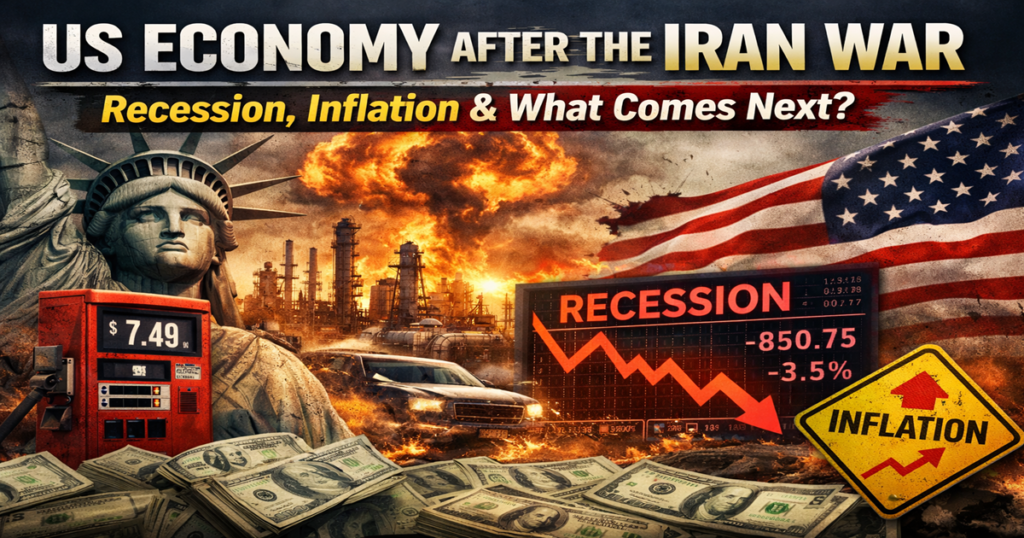
Four weeks ago, gas cost less than $3 a gallon. Today it costs nearly $4. Before the war, Goldman Sachs put the odds of a US recession at 15%. Now they say 30%. The stock market has lost 7% in a month. Diesel — which powers every truck, farm, and construction site in America — jumped from $3.75 to $5.37 a gallon.
The Iran war is hitting the US economy in three places at once. Energy prices are up. Inflation is sticky. Business confidence is falling. Moreover, the Federal Reserve cannot cut rates to support growth because inflation is rising — the classic stagflation trap. Furthermore, Mark Zandi, chief economist at Moody’s Analytics, told Newsweek directly: “Recession risks are uncomfortably high and rising.” As a result, the US economy faces its most serious threat since the pandemic — and the outcome depends entirely on how long the war lasts.
The Numbers: What Has Already Happened
| Economic Indicator | Before War (Feb 26) | Now (Late March) | Change |
| Brent crude oil | $65-70/barrel | $100-116/barrel | Up 50-70% |
| US regular gas (national avg) | $2.98/gallon | $3.98/gallon | Up $1.00/gallon |
| US diesel price | $3.75/gallon | $5.37/gallon | Up $1.62/gallon |
| Goldman Sachs recession odds | 15% | 30% | Doubled |
| EY-Parthenon recession odds | 35% | 40% | Elevated |
| Kalshi prediction market (peak) | 20% | 35% (at $119 oil peak) | Significant rise |
| RecessionPulse score | Normal range | 44/100 — elevated | Rising fast |
| US stock market (3 major indexes) | Baseline | Down 7%+ in one month | Significant decline |
| Consumer sentiment (Univ. Michigan) | Baseline | Plunged 14% in March | Sharpest drop in months |
| Year-ahead inflation expectations | 3.4% | 3.8% | Rising |
| OECD US inflation forecast (full year) | 3.0% | 4.2% | Up 1.2 percentage points |
| Mortgage rates | 5.99% (Feb 27) | 6.29% (March 12) | Rising |
“The impact so far has been very negative. There’s no upside to this — nothing but downside,” said Mark Zandi of Moody’s Analytics. Moreover, the speed of the gas price surge shocked consumers. “The speed with which it’s hitting gas stations has left consumers shocked,” Diane Swonk, KPMG’s chief economist, told CNN. Furthermore, every sustained $10 increase in oil prices costs the typical US household close to $450 annually according to Moody’s. As a result, families are paying hundreds of dollars more this year before a single month of spring even ends.
The Three Pathways to a Recession
Pathway 1 — The Energy Price Shock
Gas at $4 a gallon is painful. Gas at $4.25 a gallon tips into recession territory. That is the threshold identified by RSM economist Joe Brusuelas. At that level, consumer spending — which drives two-thirds of the US economy — takes a meaningful hit.
Higher oil prices do not just raise the cost of filling up. They feed through to every product that requires energy to make or transport — which is virtually everything. Moreover, diesel at $5.37 matters enormously. Every truck that moves goods across America runs on diesel. Every tractor in every field runs on diesel. Furthermore, oil and its byproducts appear directly in plastics, pharmaceuticals, and fertilisers. As a result, an oil shock is not simply an energy problem — it is an economy-wide cost increase that eventually shows up in every receipt at every checkout.
Pathway 2 — Inflation Keeps the Fed Trapped
The Federal Reserve had been planning rate cuts before the war began. Those plans are now on hold. Inflation was already stuck at 3% — above the Fed’s 2% target. Now it is heading higher.
The OECD projects US headline inflation at 4.2% this year — up 1.2 percentage points from its December forecast. Moreover, Rachel Ziemba of the Center for a New American Security told Al Jazeera: “Higher oil prices likely point to inflation remaining stickier, which means it’s harder for the Fed to cut interest rates.” Furthermore, mortgage rates are already rising — from 5.99% before the war to 6.29% by mid-March. As a result, every American with a variable-rate mortgage, a credit card balance, or a home purchase plan feels the impact of a Federal Reserve that cannot help.
Pathway 3 — Business Confidence Collapses
The third and arguably most dangerous pathway runs through uncertainty. Businesses do not need oil at $150 to stop hiring. They need uncertainty — and the Iran war delivers it in abundance.
Ed Yardeni of Yardeni Research told CNN: “I don’t even think oil has to go to $120 or $150. If it just stays at $100 and pushes the stock market lower, it could have an adverse impact on higher-income and higher-wealth consumers.” Moreover, hiring was already weak before the war. Wells Fargo Investment Institute’s Paul Christopher noted job growth had been “some of the lowest I’ve ever seen.” Furthermore, employers on the fence about expanding will pause and wait. As a result, a confidence shock alone — separate from the direct oil price impact — can slow hiring and investment enough to tip a vulnerable economy into contraction.
The Stagflation Risk: The Worst of Both Worlds
Economists fear stagflation more than a simple recession. In a normal recession, the Fed cuts rates, credit loosens, and recovery begins. In stagflation, growth falls AND inflation rises simultaneously. The Fed cannot cut rates to support growth because cutting rates makes inflation worse.
Al Jazeera quoted multiple economists warning of “1970s-style stagflation” if the war continues. The 1970s oil shocks — triggered by the Arab oil embargo and Iranian Revolution — produced exactly this combination. Moreover, the ECB warned the Iran war will likely trigger stagflation across Europe. Furthermore, “the combination of tighter financial conditions, more uncertainty and higher inflation is going to erode growth,” EY-Parthenon chief economist Gregory Daco told CBS News. As a result, the stagflation scenario is not a fringe prediction — it is the base case of multiple major institutions if the conflict extends through summer.
The Critical Thresholds: When Does It Get Much Worse?
| Oil Price | Gas Price | Recession Risk | Economist Consensus |
| $90-100/barrel | ~$3.80-4.00/gallon | 30-40% — elevated but manageable | Goldman Sachs, EY-Parthenon current base case |
| $100-120/barrel | ~$4.00-4.50/gallon | 40-50% — serious risk | Moody’s: odds cross 50% threshold if sustained |
| $125/barrel | ~$4.25/gallon | 50%+ — recession likely | RSM’s Brusuelas identified this as key threshold |
| $140/barrel | ~$5.00/gallon | 70%+ — recession very likely | USC economist cited by Al Jazeera |
| $150/barrel | ~$5.50/gallon | 50%+ in next year (PNC: odds top 50%) | BlackRock CEO Fink: “stark and steep global recession” |
| $200/barrel | ~$7.00+ /gallon | Near certain recession | Iran warning — Hormuz closure worst case scenario |
“Every recession since World War II, save the pandemic recession, has been preceded by a spike in oil prices,” Zandi wrote in a recent blog post. Moreover, the US is more resilient to oil shocks than in the 1970s — because it now produces as much oil as it consumes. Furthermore, “consumers still get hit hard and fast while producers invest and hire more only slowly,” Zandi noted. As a result, even a less severe oil shock than the 1970s can cause real economic damage — it just takes slightly longer to fully land.
What Economists Are Actually Forecasting
| Institution / Economist | Recession Probability | Inflation Forecast | Growth Forecast |
| Goldman Sachs | 30% — up from 15% | 3.1% by year end | Reduced — below trend |
| EY-Parthenon (Gregory Daco) | 40% — up from 35% | Above 3% — sticky | Curbed — downside risk |
| Moody’s Analytics (Mark Zandi) | Will cross 50% if war continues weeks | Rising significantly | Slowing noticeably |
| OECD | Not stated — but warned of global stagflation | 4.2% US — up 1.2pp | 2% growth — 0.3pp upgrade vs Dec |
| BCG (Carlsson-Szlezak) | Economy resilient — false alarm risk | Elevated but not catastrophic | Resilience noted |
| Apollo Global (Torsten Slok) | Low — impact “quite limited” | Up 0.1% | GDP dips 0.1% |
| RSM (Joe Brusuelas) | Rises sharply above $125 oil | Rising — $4.25 gas is threshold | Threshold-dependent |
| BlackRock (Larry Fink) | Two extremes — abundance or stark recession | Oil at $150 = severe recession | Binary outcome |
The spread of forecasts is itself telling. Apollo’s Slok sees minimal impact. Moody’s Zandi says recession odds are “uncomfortably high.” BCG warns against false alarms while acknowledging real risks. This disagreement is not random — it reflects genuine uncertainty about the war’s duration. Moreover, as HBR noted, the real risk is not a single spike but “the length of the disruption and whether a confluence of shocks will collectively overcome the economy’s resilience.” Furthermore, the US economy has survived multiple predicted recessions that never arrived. As a result, resilience is real — but it has limits, and four weeks of oil shock is testing them.
The Consumer: Already Struggling Before the War
The Iran war did not arrive at a moment of American economic strength. It arrived at a moment of accumulated household stress.
Nearly five years of elevated prices since pandemic-era inflation have eroded savings across middle and lower-income households. University of Michigan consumer sentiment plunged 14% in March. Year-ahead inflation expectations jumped to 3.8% — the highest in months. Moreover, Robert Rogowsky of Georgetown University told Al Jazeera that lower-income people “will pay the price for this inflationary burst.” Furthermore, 111 million Americans currently carry credit card balances — a 17% increase in five years. As a result, the gas price shock hits a population that was already stretched — without the savings buffer that helped absorb previous shocks.
The Longer-Term Shifts: What the War Accelerates
Even if the war ends this week, some economic shifts it triggered will not reverse quickly.
- Supply chain rewiring: David Coffey of Catalant told Al Jazeera the war is “expediting conversations about risk” for businesses. Companies that relied on Gulf logistics are exploring alternatives — a restructuring that takes years, not weeks.
- Geopolitical realignment: Rogowsky called the US strikes on Iran “an injection of adrenaline” into a realignment where middle powers seek to reduce reliance on the US. That “will affect our terms of trade,” he told Al Jazeera.
- Renewable energy acceleration: Wikipedia’s economic impact analysis confirmed the war “bolstered the necessity for renewable energy” — solar and wind reduce vulnerability to external supply shocks. Investment in alternatives accelerates every month the Hormuz stays closed.
- Deindustrialisation risk in Europe: Chemical and steel manufacturers across the EU imposed surcharges of up to 30% to offset energy costs. Wikipedia noted this could lead to “permanent deindustrialisation” in some sectors.
- Red Sea stays closed: Al Jazeera’s Peter Sand confirmed the Red Sea — already mostly closed in the previous year due to Houthi attacks — will likely remain closed throughout this year. Goods travel around Africa instead. That cost and delay becomes permanent for some supply chains.
The Political Dimension: Trump’s Economic Gamble
Trump declared the strikes on Iran a military success. He downplayed economic consequences during a cabinet meeting. He said oil and stock market reactions were “less significant than expected.”
The political reality is less comfortable. PBS reported that Americans already have “a gloomy outlook on the economy” from five years of price pressures. Trump’s “golden age” narrative has had little impact on those attitudes. Moreover, PBS quoted Alex Jacquez: “People generally don’t think that President Trump is focused on the things that they are focused on — and what they want him to be focused on is the price of groceries.” Furthermore, every week of continued war is another week of $4 gas — and gas prices are the single most visible economic indicator for most American households. As a result, the Iran war creates a direct line between military decisions and presidential approval ratings — a dynamic that may ultimately determine when the war ends.
What Happens If the War Ends — and If It Doesn’t
The economic consequences branch into two very different directions depending on the war’s trajectory. For context on Iran’s ceasefire demands — including sovereignty over the Strait of Hormuz — and the diplomatic gap between Washington and Tehran, read our full analysis: US, UK and Europe Prepare for a Long Iran War — What Comes Next?.
| Scenario | Oil Price Outlook | Inflation Trajectory | Recession Risk | Timeline |
| War ends quickly — Hormuz reopens within weeks | Brent falls to $70-80 rapidly | Inflation eases toward 3% | 30% — manageable | 2-4 weeks if deal struck |
| War drags on 3-4 months — Hormuz partially open | Brent stays $90-110 | Inflation stays 3.5-4% | 40-50% — serious | Risk accumulates through summer |
| War extends through summer — Hormuz stays closed | Brent rises toward $130-150 | Inflation pushes above 4% | 50%+ — likely recession | Moody’s crosses 50% threshold |
| Escalation — new fronts — Iran targets Saudi fields | Brent spikes toward $150-200 | Inflation surges toward 5%+ | 70%+ — recession certain | Catastrophic — global depression risk |
Rachel Ziemba of CNAS summarised it cleanly for Al Jazeera: “If it drags on and especially if it remains at this intensity, prices will be higher and more volatile for consumers. If it ends quickly, and it’s a credible and stable end, then we could see prices fairly quickly normalising.” Moreover, the key word is “credible.” A ceasefire that markets do not believe will hold does not bring oil back to $70. Furthermore, Iran’s counter-proposal — including Hormuz sovereignty demands — suggests a credible and stable end remains some distance away. As a result, the base case for most major institutions is not quick recovery but sustained economic pressure through at least mid-year.
Conclusion
The Iran war has already done real economic damage to the United States. Gas is up a dollar a gallon. Diesel is up over $1.60. Stocks are down 7%. Inflation is heading toward 4%. Recession odds have doubled at Goldman Sachs and sit uncomfortably above 40% at EY-Parthenon.
Moreover, the economy was not in perfect shape before the war began. Consumer savings were thin. Credit card debt was at record levels. Consumer sentiment was already fragile from years of elevated prices. The war did not create economic vulnerability — it found it and made it worse. Furthermore, the Federal Reserve cannot ride to the rescue because inflation is rising alongside the growth threat.
As a result, the answer to “what comes next?” depends almost entirely on one variable: how long the Strait of Hormuz stays closed. A quick ceasefire means a painful but manageable shock. A war that drags into summer means stagflation becomes the base case — and recession odds cross the 50% threshold that Zandi identified as the point of no return.
Frequently Asked Questions (FAQs)
Q1: Has the Iran war caused a recession in the US yet?
Not yet — but the risk has risen sharply. Goldman Sachs raised its recession probability to 30%. EY-Parthenon put it at 40%. RecessionPulse’s composite score reached 44 out of 100 — classified as “elevated.” Moreover, Mark Zandi of Moody’s Analytics said odds will “cross the key 50% threshold unless the conflict ends in the next few weeks, if not days.” Furthermore, the US economy entered the war in a resilient but vulnerable position — after years of elevated prices. As a result, a recession is not certain, but it is now a serious possibility rather than a fringe risk.
Q2: How much are gas prices up because of the Iran war?
US regular gas rose from $2.98 per gallon before the war to $3.98 per gallon by late March — a rise of exactly $1.00 per gallon in four weeks. Diesel, which powers trucks, farms, and construction, rose even more sharply — from $3.75 to $5.37 per gallon. Moreover, every sustained $10 increase in oil prices costs the typical US household close to $450 annually according to Moody’s Analytics. Furthermore, the key recession threshold identified by RSM economist Joe Brusuelas is $4.25 per gallon regular gas — a level the national average is approaching. As a result, consumers are already hurting, and the threshold for serious economic damage is now very close.
Q3: Why can’t the Federal Reserve cut rates to support the economy?
Because inflation is rising. The Fed’s dual mandate is to maintain price stability (2% inflation target) and maximum employment. Cutting rates stimulates growth — but it also stimulates inflation. The OECD now forecasts US inflation at 4.2% this year — more than double the Fed’s target. Moreover, Rachel Ziemba of CNAS confirmed that higher oil prices make “inflation remaining stickier, which means it’s harder for the Fed to cut interest rates.” Furthermore, mortgage rates are already rising as a consequence — from 5.99% to 6.29% in just two weeks. As a result, the Fed is trapped: cutting rates risks an inflation spiral, but holding rates slows growth during a supply shock.
Q4: What is stagflation and why do economists fear it?
Stagflation is the combination of stagnant economic growth and rising inflation occurring simultaneously. It is the most difficult economic condition for policymakers to manage. In a normal recession, the Fed cuts rates and stimulates recovery. In stagflation, cutting rates makes inflation worse — so the Fed cannot help. Moreover, the US experienced stagflation in the 1970s after the Arab oil embargo and Iranian Revolution — producing years of high unemployment, high inflation, and low growth. Furthermore, multiple economists explicitly warned the Iran war could produce a similar outcome if the Hormuz closure continues through summer. As a result, stagflation is not a theoretical concern — it is a documented historical outcome of sustained Middle East oil shocks.
Q5: Who gets hurt most by the Iran war’s economic impact?
Lower-income Americans face the hardest hit. Gas and diesel represent a much larger share of household budgets for working-class families than for affluent ones. Georgetown University’s Robert Rogowsky told Al Jazeera that lower-income people “will pay the price for this inflationary burst.” Moreover, food prices are also rising — diesel costs feed directly into farming and trucking, which affects the price of every item in every grocery store. Furthermore, consumers carrying credit card debt — 111 million Americans — face higher interest rates alongside higher prices. As a result, the economic burden of the Iran war falls most heavily on those with the least financial cushion to absorb it.