
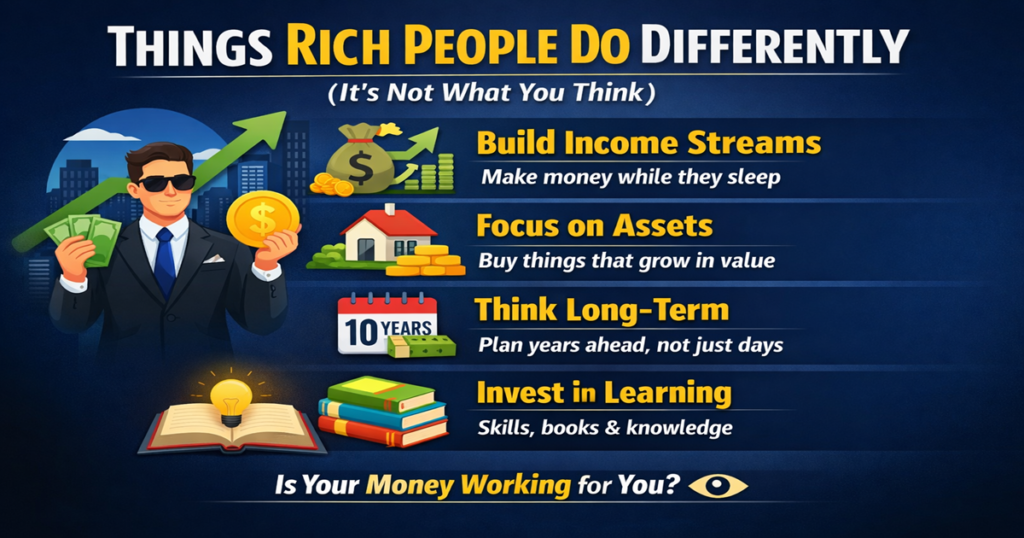
Things rich people do differently are not the flashy behaviours that tabloids and social media celebrate. Most genuinely wealthy people do not drive supercars to the office, wear luxury watches on a Tuesday, or post their holiday villas online. The reality of wealth-building is far quieter — and far more replicable — than popular culture suggests. According to a six-year study of over 6,000 wealthy individuals, 65% of self-made millionaires built their wealth through at least three concurrent income streams. IRS data confirms that the average millionaire maintains seven different income streams simultaneously. Furthermore, a 2025 Federal Reserve report found that the top drivers of American household wealth growth were stocks and mutual funds (up nearly 10%), real estate (up 3%), and retirement accounts (up 6.6%) — all patient, consistent, long-term strategies rather than dramatic windfalls.
The things rich people do differently are, at their core, a set of daily decisions about time, money, relationships, knowledge, and mindset that most people can adopt regardless of their current income level. Moreover, understanding these habits is not simply aspirational — it is practical. The same Federal Reserve data confirms that 83% of Americans believe multiple income streams are essential for financial security, and 80% wish they had started investing earlier. The gap between knowing and doing is the real wealth barrier. This guide closes that gap by documenting the specific, evidence-backed behaviours that separate people who build lasting wealth from those who do not — with a clear, honest account of both what the wealthy do and what systemic factors also shape financial outcomes.
1. They Invest Early and Let Compounding Do the Heavy Lifting
The single most powerful financial habit of wealthy people is investing early and consistently — and then leaving those investments alone to compound over time. Compounding is the process by which investment returns generate their own returns, creating exponential rather than linear growth over long periods. Albert Einstein is widely credited with calling compound interest the eighth wonder of the world — and the data validates this description completely.
According to a 2025 IPX1031 survey of over 800 Americans, the average person makes their first investment at age 27. Gen Z, however, is investing at an average age of 20 — seven years earlier — and that difference in starting age compounds into an enormous wealth gap over a working lifetime. Furthermore, 80% of Americans in the survey reported wishing they had started investing earlier in life. Kiplinger’s January 2026 wealth habits analysis confirmed that high-net-worth individuals take full advantage of tax-advantaged retirement accounts — including 401(k)s in the USA and ISAs and SIPPs in the UK — and automate regular contributions to diversified portfolios. They do not try to time the market or chase investment trends. Instead, they prioritise consistency over cleverness and long time horizons over short-term speculation.
Additionally, wealthy people understand that the amount invested matters far less than the habit of investing consistently. As Money Hacking Mama’s 2026 financial behaviours research noted, wealthy people start before they feel ready — investing 25, 50, or 100 dollars or pounds without telling themselves it is not enough. This psychological shift — from waiting until conditions are perfect to acting immediately with whatever is available — is one of the most consequential differences between those who build wealth and those who do not.
2. They Build Multiple Income Streams Systematically
Relying on a single income source is one of the most common financial vulnerabilities among non-wealthy households — and wealthy people actively work to eliminate it. IRS data confirms that the average millionaire maintains seven different income streams simultaneously. A six-year study of over 6,000 wealthy individuals found that 65% of self-made millionaires had at least three streams of income before reaching millionaire status. Moreover, Federal Reserve data confirms that 40% of households in the top 10% of wealth hold business equity — compared to just 2.5% in the bottom 10% — making business ownership one of the clearest structural separators between the wealthy and everyone else.
| Income Stream | What It Means | Who Uses It | How to Start |
| Earned income | Salary, wages, freelance fees | Almost everyone | Negotiate your salary; ask for raises |
| Business income | Profits from owned businesses | 40% of top 10% wealth holders | Start a side business; build equity |
| Dividend income | Payments from stock ownership | Most serious investors | Invest in dividend ETFs (e.g. SCHD) |
| Rental income | Revenue from property rentals | Common among millionaires | Buy-to-let, REITs, property syndications |
| Capital gains | Profit from selling appreciated assets | Long-term investors | Buy and hold stocks, index funds, property |
| Interest income | Earnings from savings, bonds, lending | Almost any saver | High-yield savings accounts, bonds |
| Royalty income | Payments for intellectual property | Authors, inventors, creators | Write, create, license your ideas |
The path to multiple income streams does not require dramatic action. Empower’s 2025 wealth research confirmed that the top wealth-building strategies Americans currently deploy are investing (26%), career advancement (25%), maximising retirement contributions (24%), and side hustles (24%) — four complementary streams that together describe the typical wealth-building journey. Furthermore, Gulf News reported in April 2025 that the most practical millionaire playbook is to use earned income to fund investments, then progressively shift from active to passive income as assets accumulate — moving, as wealth researchers describe it, from labour to leverage.
3. They Live Below Their Means — Quietly
One of the most consistently documented things rich people do differently is the systematic rejection of lifestyle inflation. The media image of wealth — supercars, luxury holidays, designer labels on display — describes a small, visible minority. The majority of genuinely wealthy people live in ways that surprise those around them. Kiplinger’s 2026 analysis confirmed that many millionaires quietly choose used cars, modest houses, and simple pleasures — and that this restraint is precisely what allows them to build cash reserves, take calculated investment risks, and weather financial challenges without relying on debt.
Lifestyle creep — the pattern of automatically increasing spending as income rises — is one of the most reliable destroyers of wealth-building momentum. JFS Wealth Advisors’ 2026 Money Mindset report noted that credit card debt in the USA reached an unprecedented 1.17 trillion dollars in the first quarter of 2025, reflecting how common it is for rising income to produce rising spending rather than rising investment. By contrast, wealthy people treat the gap between income and expenditure not as a surplus to be spent but as capital to be deployed. Moreover, Amerant Bank’s wealth habits research confirmed that wealthy individuals prioritise quality over quantity — buying items that provide long-term value and carefully considering necessity and potential return on investment before purchasing, rather than responding to impulse or social pressure.
The psychology behind this behaviour is important. PersonalOne Finance’s 2025 mindset research highlighted that many people spend to perform wealth rather than build it — buying status signals that demonstrate financial arrival rather than actually creating it. Wealthy people, by contrast, tend to measure financial progress through net worth — the gap between what they own and what they owe — rather than through income or possessions. This scoreboard shift is both practically and psychologically fundamental to long-term wealth creation.
4. They Treat Financial Literacy as a Core Life Skill
Wealthy people talk about money, study money, and continuously upgrade their financial knowledge in ways that most people simply do not. Get Rich Slowly’s long-form research on wealthy habits confirmed that in cultures where discussing money is considered bad manners — particularly in the UK and parts of the USA — the wealthy quietly disregard this norm among themselves, using financial conversation as a practical tool for better decision-making. JFS Wealth Advisors’ 2026 report listed financial literacy as one of the key attributes separating the financially secure from those who are not — describing it as a good working knowledge of budgeting, investing, inflation, the time value of money, and the types of debt to avoid.
Furthermore, the reading habits of wealthy people are among the most consistently documented differences between the wealthy and general population. Multiple studies confirm that 85% of wealthy people read at least 30 minutes per day for education, career development, or self-improvement — compared to 2% of those in financial difficulty. CNBC’s April 2025 profile of interviews with over 100 millionaires found that Jaspreet Singh, CEO of Briefs Media, attributed his success specifically to the discipline to keep learning and improving even when it was uncomfortable. Barbara Corcoran and Kim Kiyosaki both described continuous self-education and the refusal to self-doubt as foundational to their financial trajectories.
In practice, financial literacy among the wealthy means understanding how tax-advantaged accounts work and maximising them, knowing the difference between assets and liabilities, understanding how inflation erodes savings, being able to read a balance sheet, and staying informed about investment trends without being driven by them. Moreover, wealthy people in both the UK and USA consistently use professional financial advisers — First Citizens’ 2025 Beyond Wealth survey found that individuals working with advisers reported greater financial preparedness, lower stress, and better retirement outcomes than those managing entirely on their own.
5. They Set Specific, Written Goals With Systems to Achieve Them
Wealthy people do not have vague wishes about money — they set specific, measurable, time-bound financial goals and build systems to pursue them relentlessly. Scranton University research found that only 8% of people achieve their New Year’s resolutions — not because they lack motivation but because they set goals without creating the systems and accountability structures needed to reach them. Wealthy people close this gap by treating their financial goals with the same rigour they would apply to a business plan.
Stephatch’s October 2025 habits analysis described the typical wealthy person’s goal-setting framework: quarterly goals broken into monthly milestones, reviewed weekly against a tracked scorecard of net worth, income targets, investment contributions, and debt payoff. This systematic approach transforms abstract aspiration into accountable action. Furthermore, Money Hacking Mama’s 2026 research identified the ability to think long-term consistently — even in small, daily decisions — as one of the single strongest predictors of eventual wealth, noting that this trait shows up in the financial trajectories of wealthy people long before the money does.
For UK and US readers, this habit translates into concrete practices: contributing the maximum to your pension or 401(k) every year regardless of how markets are performing, reviewing your net worth monthly rather than reacting emotionally to account balances, automating savings and investment contributions so they happen before discretionary spending is possible, and setting explicit income growth targets — rather than waiting passively for a pay review.
6. They Invest in Themselves Relentlessly
Wealthy people understand that their most important asset is not their property portfolio or their investment account — it is their own earning potential. Every pound or dollar invested in acquiring a valuable skill, gaining a qualification, building expertise, or developing professional relationships produces returns that compound across an entire career. Money Hacking Mama’s 2026 financial behaviours research described this precisely: wealthy mindsets upgrade proactively, taking classes and buying books because they want to grow — not because they are forced to — building what the research called the asset that prints money forever: earning power.
Furthermore, this principle extends to health. Multiple studies of high-achievers and wealthy individuals confirm that they consistently prioritise sleep quality, regular exercise, and strategic nutrition — not for vanity but as productivity and cognitive performance investments. Stephatch’s October 2025 analysis noted that wealthy people optimise sleep quality and wake earlier, treating the quiet hours before others are active as protected time for high-value work, reflection, and learning. This discipline — investing in physical and mental capacity as a financial strategy — distinguishes long-term wealth-builders from those who treat health as a luxury rather than a foundation.
7. They Build and Leverage Strategic Networks
The people you spend time with shape your financial ceiling more powerfully than almost any other single factor. Wealthy people understand this and actively cultivate networks of people who challenge, inspire, and inform them. Stephatch’s research documented this shift precisely: when intentionally networking with people earning five to ten times what you currently earn, your entire mindset shifts — what you considered a good income becomes recognisable as comfortable mediocrity. Their normal becomes your new target.
Moreover, wealthy people consistently seek mentors — people who have already achieved what they are working toward and are willing to share how. This is not networking in the superficial sense of collecting business cards. It is building genuine relationships with people who operate at levels of financial sophistication and ambition above your current position, and allowing those relationships to raise your own expectations and expand your understanding of what is possible. Platforms like LinkedIn have made this more accessible than at any previous point in history.
For UK readers, this habit connects directly to the well-documented role of professional networks in salary progression, business development, and investment access. For US readers, it reflects a cultural openness about money and success that Get Rich Slowly identified as one of the clearest behavioural distinctions between the wealthy and everyone else — the willingness to discuss finances, ambitions, and strategies openly rather than treating money as a taboo subject.
8. They Manage Debt Strategically — and Avoid Bad Debt
Wealthy people are not necessarily debt-free — but they are disciplined about the type and purpose of debt they carry. Amerant Bank’s wealth habits research confirmed that wealthy individuals recognise the detrimental impact of excessive debt on financial wellbeing and take proactive steps to minimise it. The distinction that wealthy people consistently draw is between productive debt — borrowing to acquire assets that appreciate or generate income, such as a buy-to-let property or a business investment — and consumptive debt — borrowing to fund lifestyle spending, holidays, or depreciating purchases.
JFS Wealth Advisors’ 2026 financial mindset report identified excessive credit card debt as the single most common symptom of poor financial health, noting that the USA reached a historic 1.17 trillion dollars in credit card debt in Q1 2025. By contrast, wealthy people who carry debt typically use it strategically for investment leverage, maintain clear repayment plans, and keep their overall debt-to-asset ratio controlled. Furthermore, they consistently maintain emergency funds covering three to six months of living expenses — a liquid buffer that prevents a single financial shock from derailing long-term investment plans and forcing high-interest borrowing.
9. They Think Like Owners, Not Employees
One of the most consistent findings across research on wealthy people’s mindsets is the shift from an employee orientation — trading time for a fixed wage — to an ownership orientation — building systems, assets, and equity that generate income independently of personal time investment. Federal Reserve data makes this structural reality explicit: 40% of households in the top 10% of wealth hold business equity, compared to just 2.5% in the bottom 10%. Ownership is not just a route to wealth — it is the primary mechanism through which most substantial wealth is created.
This ownership mindset does not require starting a large company. It means treating a side project with the seriousness of a business, understanding equity and profit rather than just salary, seeking roles that offer performance-based upside rather than purely fixed compensation, and consistently asking how value can be created rather than simply delivered. Moreover, PersonalOne Finance’s 2025 research highlighted the replacement of the scarcity mindset — which tells people their income is fixed — with an abundance mindset that treats income as flexible and negotiable. Wealthy people communicate their value, negotiate it, upgrade it, and refuse to stay underpaid out of fear or politeness.
10. They Are Disciplined, Patient, and Comfortable with Delayed Gratification
Perhaps the most fundamental thing rich people do differently is the consistent, unglamorous practice of delayed gratification — choosing long-term financial position over short-term pleasure, again and again, across years and decades. PersonalOne Finance described this as a trainable skill rather than a fixed personality trait, recommending a 48-hour rule on non-essential purchases above a set threshold, allowing emotional urgency to fade and rational assessment to replace it.
CNBC’s millionaire interview series documented Jaspreet Singh’s description of this habit with particular clarity: building wealth takes discipline to get up when you do not feel like it, keep working when people say you are working too hard, and maintain the systems that most people abandon after the initial motivation fades. Furthermore, Altrata’s World Ultra Wealth Report 2025 confirms that the ultra high net worth population — individuals with a net worth exceeding 30 million dollars — has grown to hold collective wealth totalling almost 60 trillion dollars, double the annual GDP of the United States. This group is projected to grow 31% by 2030. Their wealth was not built through luck or inheritance alone: Federal Reserve data consistently shows that the primary mechanisms are patient, consistent investment in equities, real estate, and business equity over long periods.
| Habit | What Most People Do | What Rich People Do | The Result |
| Investing | Wait until they have ‘enough’ to start | Start small immediately; automate it | Decades of compounding returns |
| Income | Rely entirely on one salary | Build 7 income streams over time | Financial resilience and freedom |
| Spending | Increase lifestyle as income rises | Live below means; invest the gap | Accelerating net worth growth |
| Financial knowledge | Avoid financial topics | Read 30+ mins/day; use advisers | Better decisions, fewer costly mistakes |
| Goals | Vague wishes about ‘being richer’ | Specific, tracked, system-backed goals | 8% actually achieve — rich people are in that 8% |
| Self-investment | Treat learning as optional | Invest in skills, health, and capacity | Higher earning power that compounds |
| Network | Socialise with similar-income peers | Seek mentors and high-achievers | Expanded ambition, access, and opportunity |
| Debt | Carry consumer debt for lifestyle | Use debt strategically for assets only | Low financial drag; emergency fund intact |
| Mindset | Employee: trade time for fixed wage | Owner: build systems and equity | Income that works without their time |
| Patience | Chase quick returns; abandon systems | Delayed gratification over decades | Quiet, consistent, compounding wealth |
An Honest Note: What Rich People Do Differently Also Includes Privilege
A genuinely complete account of the things rich people do differently must acknowledge what research consistently confirms: systemic advantages play a significant and often underacknowledged role in wealth creation. Get Rich Slowly’s comprehensive wealth habits analysis noted that many of the mindset and behaviour frameworks used to explain wealth — including some of the habits described above — can reflect the perspective of people who have lived with safety nets, inherited wealth, quality education, and stable starting points that many people simply do not have.
As Get Rich Slowly’s analysis observed: some people act in spite of fear because they have a safety net. Some struggle not because of mindset but because of genuine structural barriers — wage stagnation, lack of access to investment accounts, predatory lending, healthcare costs, and the scarcity mindset that poverty itself produces and that research confirms is extremely difficult to overcome. These factors do not negate the value of the habits described in this guide — but they are honest context for why the same behaviours produce different outcomes for different people in different circumstances.
Furthermore, Altrata’s 2025 Ultra Wealth Report notes that 23% of wealthy Americans cite inheritance as an income source. These are not habits — they are structural advantages. The goal of this guide is to document what is genuinely learnable and applicable across income levels, while being honest that financial outcomes are shaped by far more than behaviour alone.
Frequently Asked Questions About Things Rich People Do Differently
Q1. What is the most important financial habit of wealthy people?
The research consistently points to early, consistent investing as the single most impactful financial habit. IPX1031’s 2025 survey found that 80% of Americans wish they had started investing earlier — and the gap between starting at 20 versus 27 translates into hundreds of thousands of dollars in compounded wealth over a career. Furthermore, wealthy people combine early investing with low-cost, diversified, long-term strategies rather than trying to beat the market through timing or stock-picking. Automating investment contributions removes the behavioural barrier of decision-making and ensures consistency regardless of short-term market conditions or lifestyle pressures.
Q2. How many income streams do rich people have?
According to IRS data, the average millionaire maintains seven different income streams simultaneously. A six-year study of over 6,000 wealthy individuals confirmed that 65% of self-made millionaires had at least three income streams before reaching millionaire status. The seven streams IRS data identifies are: earned income from employment, business profits, dividend income from stocks, rental income from property, capital gains from asset sales, interest income from savings and bonds, and royalty income from intellectual property. Wealth researchers consistently advise building income streams sequentially — starting with one or two beyond earned income, then progressively adding more as each stream becomes established and generates capital for the next.
Q3. Do rich people really drive cheap cars and live modestly?
Many do — particularly self-made wealthy people rather than those who inherited or performatively display wealth. Kiplinger’s January 2026 analysis confirmed that many millionaires quietly choose used cars, modest homes, and simple pleasures, noting that this restraint is precisely what allows them to build investment reserves and weather financial challenges without debt. The Thomas Stanley research tradition — which produced The Millionaire Next Door — documented comprehensively that the majority of American millionaires live in ordinary neighbourhoods, drive ordinary vehicles, and are largely invisible as wealthy people precisely because they do not perform their wealth. The wealthy people who display luxury are typically visible because they are exceptions, not because they are the rule.
Q4. Can these habits work for people on average incomes in the UK and USA?
Many of these habits are applicable at any income level — though with important caveats about systemic barriers. Investing even small amounts consistently in a Stocks and Shares ISA (UK) or a Roth IRA (USA) from an early age produces meaningful long-term outcomes. Living below your means is possible across income levels, though harder at lower incomes where essential costs consume most of available income. Building financial literacy, setting written goals, and developing professional networks cost nothing. However, it is also honest to acknowledge that habits alone cannot fully overcome structural barriers of wage stagnation, limited access to employer retirement matching, healthcare costs, or the absence of generational wealth. The habits described here improve financial outcomes relative to your starting position — they do not guarantee equality of outcome.
Q5. How do rich people approach failure and setbacks?
Wealthy people consistently demonstrate what researchers call failure resilience — the ability to reframe setbacks as information rather than verdicts. CNBC’s interviews with over 100 millionaires found that Kim Kiyosaki turned being fired from her first job into the realisation she was meant to build her own business. Barbara Corcoran described treating fear as a signal to act rather than stop, using a fake it until you make it approach to work through her biggest challenges. Moreover, wealthy people typically maintain financial buffers — emergency funds covering three to six months of expenses — that allow them to absorb setbacks without abandoning their long-term investment plans. The financial consequence of failure is significantly lower when you have reserves and multiple income streams than when you depend entirely on a single job.
Q6. Is it too late to start building wealth at 40 or 50?
No — it is never too late, though the strategies shift as you age. At 40 or 50 in the UK or USA, time horizon for investment is 20 to 30 years for most people — still substantial enough for compounding to produce meaningful wealth. The priority at this stage is maximising pension and retirement account contributions, eliminating high-interest debt, building multiple income streams aggressively, and potentially downsizing lifestyle to accelerate the gap between income and expenditure. First Citizens’ 2025 wealth survey found that wealthy Americans’ average expected retirement age has risen to 65, and that the single most effective intervention for those with retirement gaps is to increase contributions immediately — noting that even small adjustments sustained over a decade make a significant difference.
Q7. What separates the ultra-wealthy from ordinary millionaires?
Altrata’s World Ultra Wealth Report 2025 defines ultra high net worth individuals as those with a net worth exceeding 30 million dollars. This group holds collective wealth of approximately 60 trillion dollars — double the annual GDP of the United States. What separates them from ordinary millionaires is primarily scale of business ownership and equity, concentration in high-growth assets, access to exclusive investment opportunities unavailable to retail investors, and multi-generational wealth transfer through sophisticated estate planning. Furthermore, three quarters of the ultra wealthy reside in just 10 countries — with North America dominant. However, Altrata projects the strongest growth in ultra wealth in Asia, particularly India, through 2030. The habits described in this guide — investing early, living below means, building multiple streams, thinking like an owner — are the foundation of this ultra wealth, applied consistently at larger and larger scale over longer and longer periods.
Conclusion: The Quiet Disciplines That Build Lasting Wealth
The things rich people do differently are not secrets. They are not arcane financial instruments, insider information, or strokes of spectacular luck. They are, as Money Hacking Mama’s 2026 research captured precisely, small behaviours repeated over time — treating money as data rather than drama, living below means as a default rather than a deprivation, starting to invest before it feels consequential, building income streams one at a time, reading and learning continuously, and refusing to let the gap between income and expenditure be consumed by lifestyle creep.
Moreover, the data is unambiguous about what these habits produce. Federal Reserve data confirms that the top drivers of American household wealth in 2025 were patient, consistent investment in stocks, real estate, and retirement accounts. IRS data confirms that millionaires build multiple income streams systematically. Empower research confirms that 83% of Americans believe multiple income streams are essential for long-term security. Furthermore, the Altrata World Ultra Wealth Report 2025 projects 31% growth in the global ultra wealthy population by 2030 — a trajectory built overwhelmingly on the compounding of disciplined financial behaviour over decades.
Therefore, the question is not whether these habits work. The evidence confirms that they do. The question is whether you are willing to practise them consistently, with patience, in the face of a culture that celebrates spending over saving, performance over substance, and overnight success over quiet compounding. The things rich people do differently are available to anyone who chooses them. The constraint is never information. It is always sustained, unglamorous action.