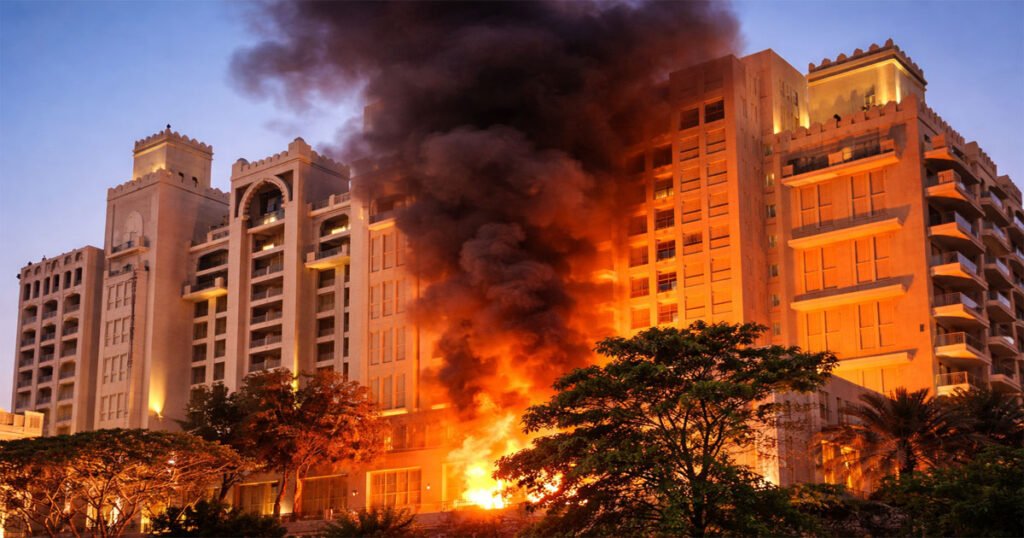
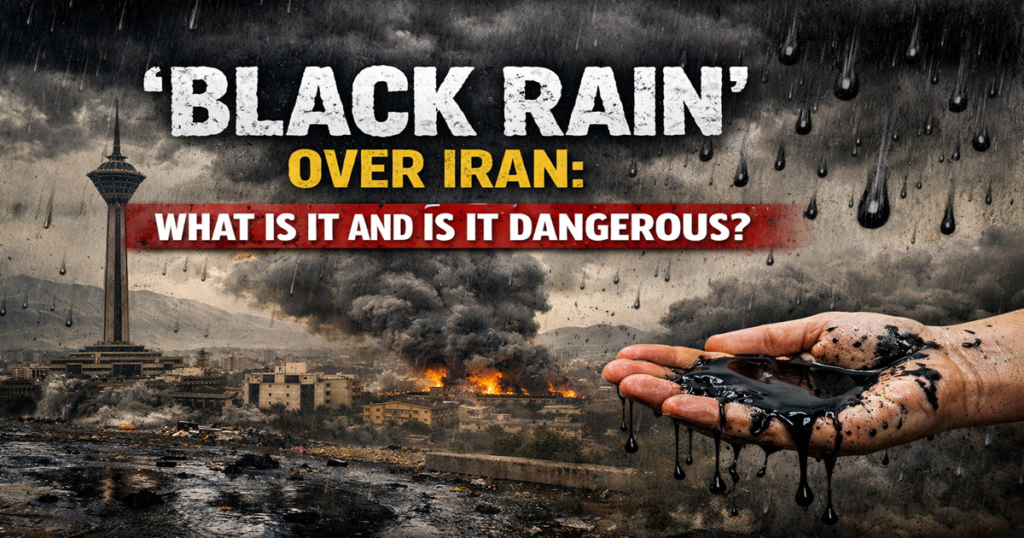
On the morning of March 8, residents of Tehran woke to something that looked like ordinary rain until it landed. It was black. Oily. It coated cars, windows, and clothes with a dark, sooty residue. It stung the eyes and irritated the throat. Within hours, Iran’s Red Crescent Society had issued an emergency warning: stay indoors, do not touch the rain, wash immediately if exposed, seal windows and doors. The cause was the massive oil fires burning across the city — the result of US-Israeli airstrikes on four major oil facilities that had begun on March 7.
Moreover, the black rain that fell on Tehran was not merely a visual spectacle. It was a toxic event carrying a mixture of chemicals that scientists and health authorities — from the World Health Organisation to university laboratories around the world — quickly identified as a serious, potentially lasting public health emergency. Furthermore, it is still happening as of this writing, and its consequences will extend long after the fires are extinguished and the smoke clears. This article explains exactly what black rain is, what chemicals it contains, what it does to the human body, how long it persists, and what the international health and legal community has said about its implications.
The Four Oil Facilities That Triggered the Crisis
The black rain crisis began with the targeting of four major oil infrastructure sites in and around Tehran. According to the Conflict and Environment Observatory — a UK-based nonprofit that monitors the environmental consequences of armed conflict — the four facilities struck were the oil depots at Karaj, Shahran, and Aghdasiyeh, and the Shahran oil refinery in northwestern Tehran. Moreover, these were not peripheral industrial sites on the edge of the city. The Shahran refinery sits in a densely populated northwestern neighbourhood of a megacity of approximately 15 to 17 million people. Furthermore, Doug Weir, director of the Conflict and Environment Observatory, told CBC Radio that Tehran’s geography makes it especially vulnerable to this kind of event: the city is hemmed in by the Alborz mountain range to its north, which pushes pollutants downward toward ground level rather than allowing them to disperse. As a result, the smoke from the burning oil facilities could not escape the city. It settled into it.
What Is Black Rain? The Science Behind It
Definition and Formation
Black rain is a general term for precipitation carrying high concentrations of pollutants from the atmosphere. Farzana Kastury, an environmental scientist at the University of Adelaide, told Nature that it is typically generated by bushfire smoke or the burning of heavy fuel — a thick, low-quality byproduct of crude oil refining. Moreover, in ordinary rainfall, water droplets act as an atmospheric cleaning mechanism — absorbing particles and washing them out of the air. Furthermore, in Tehran’s case the opposite happened: the atmosphere was so saturated with combustion products that falling rain absorbed them on the way down and delivered them concentrated to the surface. As a result, instead of cleaning the air, the rain became a vehicle for distributing toxic chemicals across the city.
The Chemical Formation Process
Gabriel da Silva, associate professor of chemical engineering at the University of Melbourne, explained the mechanism to PBS NewsHour and The Conversation. As fuel oil burns incompletely, it releases vast quantities of unburned and partially burned hydrocarbons into the atmosphere as smoke particles. Moreover, sulfur dioxide and nitrogen dioxide are released simultaneously from compounds naturally present in crude oil. These gases react with atmospheric moisture to form sulfuric acid and nitric acid — the classic constituents of acid rain. Furthermore, unburned hydrocarbon particles, heavy metals from structural materials caught in the fires, and organic compounds attach to water droplets as they form in the clouds above the fires. As a result, when those droplets fall as rain, they deliver the entire chemical cocktail to the surface.
What Is Actually Inside the Black Rain?
| Chemical Class | Specific Compounds | Health Risk | Expert Source |
| Carcinogenic hydrocarbons | Benzene, toluene, acetone, methylene chloride, PAHs | Cancer — benzene is a known human carcinogen; PAHs cause DNA damage | Kastury, Univ. of Adelaide (Nature) |
| Acid-forming gases | Sulfur dioxide, nitrogen dioxide | Form sulfuric and nitric acid — chemical burns on skin and lungs | da Silva, Univ. of Melbourne (PBS) |
| Ultrafine particulates | PM2.5 (under 2.5 microns) | Penetrate deep into lungs and bloodstream — heart disease, stroke, lung cancer | WHO / da Silva / McNeill (Columbia) |
| Heavy metals | Lead, mercury, cadmium, chromium | Neurological damage, kidney failure, carcinogenic | da Silva / The Conversation |
| Unknown organic compounds | Building materials and stored chemicals from explosions | Profile unknown — many poorly characterised at these concentrations | Driscoll / ABC News |
| Acidic precipitation | Sulfuric acid, nitric acid in rainwater | Burns skin on contact, damages lung tissue, corrodes buildings | WHO / Iranian Red Crescent |
Da Silva stated the black rain indicates toxic pollutants including hydrocarbons, ultrafine PM2.5 particles, and carcinogenic polycyclic aromatic hydrocarbons have entered the rain. Moreover, he confirmed additional unknown chemicals are likely present, including heavy metals and inorganic compounds from building materials caught in the initial explosions. Furthermore, V. Faye McNeill, a chemical engineering professor at Columbia University specialising in atmospheric chemistry, told Business Standard: “We can definitely expect acute health effects from an event like this.” As a result, the black rain is not one chemical hazard but many — compounded by the sheer density of the city in which it fell.
Health Effects: Short-Term and Long-Term
What Tehran Residents Experienced Immediately
The immediate symptoms reported by Tehran residents were consistent with exposure to the identified chemical mixture. Residents reported burning eyes and difficulty breathing as the primary complaints — consistent with benzene and sulfur dioxide exposure. Others described headaches and throat irritation. Moreover, oily, sooty residue covered cars, windowsills, and outdoor surfaces across the city — physical evidence of widespread atmospheric contamination. Furthermore, the Iranian Red Crescent confirmed reports of skin and eye irritation among people caught outdoors in the rain. As a result, these immediate effects — while serious — represent only the beginning of the health picture.
Short-Term Risks by Population Group
| Population Group | Primary Risk | Severity |
| Children | Lung damage — narrower airways increase vulnerability; heavy metal neurological risk | HIGH — most vulnerable group per ABC News/Cleetus |
| Elderly | Respiratory compromise, cardiovascular stress from PM2.5 | HIGH — existing conditions amplified |
| People with asthma/COPD | Acute exacerbation from PM2.5 and sulfur compounds | HIGH — potentially life-threatening |
| Healthy adults outdoors | Eye burns, skin irritation, lung irritation, headaches | MODERATE to HIGH depending on exposure duration |
| Healthy adults indoors | Reduced but not eliminated — indoor air quality also affected | LOW to MODERATE |
| Pregnant women | Fetal exposure to carcinogens and heavy metals via bloodstream | HIGH — long-term developmental risk to fetus |
Long-Term Health Consequences
The long-term health consequences are the greater concern among scientists. Peter Ross, pollution specialist and senior scientist at the Raincoast Conservation Foundation, told CBC News: “The potential for long, severe, long-term consequences is very real.” Moreover, benzene is a well-established human carcinogen — sustained exposure significantly elevates leukaemia and blood cancer risk. Polycyclic aromatic hydrocarbons are linked to lung, skin, and bladder cancer. Heavy metals including lead and mercury cause irreversible neurological damage, particularly in children whose nervous systems are still developing. Furthermore, the PM2.5 particles that penetrate deepest into the lungs are linked to elevated long-term rates of cardiovascular disease, stroke, and lung cancer even at low concentrations — and Tehran’s concentrations were far from low. As a result, health experts anticipate elevated disease rates in Tehran’s exposed population for years and possibly decades ahead.
Water and Food Contamination
Beyond the respiratory threat, scientists have raised a second major concern that will persist long after the black rain stops: contamination of the water supply and food chain. Heavy metals, PAHs, and hydrocarbons that fall from the sky in black rain accumulate in soil — where they are absorbed by crops and enter the food chain. Moreover, CBC News confirmed that scientists identified concerns that could impact water and food sources long after the smoke clears. Furthermore, Tehran draws significant portions of its water supply from mountain catchments surrounding the city — the same mountains that trap pollution at ground level. As a result, contamination of those catchments with oil fire combustion products represents a water security risk that could affect millions of people for months or years after the fires themselves are extinguished.
Tehran’s Pre-Existing Vulnerability
Tehran was not starting from a position of clean air when the oil fires began. The city already has some of the worst urban air quality in the world, owing to its mountain geography, its extreme population density, and decades of inadequate vehicle emissions regulation. Weir explained that the Alborz mountain range to Tehran’s north creates a natural bowl that traps air pollution at ground level. Moreover, the city’s density means air does not move around as much as it should. Furthermore, Weir explicitly stated that the Israeli policy decision to bomb oil facilities inside Tehran “was quite extraordinary in terms of civilian risk” — specifically because attacking urban oil infrastructure in a city with Tehran’s geography was predictably catastrophic for air quality. As a result, Rachel Cleetus of the Union of Concerned Scientists confirmed that risks are especially acute for the city’s most vulnerable residents.
Historical Precedents: Kuwait 1991 and Iraq Burn Pits
The Kuwait 1991 Oil Fires
When Iraqi forces retreated from Kuwait in 1991, they set fire to over 700 oil wells. The fires burned for approximately nine months, releasing an estimated two million barrels of oil per day into the atmosphere. Black smoke covered Kuwait and parts of neighbouring countries. Moreover, studies conducted in subsequent years documented elevated rates of respiratory illness, cancer, and neurological disorders among both Kuwaiti civilians and foreign military personnel. Furthermore, da Silva explicitly cited the Kuwait fires as the closest historical parallel to Tehran, noting that in this region there is no precedent for the impact on a populated area of Tehran’s size and density. As a result, the Kuwait precedent suggests consequences extending for years after the fires are extinguished.
Iraq and Afghanistan Burn Pits
The long-term health effects documented among US military personnel exposed to open burn pits in Iraq and Afghanistan provide a second sobering parallel. Burn pits produced toxic smoke from incinerated plastics, metals, chemicals, and medical waste — and personnel were exposed daily. Moreover, the US Department of Veterans Affairs has since acknowledged a wide range of burn pit-associated illnesses, including rare cancers, constrictive bronchiolitis, and neurological disorders, that emerged years after initial exposure. Furthermore, da Silva noted: “We now know there are long-term health impacts on returning service people. So we can assume local populations are also profoundly affected.” As a result, the burn pit precedent is a direct warning for Tehran’s civilian population.
WHO Warning and the International Response
The international health response was swift. The WHO issued a formal warning about toxic pollutants in the air — confirming multiple reports of black rain and supporting Iran’s advisory to remain indoors. WHO spokesperson Christian Lindmeier confirmed the “massive release” of toxic hydrocarbons, sulfur oxides, and nitrogen compounds and stated: “It is a dangerous situation.” Moreover, the UN Human Rights Office spokesperson Ravina Shamdasani raised concerns in Geneva, stating the health and environmental impacts “raise serious questions as to whether the proportionality and precaution obligations under international humanitarian law were met.” Furthermore, the UN explicitly noted the sites struck “do not appear to be of military exclusive usage.” As a result, the black rain triggered not just a health emergency response but a formal international legal and ethical debate.
The Chemical Warfare Question
Rachel Cleetus of the Union of Concerned Scientists told ABC News directly: “The attack on the oil depots could be construed as chemical warfare, which violates international law, because the aggressors likely knew the hazards the civilians who live in Tehran would face.” Moreover, Iranian Foreign Ministry spokesperson Esmaeil Baghaei stated publicly that attacks on fuel storage facilities amount to “intentional chemical warfare against the Iranian citizens.” Furthermore, the UN Human Rights Office confirmed the strikes raise serious proportionality and precaution questions under international humanitarian law. As a result, while no formal war crimes proceedings have been announced, the legal argument has been raised by scientists, foreign ministries, and multiple UN bodies simultaneously.
What to Do If Exposed: Official Safety Guidance
| Situation | Action Required |
| Currently indoors in affected area | Stay inside — seal windows and doors — do not open windows or doors unnecessarily |
| Must go outdoors | Wear N95 or equivalent mask, cover all skin, minimise time outside |
| Black rain contacted skin | Do NOT rub — wash only with continuous cold water stream — change clothes immediately |
| Clothing exposed to black rain | Remove at once — place in sealed plastic bag — do not shake or brush |
| Eyes or face exposed | Flush with continuous clean water for at least 15 minutes — seek medical attention |
| Indoor surfaces contaminated | Wipe with damp cloth — do not dry sweep or dust (spreads particles) |
| Children and elderly present | Maximum precaution — keep indoors entirely — highest vulnerability group |
| Existing respiratory conditions | Do not go outdoors — follow medical provider guidance urgently |
| Produce from affected area | Wash very thoroughly — avoid consuming anything directly exposed to rain or runoff |
| Drinking water concerns | Use sealed bottled water — monitor official guidance on tap water safety |
How Long Will the Danger Last?
The danger has two separate timelines. For the air, Business Standard confirmed that rain washes hazardous chemicals out of the atmosphere relatively quickly — typically within hours to days once source fires are extinguished. Moreover, once the oil facilities stop burning, the continuous generation of new smoke particles ceases, and atmospheric dispersal gradually clears the air. As a result, the acute atmospheric danger diminishes once fires are fully extinguished — though this has not yet occurred at the time of writing.
For the ground and water supply, the timeline is far longer. Heavy metals deposited in soil by black rain accumulate and persist for years or decades. PAHs and other organic contaminants degrade slowly under natural conditions. Moreover, Peter Ross confirmed that health and environmental concerns could impact water and food sources long after the smoke clears. Furthermore, contaminated water catchments may require monitoring and remediation treatment for months or years. As a result, the environmental legacy of the Tehran oil fires will outlast the war itself by a significant margin.
Conclusion
“Black rain” falling over Tehran is one of the most visible and most toxic environmental consequences of the Iran war. It is not a natural phenomenon, not an unforeseeable side effect, and not a minor inconvenience. It is a complex chemical event depositing carcinogens, heavy metals, acid compounds, and ultrafine particles into a megacity of 15 to 17 million people — a city already compromised by some of the world’s worst urban air quality, trapped in a mountain bowl that holds pollution against the ground.
Moreover, the historical precedents from Kuwait 1991 and the Iraq burn pits deliver the same message: the acute phase lasts weeks. The chronic phase lasts decades. The children of Tehran who breathed benzene-saturated air in March 2026 will carry that exposure in their cells for the rest of their lives. Furthermore, the WHO, the UN Human Rights Office, and scientists on four continents have been unambiguous: this is a serious, documented, long-term public health emergency. As a result, the black rain over Iran is not merely a consequence of war — it is a war crime argument in chemical form, falling on the people who had the least say in the conflict that caused it.
Frequently Asked Questions (FAQs)
Q1: What caused the black rain in Tehran?
US-Israeli airstrikes struck four major oil facilities in and around Tehran on March 7 and 8 — the Karaj, Shahran, and Aghdasiyeh oil depots and the Shahran oil refinery. The fires released massive combustion products into the atmosphere. Moreover, Tehran’s mountain geography trapped the smoke at ground level rather than allowing it to disperse. When rain fell, it absorbed the concentrated pollutants — hydrocarbons, heavy metals, sulfuric and nitric acid — and deposited them as black, oily, toxic rain across the city. As a result, the black rain was a direct and predictable consequence of striking oil infrastructure inside a densely populated megacity.
Q2: Is black rain dangerous to humans?
Yes — seriously, both immediately and long-term. Short-term exposure causes burning eyes, skin irritation, chemical burns from acid contact, and serious lung damage from inhaled compounds. Moreover, vulnerable groups including children, the elderly, and those with respiratory conditions face the highest immediate risk. Furthermore, long-term consequences include elevated cancer risk from benzene and PAH exposure, neurological damage from heavy metal exposure, and increased cardiovascular disease from PM2.5 inhalation. WHO described it as “a dangerous situation” and issued a formal public health warning. As a result, the health impact of this event will be measured over years and decades, not just days.
Q3: What specific chemicals are in the black rain over Tehran?
Scientists have confirmed several categories: cancer-causing benzene, toluene, and PAHs; PM2.5 ultrafine particles that penetrate deep into lungs; sulfuric and nitric acid from atmospheric reactions with sulfur and nitrogen dioxide; and heavy metals including lead, mercury, and cadmium from structural materials in the explosions. Moreover, atmospheric chemist Gabriel da Silva confirmed additional unknown compounds are likely present. Furthermore, the full chemical inventory has not yet been completely characterised. As a result, the known hazards are already severe — and the unknown ones may add further risk as analysis continues.
Q4: How does the Tehran black rain compare to Kuwait 1991?
Kuwait 1991 is the closest historical parallel — over 700 oil wells burned for nine months, and studies documented elevated respiratory illness, cancer, and neurological disorders in civilians and military personnel for years afterward. Moreover, da Silva explicitly cited this precedent in his analysis. However, he noted there is no precedent for the specific impact on a populated area of Tehran’s density and geographic confinement. Furthermore, the Iraq and Afghanistan burn pit health legacy — where conditions took years to manifest — is a second direct warning for Tehran’s population. As a result, the Tehran experience may ultimately prove worse than Kuwait given the urban density involved.
Q5: Could targeting oil depots near civilians be a war crime?
This question has been formally raised by multiple authoritative bodies. Rachel Cleetus of the Union of Concerned Scientists told ABC News the attacks could be construed as chemical warfare under international law. Moreover, the UN Human Rights Office stated the strikes raise serious questions about whether proportionality and precaution obligations under international humanitarian law were met. Furthermore, the UN noted the sites struck do not appear to be of military exclusive usage — a key legal threshold. As a result, while no formal proceedings have been announced, the legal argument has been raised simultaneously by scientists, the Iranian government, and UN human rights bodies.