
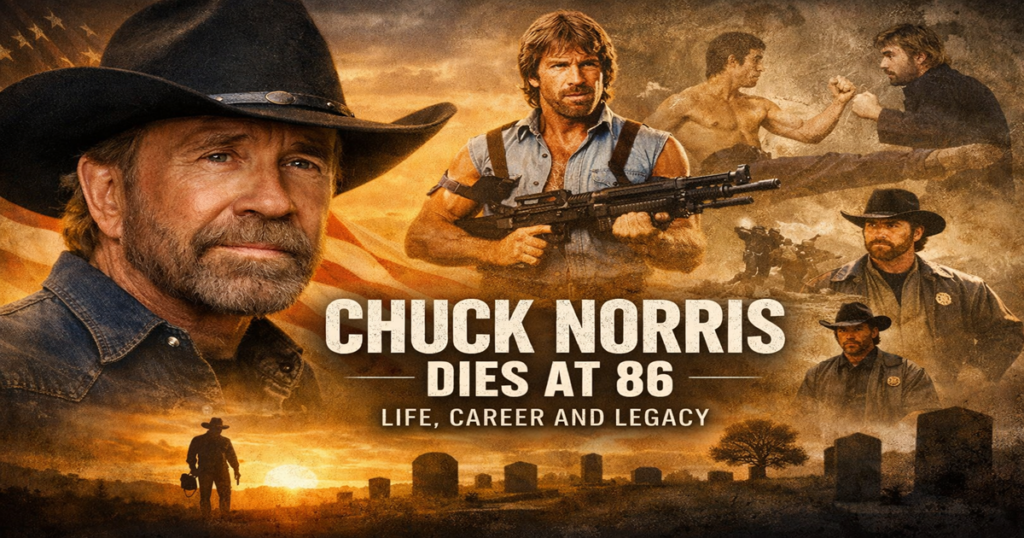
On March 19, 2026, the world lost one of its most enduring icons. Chuck Norris — martial arts world champion, 1980s action hero, Walker Texas Ranger star, and internet legend — died in Hawaii at the age of 86. His family confirmed the news the following morning. “It is with heavy hearts that our family shares the sudden passing of our beloved Chuck Norris,” the statement read. The family asked that the circumstances remain private.
Chuck Norris spent six decades building one of the most remarkable careers in American entertainment. He started as a martial arts instructor. He became Bruce Lee’s on-screen opponent. He built an action film empire in the 1980s. He reinvented himself on television. Moreover, he became one of the earliest and most enduring internet memes. Furthermore, just eleven days before his death, on his 86th birthday on March 10, he posted a video of himself training — declaring “I don’t age. I level up.” As a result, the world lost not just an actor, but an American original.
The Family Statement
“To the world, he was a martial artist, actor, and a symbol of strength,” the Norris family wrote on Instagram and Facebook. “To us, he was a devoted husband, a loving father and grandfather, an incredible brother, and the heart of our family.”
“He lived his life with faith, purpose, and an unwavering commitment to the people he loved. Through his work, discipline, and kindness, he inspired millions around the world and left a lasting impact on so many lives.” Moreover, the family confirmed he died surrounded by loved ones and was at peace. As a result, the statement gave the world what it needed — confirmation that the man who played the toughest characters on screen spent his final moments in warmth and family.
Early Life: From Oklahoma to Korea
Born Carlos Ray Norris
Carlos Ray Norris was born on March 10, 1940, in Ryan, Oklahoma. His father — Ray Dee Norris — served as a soldier in World War II. His mother was of Irish and Cherokee Native American descent. Following his parents’ divorce, his mother relocated the family — Chuck and his two younger brothers — to Prairie Village, Kansas, and later to Torrance, California.
Chuck grew up shy and self-described as a non-athlete. He later said he had no confidence as a young man. Moreover, the move to California introduced him to a different world — one that would soon pivot entirely when the US Air Force came calling. Furthermore, he enlisted in 1958 as an Air Policeman and received his posting to Osan Air Base in South Korea. As a result, that posting changed everything.
Korea: The Birth of a Martial Artist
At Osan Air Base in South Korea, Norris encountered Tang Soo Do for the first time. He began training — and discovered something that would define the rest of his life. “I started training over there,” he once said, “and then I came back and got out of the service and started teaching.”
Moreover, it was at Osan where he acquired the nickname “Chuck” — a name that stuck for the rest of his life. Furthermore, he earned his black belt in Tang Soo Do and went on to achieve black belts in multiple additional disciplines — including Brazilian jiu-jitsu, a black belt he received from the Machado brothers. As a result, he left Korea not as a shy Oklahoma boy but as a driven, disciplined martial artist with a clear purpose.
Martial Arts Career: World Champion
After his Air Force discharge in 1962, Norris opened a chain of martial arts studios in California. He taught some of Hollywood’s biggest names — including Steve McQueen, Priscilla Presley, and Bob Barker. Moreover, he became one of the most decorated competitive fighters of his era.
| Achievement | Year | Details |
| Black Belt — Tang Soo Do | 1962 | Earned during and after Air Force service in Korea |
| Professional karate career begins | 1964 | Entered competition circuit after opening studios |
| Undefeated middleweight champion | 1968-1974 | Six consecutive years without a loss in professional competition |
| Black Belt Magazine Fighter of the Year | 1969 | Recognised as top competitive fighter in the US |
| World Professional Middle Weight Karate Champion | 1968 | First title — defended it for six years straight |
| Founded Chun Kuk Do | 1990 | Developed his own hybrid martial arts system — “The Universal Way” |
| Black belt — Brazilian jiu-jitsu | 2014 | Received from Machado brothers — one of very few in Hollywood |
| Honorary Texas Ranger | 2010 | Became an actual Texas Ranger — the role he played on TV |
| Hollywood Walk of Fame star | 1989 | Recognised for film and television contributions |
Furthermore, his time as an undefeated world champion — six years without a single professional loss — established his credibility as a genuine martial artist before Hollywood ever discovered him. As a result, when he transitioned to film, he brought something most action heroes could not: authentic mastery.
The Bruce Lee Connection
The most pivotal moment of Chuck Norris’s career came through his friendship with Bruce Lee. The two men met in the mid-1960s when both were competing in the martial arts world. They trained together, compared styles, and formed a genuine friendship built on mutual respect.
In 1972, that friendship produced one of cinema’s most iconic sequences. “The Way of the Dragon” — directed by and starring Bruce Lee — featured Norris as Colt, Lee’s final opponent. The fight scene, shot in the Colosseum in Rome, remains one of the most celebrated martial arts sequences in film history. Moreover, Norris’s performance — stoic, powerful, and dignified even in defeat — showed Hollywood he could hold the screen. Furthermore, NPR noted that the film “fetishized Norris’ hairy chest opposite Lee’s smooth one” — creating an instant visual contrast that made both men unforgettable. As a result, the Bruce Lee film launched a film career that Norris would sustain for the next five decades.
The 1980s: America’s Action Hero
The 1980s belonged to Chuck Norris. No decade more fully embodied his screen persona — the square-jawed, stoic, physically unstoppable American hero who always got the job done.
| Film | Year | Significance |
| Breaker! Breaker! | 1977 | First leading role — shot in 11 days — made money and opened Hollywood doors |
| Good Guys Wear Black | 1978 | Established his action hero template — Vietnam vet doing what governments won’t |
| The Octagon | 1980 | First major action hit — introduced the ninja element that defined his 80s work |
| Lone Wolf McQuade | 1983 | His most critically praised 1980s film — called “the best Chuck Norris film ever” |
| Missing in Action | 1984 | POW rescue thriller — became a franchise — three films total |
| Code of Silence | 1985 | His best-reviewed film — critics praised the gritty Chicago cop story |
| Invasion U.S.A. | 1985 | Soviet terrorist invasion film — delivered his most memorable one-liners |
| Delta Force | 1986 | Based on real 1985 TWA hijacking — co-starred Lee Marvin |
| Firewalker | 1986 | Rare comic adventure — showed range beyond pure action |
| The Expendables 2 | 2012 | Career reunion — returned after 7-year screen absence alongside Stallone, Willis |
Variety described his approach directly: “While he scored high on credibility, Norris did not leaven his work with humor the way Arnold Schwarzenegger, Bruce Willis and Jackie Chan did. He was nevertheless the action star of choice for those seeking an all-American icon.” Moreover, his Missing in Action films — centred on rescuing American POWs left behind after Vietnam — tapped directly into a national wound that millions of Americans still felt. As a result, his box office success in the 1980s reflected a cultural moment as much as individual stardom.
Walker Texas Ranger: The Television Years
When his film career cooled in the early 1990s, Norris did what few action stars managed: he reinvented himself completely. Walker Texas Ranger premiered in 1993 and ran until 2001 — eight seasons, 196 episodes.
The show cast Norris as Cordell Walker — a veteran Texas Ranger fighting crime across Dallas and the Lone Star State. It ran on CBS on Saturday nights and drew a loyal audience of tens of millions each week. Moreover, it earned Norris a TV Guide Award nomination as favourite actor in a drama in 1999. Furthermore, Walker became his most enduring character — more recognisable to younger generations than any of his 1980s films. As a result, the show extended his career by a full decade and introduced him to an entirely new audience.
The Internet Meme Phenomenon
No account of Chuck Norris is complete without addressing what happened to his image in the early 2000s internet. “Chuck Norris Facts” — a genre of absurdist, hyperbolic jokes about his supposed invincibility — spread across the early internet and made him one of the first true internet memes.
Examples included: “Chuck Norris kills 100% of germs,” “Paper beats rock, rock beats scissors, scissors beats paper — but Chuck Norris beats all three at the same time,” and “Chuck Norris doesn’t sleep — he waits.” Moreover, Norris himself found this genuinely amusing. NPR reported he joked in one video: “Did you know that I got bit by a king cobra? And after five days of agonizing pain, the cobra died.” Furthermore, The Bulwark noted he found “an odd second life as one of the early internet memes — a sort of Bunyan-esque character on the American scene.” As a result, while other 1980s stars faded, Norris remained culturally relevant through a completely unexpected new medium.
Personal Life
Family and Faith
Chuck Norris married twice. His first marriage — to Dianne Holechek — lasted from 1958 to 1989. They had two sons together: Mike Norris, who became an actor and director, and Eric Norris, who became a NASCAR driver. Norris also had a daughter, Dina, from a relationship with an actress.
In 1998, he married Gena O’Kelley — a model — and they had twins together: Dakota Alan and Danilee Kelly. Moreover, faith played a central role in his life and public identity. He was a committed Christian and wrote extensively about his faith. Furthermore, in his final years he experienced significant personal loss: his mother died in 2024, and his first wife Dianne passed away in December 2025. As a result, his death came after a period of loss that those who knew him said he handled with characteristic quiet strength.
Health and Fitness to the End
Chuck Norris trained his entire life. TMZ confirmed that a source who had spoken with him on Wednesday March 18 — just one day before his death — said he had been working out and was “in an upbeat, jovial mood.” Moreover, on March 10 — his 86th birthday — he posted a video of himself sparring on social media, declaring “I don’t age. I level up.” Furthermore, at his home in Texas he continued to work out and train well into his 80s. As a result, the suddenness of his death shocked even those close to him — a man who seemed, by every observable measure, indestructible.
Tributes From Around the World
Within hours of the announcement, tributes poured in from across the entertainment world, the martial arts community, and political figures who had admired him.
- Sylvester Stallone: “Chuck was the real deal. A genuine martial artist, a genuine American, and one of the kindest men I ever worked with. Rest easy, legend.”
- Arnold Schwarzenegger: “Chuck Norris proved that you don’t need a screenplay to be tough — you just need to be Chuck Norris. The world is a little less strong today.”
- UFC President Dana White: “Chuck Norris is the reason a generation of kids got into martial arts. His legacy in combat sports is as real as his legacy in Hollywood.”
- Texas Governor Greg Abbott: “Chuck Norris was an honorary Texas Ranger, a true American hero, and a man whose values reflected the best of what Texas stands for. He will never be forgotten.”
The Legacy: What Chuck Norris Left Behind
| Legacy Category | What He Built |
| Martial arts | Six-year undefeated world champion — founded Chun Kuk Do — introduced millions to martial arts through film and TV |
| Film | Over 40 films — defined 1980s American action cinema — Missing in Action, Code of Silence, Delta Force |
| Television | Walker Texas Ranger — 8 seasons — 196 episodes — one of CBS’s longest-running action dramas |
| Internet culture | Pioneer internet meme — Chuck Norris Facts — one of the earliest and most enduring viral phenomena |
| Military support | Lifelong advocate for veterans — used his platform consistently to support US military and POW/MIA families |
| Faith | Publicly committed Christian — authored books on faith — inspired millions through his personal convictions |
| Fitness | Trained into his 80s — authored fitness books — inspired generations to take physical discipline seriously |
| Martial arts schools | Operated studios across California — taught celebrities — brought martial arts to mainstream American culture |
Conclusion
Chuck Norris leaves behind a legacy that defies easy summary. He was a World Champion before he was a movie star. He was a movie star before he was a TV icon. He was a TV icon before he became a meme. At every stage, he adapted, persisted, and found a new audience.
Moreover, the Chuck Norris Facts that made him an internet legend captured something real — not just about his screen persona, but about what he represented. Discipline. Persistence. Toughness without cruelty. An all-American belief that hard work and training could take a shy kid from Oklahoma all the way to the top.
Furthermore, the family’s statement said it most simply: “He lived his life with faith, purpose, and an unwavering commitment to the people he loved.” As a result, Carlos Ray “Chuck” Norris — born March 10, 1940, in Ryan, Oklahoma — died as he lived: surrounded by family, still training eleven days before the end, still himself until the very last.
Frequently Asked Questions (FAQs)
Q1: How did Chuck Norris die?
Chuck Norris died on Thursday, March 19, 2026, in Hawaii following an unidentified medical emergency. His family confirmed the news in a statement posted to social media on Friday morning. Moreover, the family asked that the specific circumstances of his death remain private. Furthermore, just one day before his death, a source told TMZ he had been working out and was in an upbeat, jovial mood. As a result, his passing was sudden and unexpected — even to those close to him.
Q2: What was Chuck Norris most famous for?
Chuck Norris built his fame across three distinct eras. In the 1970s and 1980s, he starred in action films including Missing in Action, Code of Silence, The Delta Force, and Lone Wolf McQuade — becoming America’s defining action hero of the decade. Moreover, from 1993 to 2001, he starred in Walker Texas Ranger — one of CBS’s longest-running dramas. Furthermore, in the 2000s he became one of the internet’s earliest and most enduring memes through the “Chuck Norris Facts” phenomenon. As a result, he remains recognisable to audiences spanning five decades.
Q3: Was Chuck Norris a real martial arts champion?
Yes — absolutely. Chuck Norris was a genuine world-class martial artist before he became an actor. He held the World Professional Middle Weight Karate Championship for six consecutive years from 1968 to 1974 without a single professional loss. Moreover, he held black belts in multiple disciplines including Tang Soo Do and Brazilian jiu-jitsu. Furthermore, he founded his own hybrid martial arts system — Chun Kuk Do — in 1990. As a result, unlike many action stars, his on-screen fighting credibility was backed by authentic championship-level skill.
Q4: What is Chuck Norris’s connection to Bruce Lee?
Chuck Norris and Bruce Lee met in the mid-1960s through the martial arts competition circuit and formed a genuine friendship. They trained together and exchanged techniques. In 1972, Lee cast Norris as his final opponent in “The Way of the Dragon” — a fight scene shot at the Colosseum in Rome that remains one of the most celebrated in martial arts film history. Moreover, it was Steve McQueen — one of Norris’s martial arts students — who suggested he take acting lessons after the Lee film. As a result, the Bruce Lee connection directly launched Chuck Norris’s acting career.
Q5: How old was Chuck Norris when he died and what was his last public appearance?
Chuck Norris was 86 years old when he died on March 19 — just nine days after his 86th birthday on March 10. His last public appearance was that birthday post on social media, in which he filmed himself training and sparring, declaring “I don’t age. I level up.” Moreover, TMZ confirmed a source had spoken with him the day before his death and found him working out and in excellent spirits. Furthermore, NPR noted he continued to train at his Texas home well into his 80s. As a result, he remained physically active and publicly engaged until the very end of his life.