For years, analysts debated what would happen if the United States and Israel ever directly struck Iran. On February 28, 2026, that question stopped being hypothetical. In the early hours of that Saturday morning, the United States and Israel launched coordinated military strikes against Iran in what the US military codenamed Operation Epic Fury and Israel called Operation Roaring Lion. Moreover, within hours, the Middle East had been transformed into an active theater of war on a scale not seen in the region since the 2003 invasion of Iraq. Therefore, the urgent question facing the world right now is this: what will Iran do next — and what does its response mean for the region and the global economy?
DISCLAIMER: This article is a factual news-based analysis for informational purposes only. All events referenced are drawn from publicly available international news sources as of March 2026. This article does not advocate for any side in this conflict.
Furthermore, Iran’s response has already begun — and it is both immediate and multi-dimensional. This analysis draws on verified international reporting to outline what has happened so far, what Iran’s strategic options are going forward, and what the broader geopolitical and economic consequences may be.
What Happened: The Strikes That Changed Everything
The US-Israeli strikes of February 28, 2026 were not a targeted warning shot. According to multiple verified international sources including CNN, CNBC, and the UK Parliament’s House of Commons Library, the operation was explicitly aimed at regime change in Iran — the most ambitious military objective undertaken in the Middle East in over two decades. Moreover, the strikes targeted Iran’s top political and military leadership, nuclear facilities, missile sites, and command infrastructure across multiple cities including Tehran, Isfahan, Qom, Karaj, and Kermanshah.
The most significant single outcome of the strikes was the assassination of Supreme Leader Ali Khamenei, whose compound was destroyed in the initial wave of attacks. Furthermore, Iranian state media confirmed his death in the early hours of March 1, 2026 — ending the 35-year rule of the man who had been the ultimate authority in Iran since 1989. As a result, Iran now faces not only a military crisis but a profound leadership vacuum at the most critical moment in the Islamic Republic’s history.
Timeline of Key Events — February to March 2026
| Date | Event | Significance |
| Jan 13, 2026 | Trump calls on Iranians to protest and take over institutions | Signals regime change intent |
| Jan 23, 2026 | Trump announces US armada heading to Middle East | USS Abraham Lincoln deployed to region |
| Feb 25, 2026 | Iranian FM Araghchi says nuclear deal is “within reach” | Final diplomatic window opens |
| Feb 26, 2026 | Third round of indirect nuclear talks in Geneva | Last negotiations before strikes |
| Feb 28, 2026 | US and Israel launch Operations Epic Fury and Roaring Lion | War begins — regime change objective |
| Mar 1, 2026 | Khamenei death confirmed — Iran declares 40 days of mourning | Historic leadership vacuum created |
| Mar 2, 2026 | Iran launches Operation True Promise IV — strikes on 6+ countries | Full-scale retaliation begins |
| Mar 3, 2026 | Conflict enters third day — US says hardest strikes are yet to come | Escalation continues |
Iran’s Response So Far: Operation True Promise IV
Iran’s military response — officially named Operation True Promise IV, continuing a series of previous retaliatory operations — has been immediate, broad, and deliberately designed to demonstrate that Iran retains significant offensive capability despite the strikes against its leadership and infrastructure. Moreover, the scale of the retaliation has surprised many analysts who had expected Iran’s response to be more limited given the damage inflicted.
Missile and Drone Strikes Across the Region
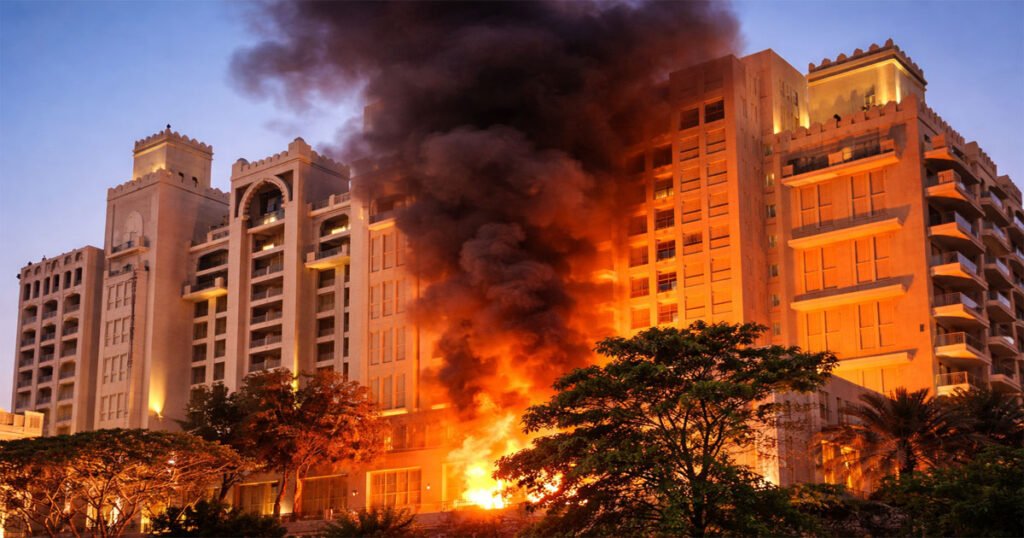
According to verified reports from CNN, CNBC, and the UN News Service, Iran has launched missiles and drone strikes against targets in Israel, US military bases in the Gulf region, and civilian and military infrastructure across multiple Arab states. Furthermore, major cities including Dubai, Abu Dhabi, and Doha reported explosions and missile interceptions in their airspace. As a result, major airlines including Emirates, Etihad, and Qatar Airways suspended all flights — disrupting air travel for millions of passengers globally.
Moreover, Iran struck what it described as US military positions in the UAE, Qatar, Kuwait, and Saudi Arabia. The Islamic Resistance in Iraq — an Iranian-aligned proxy group — claimed responsibility for over 23 separate drone strikes against US assets in Erbil, Iraq. Consequently, the conflict has already spread well beyond Iran’s borders into a genuinely regional war.
Strait of Hormuz Closure Order
Perhaps the most consequential single action Iran has taken is the order to close the Strait of Hormuz — the narrow waterway through which approximately 20% of the world’s oil supply passes every day. Furthermore, this move immediately sent global oil prices surging, with US crude rising over 8% and Brent crude approaching $80 per barrel within hours of the announcement. As a result, energy markets worldwide went into crisis mode, and shipping insurance providers began withdrawing war risk coverage for vessels in the region entirely.
Hezbollah and Proxy Activation
Iran has also activated Hezbollah — its most powerful regional proxy force, based in Lebanon — which has begun launching strikes against northern Israel. Moreover, the Israeli Defense Forces responded with a major wave of strikes across Lebanon, including in Beirut and the Beqaa Valley, killing over 50 people according to Lebanese authorities. Furthermore, as of March 3, 2026, Lebanon has ordered Hezbollah to stand down and hand over its weapons — a dramatic development that reflects the enormous pressure regional actors are under to prevent further escalation. However, whether Hezbollah complies remains deeply uncertain.
Iran’s Strategic Options Going Forward
Understanding what Iran will do next requires understanding the strategic logic that has guided Iranian foreign policy for decades. Moreover, Iran’s decision-making is now being managed by a temporary leadership council comprising President Masoud Pezeshkian and other senior officials following Khamenei’s death. Therefore, the country is simultaneously fighting a war and managing a historic political transition — a combination of pressures that no modern Iranian government has ever faced.
Option 1: Sustained Proxy Warfare
Iran’s most durable strategic weapon has always been its network of regional proxy forces — Hezbollah in Lebanon, Hamas in Gaza, the Houthis in Yemen, and various Shia militia groups across Iraq and Syria. Furthermore, these groups give Iran the ability to project military pressure across the region without committing its own forces directly to conventional battle, which it cannot win against US air power. Therefore, analysts widely expect Iran to rely heavily on proxy escalation as a primary tool in the weeks ahead, even if direct missile and drone strikes are degraded by continued US and Israeli air operations.
Option 2: Economic Warfare Through the Strait of Hormuz
The Strait of Hormuz closure is Iran’s most powerful economic weapon. Moreover, a prolonged blockade of this waterway would affect not only Western economies but also China, India, Japan, and South Korea — all of which depend heavily on Gulf oil exports. As a result, Iran may calculate that sustained energy disruption creates international pressure on the United States to halt its military campaign. Furthermore, China in particular has significant economic incentive to push for a ceasefire given its deep dependence on Iranian and Gulf oil, and Iran may be counting on Beijing to apply diplomatic pressure on Washington.
Option 3: Cyberattacks and Asymmetric Operations
Iran possesses one of the most capable offensive cyber programs in the world. Therefore, analysts expect a significant escalation in Iranian cyberattacks against US and Israeli critical infrastructure — financial systems, power grids, communication networks, and government databases. Furthermore, Iran has previously demonstrated the ability to conduct sophisticated cyber operations, including the Shamoon attacks on Saudi Aramco and various operations against US financial institutions. As a result, businesses and governments globally are on heightened alert for Iranian cyber activity in the weeks ahead.
Option 4: Nuclear Escalation
This is the option that most alarms international observers. Prior to the strikes, Iran had been enriching uranium at levels close to weapons-grade. Moreover, the US and Israeli strikes specifically targeted Iran’s nuclear facilities, including the Natanz enrichment plant. However, the UN’s International Atomic Energy Agency chief has urgently called for a return to diplomacy, citing increasing risks to nuclear safety from the damaged facilities. Furthermore, if Iran’s remaining nuclear scientists and facilities survive the strikes, Tehran may accelerate efforts to produce a nuclear device as the ultimate deterrent against regime change — a calculation that could fundamentally alter the strategic calculus of the entire conflict.
Option 5: Negotiated Settlement
Despite the scale of the violence, the door to negotiation has not entirely closed. Moreover, multiple regional actors including Turkey, Qatar, and Oman — all of which have maintained communication channels with both Tehran and Washington — are actively pushing for a ceasefire. Furthermore, Trump himself has not ruled out a negotiated outcome, and Secretary of State Rubio has stated that US objectives are specific rather than open-ended. As a result, there remains a narrow but real possibility that intensive back-channel diplomacy could produce a halt to hostilities before the conflict becomes fully uncontrollable.
Regional Reactions: Who Stands Where
The geopolitical response to the conflict has revealed significant divisions both within the Middle East and globally. Moreover, the positions of key regional and international actors will heavily influence how the conflict evolves in the coming weeks.
- Saudi Arabia: According to multiple reports, Crown Prince Mohammed bin Salman actively encouraged Trump to conduct the strikes. However, Saudi territory and facilities hosting US forces have since been targeted by Iranian retaliatory strikes — putting Riyadh in an extremely uncomfortable position.
- Turkey: Ankara has adopted a non-aligned stance and Foreign Minister Hakan Fidan is leading a diplomatic effort to secure a ceasefire. Moreover, Turkey faces direct economic consequences as Iran supplies approximately 15% of its natural gas, and any pipeline disruption would cause immediate energy shortages.
- China: Beijing has not condemned the strikes but has called for restraint. Furthermore, given China’s deep economic dependence on Gulf energy and its significant investment in Iran, the conflict directly threatens core Chinese economic interests — creating pressure on Beijing to mediate.
- Russia: Moscow has condemned the strikes and called for an emergency UN Security Council session. However, given Russia’s ongoing involvement in Ukraine, its practical ability to influence events on the ground in the Middle East is limited.
- United Kingdom: UK bases in Bahrain, Qatar, and Cyprus have been attacked by Iranian forces. As a result, the RAF has been deployed in a defensive capacity — making the UK an active participant in the conflict despite not having been consulted on the initial strikes, according to European reports.
Global Economic Consequences
The economic fallout from the Iran-US conflict is already significant and spreading rapidly. Moreover, the combination of oil price surges, shipping disruption, airspace closures, and investor uncertainty is creating shock waves across global markets that economists warn could deepen substantially if the conflict is not contained quickly.
| Sector | Impact | Direction |
| Crude Oil (Brent) | Surged approx. 9% to near $80/barrel | Rising |
| Gold | Up approximately 2% — safe-haven demand | Rising |
| Global Equities | US and Asian markets pulled back sharply | Falling |
| Natural Gas Prices | Surging on Middle East supply fears | Rising |
| Airline Industry | Major Gulf carriers suspended all flights | Severe disruption |
| Shipping Insurance | War risk coverage withdrawn for Gulf region | Critical concern |
| US Dollar Index | Marginally higher as safe-haven currency | Slightly rising |
| 10-Year Treasury Yield | Fell to near 11-month low of 3.93% | Falling |
Conclusion: An Uncertain and Dangerous Moment
The question of what Iran will do in response to the United States is no longer purely hypothetical — the response has already begun, and it is escalating. Moreover, Iran is simultaneously managing a historic leadership transition, fighting on multiple fronts, and wielding powerful economic weapons including the Strait of Hormuz closure that affect the entire global economy. Therefore, the situation as of March 2026 represents one of the most dangerous geopolitical moments of the post-Cold War era.
Furthermore, the outcome of this conflict will depend on decisions made in the coming days and weeks by a small number of leaders operating under enormous pressure, with incomplete information, and in a rapidly changing environment. As a result, the international community — including regional mediators like Turkey and Oman, major powers like China and Russia, and international institutions like the UN — faces a narrow and urgently closing window to prevent a regional conflict from escalating into something far more catastrophic. Consequently, the world is watching this situation with a degree of anxiety not seen since the darkest days of the Cold War.
Frequently Asked Questions (FAQs)
Q1: Has Iran already responded militarily to the US strikes?
Yes. Iran launched what it officially named Operation True Promise IV beginning March 1-2, 2026. This includes missile and drone strikes against Israel, US military bases in the Gulf, and civilian and military infrastructure across the UAE, Qatar, Kuwait, and Saudi Arabia. Furthermore, Iranian-aligned proxy forces in Iraq have conducted over 23 drone strikes against US assets in Erbil.
Q2: What is the Strait of Hormuz and why does its closure matter?
The Strait of Hormuz is a narrow waterway between Iran and the Arabian Peninsula through which approximately 20% of the world’s daily oil supply passes. Moreover, Iran has ordered its closure as part of its retaliation strategy. If sustained, this blockade would cause severe energy supply disruptions affecting Europe, Asia, and global markets — driving oil prices dramatically higher and potentially tipping multiple economies into recession.
Q3: Who is leading Iran after Khamenei’s death?
A temporary leadership council comprising Iranian President Masoud Pezeshkian, the judiciary head, and a member of the Guardians Council has assumed leadership duties following Khamenei’s assassination. Furthermore, Iran’s constitution provides a framework for selecting a new Supreme Leader, but this process — which involves the Assembly of Experts — has never been conducted during an active war, making the political situation deeply uncertain.
Q4: Is a ceasefire possible?
Multiple regional actors including Turkey, Qatar, and Oman are actively pursuing ceasefire negotiations. Moreover, Iranian Foreign Minister Araghchi had indicated just days before the strikes that a diplomatic agreement was within reach, suggesting Iran has an interest in avoiding total war. However, the assassination of Khamenei has created enormous pressure on Iran’s new leadership to demonstrate strength, making an immediate ceasefire politically very difficult. Furthermore, Trump has indicated the conflict may last weeks, not days.
Q5: How does this conflict affect ordinary people around the world?
The most immediate global impact is on energy prices — oil surging over 9% directly translates into higher fuel and electricity costs for consumers worldwide. Furthermore, the disruption to major Gulf airports and airways affects millions of travelers and global supply chains. Moreover, if the conflict escalates further and the Strait of Hormuz remains closed for an extended period, economists warn of significant inflationary pressure across nearly every sector of the global economy, from transportation to food production to manufactured goods.