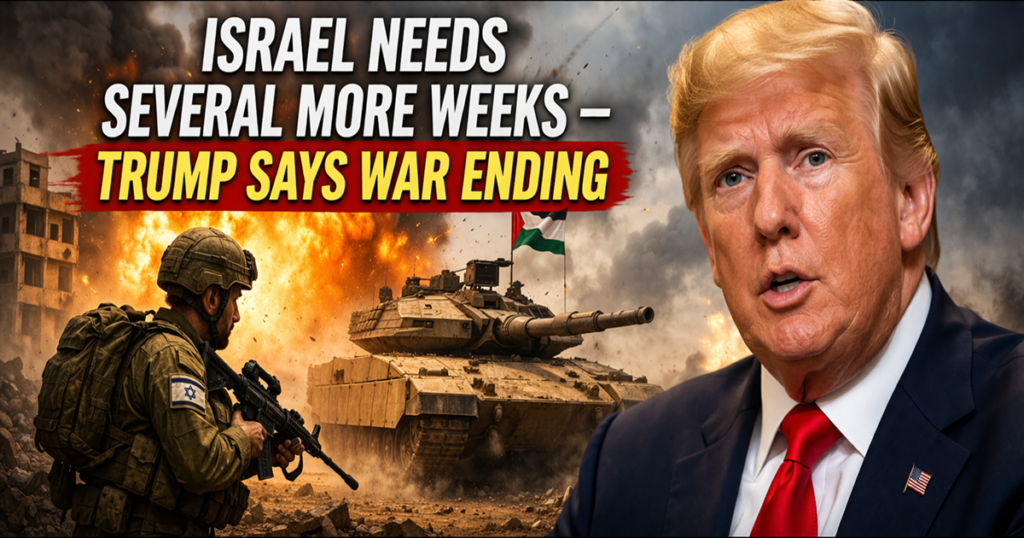
Two things happened on March 24 at the same time. Trump announced the US is negotiating an end to the Iran war. And Israel told Washington it needs several more weeks of fighting. Both statements are true. Both are official. And they directly contradict each other.
This is week four of Operation Epic Fury. The war between the US, Israel, and Iran has killed thousands. It has driven oil above $100 per barrel. It has closed the Strait of Hormuz. Moreover, it has exposed a fundamental tension in the alliance: Trump wants out. Israel is not done. Furthermore, Iran says it will talk — but only on its own terms. As a result, the world watches a war that all three sides publicly claim to want to end — while none of them actually stops fighting.
What Trump Said: “We Are Getting Very Close”
Trump posted on Truth Social on March 21: “We are getting very close to meeting objectives.” He followed up on March 24 with a stronger signal. He confirmed that Vice President JD Vance and Secretary of State Marco Rubio are leading diplomatic negotiations with Iran.
Trump told reporters the war was approaching its end. He said US military objectives were “substantially complete.” Moreover, he expressed frustration that Israel wanted to continue operations beyond the US timeline. Furthermore, White House sources told multiple outlets that Trump sees a deal as achievable within days. As a result, the president publicly positioned himself as the man ready to declare victory and go home.
What Israel Said: “We Need Several More Weeks”
Israel’s position is different. Senior Israeli military officials told the government that completing their war objectives requires several more weeks. Israel’s primary goal is the permanent destruction of Iran’s missile production capacity.
Israeli military estimates suggest significant missile infrastructure remains intact. Moreover, Israel wants to strike additional IRGC command and control facilities. Furthermore, Israeli officials privately told Washington they believe stopping now locks in an incomplete result. As a result, Israel and the US entered the fourth week of the war with publicly diverging timelines and privately growing tension.
What Iran Said: “We Will Listen”
An Iranian source told CNN that Tehran is willing to listen to “sustainable” proposals. This is careful diplomatic language. It signals openness without commitment.
Iran has not formally agreed to any talks. Moreover, new Supreme Leader Mojtaba Khamenei’s first statement called for vengeance and continued resistance. Furthermore, Iran continues Hormuz closure and proxy attacks on US bases. As a result, Iran sends two signals simultaneously — one through back channels suggesting talks, and one through military action suggesting the fight continues.
For a full profile of Iran’s new leadership and what Mojtaba Khamenei’s rise means for these negotiations, read: Mojtaba Khamenei: Iran’s New Supreme Leader.
The Oil Market Reaction: Brent Drops Below $100
Markets react to words as much as actions. When peace talk reports spread on March 24, Brent crude dropped almost 5%. It fell below $100 per barrel for the first time since the war began.
This is significant. Oil above $100 has been the war’s most damaging economic consequence. Moreover, the drop signals that markets believe a deal is possible. Furthermore, if the Hormuz strait reopens, analysts forecast Brent could fall rapidly toward $70-80. As a result, the peace talk reports alone — before any deal exists — provided temporary economic relief to millions of consumers worldwide.
The Core Contradiction: A Three-Way Disconnect
| Party | Public Position | Private Reality | What They Actually Want |
| United States | War objectives substantially complete — ready for deal | Israel pushing back — domestic gas prices politically painful | End the war fast — declare victory before midterms |
| Israel | Need several more weeks to finish the job | Concerned US will cut a deal before Iran’s military is fully degraded | Complete destruction of Iran’s missile capacity |
| Iran | Willing to listen to sustainable proposals | Hormuz still closed — proxy attacks continue — military signal ongoing | Ceasefire without regime change — Hormuz as permanent leverage |
| Global markets | Priced in 70% chance of deal within 2 weeks | Volatility extreme — any new strike reverses gains | Hormuz reopens — oil back to $70-80 |
Week 4: What Has the War Achieved So Far?
US and Israeli Military Gains
The military campaign has caused serious damage to Iran. Iran’s Supreme Leader Ali Khamenei was killed on February 28. Multiple IRGC commanders are dead. Natanz and Fordow nuclear facilities suffered significant damage. Iran’s air defence systems are degraded across large areas.
Moreover, Iran’s navy has taken heavy losses. Long-range missile production sites have been struck repeatedly. Furthermore, IRGC command and control infrastructure faces ongoing disruption. As a result, Iran’s conventional military capacity is significantly weaker than it was four weeks ago.
Iran’s Strategic Gains
Iran has also achieved significant strategic results. Brent crude hit $119 — costing the US economy hundreds of billions in consumer spending. The Strait of Hormuz remains effectively closed. 20 million barrels per day stay off global markets.
Moreover, Iran forced the US to lift its own maximum pressure sanctions on Iranian oil — a significant reversal. Furthermore, Iran’s proxies struck US military bases across the Gulf repeatedly. As a result, Iran lost militarily but gained economically and strategically — a trade the regime may consider acceptable.
The Human Cost
The war has killed thousands of people. Iran Human Rights confirmed over 4,000 Iranian civilian deaths from airstrikes. US military casualties stand at 11 confirmed deaths — including six in the KC-135 crash in Iraq. Coalition partners lost personnel in multiple incidents.
Moreover, the Minab school strike killed 175 people — mostly children — in one of the war’s most devastating civilian incidents. Furthermore, Gulf energy infrastructure attacks created fuel shortages affecting hundreds of millions across Asia and Europe. As a result, the human cost of four weeks of war has been enormous — on both sides and far beyond the immediate conflict zone.
The Vance-Rubio Diplomatic Track: What Is On the Table
JD Vance and Marco Rubio lead the US diplomatic effort. Sources familiar with the talks describe a framework built around four elements.
| Element | US Position | Iran’s Known Position | Gap |
| Ceasefire timeline | Immediate — Trump wants it now | Willing to discuss — conditions unclear | Bridgeable if terms agree |
| Hormuz reopening | Must happen as part of deal | Iran uses it as leverage — will not give for free | Major sticking point |
| Nuclear programme | Permanent end to enrichment above 5% | Will not permanently abandon enrichment right | Large gap — core issue |
| Sanctions relief | Possible if deal is comprehensive | Wants full sanctions removal — not partial | Negotiating range exists |
| Regime change | Trump says not the goal — officially | Iran fears this is the real goal | Trust deficit is enormous |
| Reparations | Not on US agenda | Iran demands compensation for war damage | Non-starter for US |
| Israel’s role | US says Israel must stop when deal is done | Iran will not deal with Israel directly | Structural problem |
Axios confirmed that US officials describe the talks as “serious but fragile.” Moreover, one official told NPR the biggest obstacle is not the terms but the trust gap — neither side believes the other will honour an agreement. Furthermore, Iran’s demand that the US guarantee Israel stops fighting is particularly complex — Washington cannot legally bind Israel to a ceasefire. As a result, the Vance-Rubio diplomatic track faces obstacles that go beyond typical negotiation friction.
The Israel Problem: What Happens If Trump Stops and Israel Continues
The most dangerous scenario is a partial ceasefire. Trump declares the US has met its objectives and stops American operations. Iran agrees to a ceasefire with the US. But Israel keeps striking.
This scenario would place the US in an impossible position. Moreover, Iran would likely resume attacks on US targets arguing the ceasefire only covers direct US operations. Furthermore, the Hormuz closure might continue as leverage against Israeli operations. As a result, a US-only ceasefire without Israeli participation could produce worse outcomes than no ceasefire at all.
Israeli Prime Minister Benjamin Netanyahu publicly stated Israel’s goals require more time. However, Israel depends entirely on US logistics, intelligence, and munitions supply for its Iran operations. Moreover, Trump controls that supply chain. Furthermore, multiple analysts noted Trump could effectively force an Israeli pause simply by slowing resupply. As a result, the real question is not whether Israel can continue — it is whether Trump will let it.
What Comes After: The Four Possible Outcomes
| Outcome | Likelihood | Oil Price Impact | Regional Stability |
| Full ceasefire — US, Israel, Iran all stop — deal signed | Possible (25%) | Brent falls to $70-80 rapidly | Hormuz reopens — recovery begins |
| US stops — Israel continues — partial war | Possible (30%) | Oil stays above $90 — uncertainty remains | Most dangerous scenario — ceasefire collapses |
| Talks collapse — war escalates — new strikes | Possible (25%) | Oil returns to $110-120+ | Worst case — wider regional conflict risk |
| Stalemate — low-level conflict continues — no deal, no escalation | Likely if talks stall (20%) | Oil stabilises $90-100 | Hormuz partially reopens under pressure |
Conclusion
Week four of the Iran war produced the clearest signal yet that the conflict may be approaching an end. Trump wants a deal. Vance and Rubio are negotiating one. Iran says it will listen. Oil fell below $100 on the news alone.
But the contradictions are real. Israel needs more time. Iran keeps the Hormuz closed. Mojtaba Khamenei calls for vengeance. The gap between diplomatic signals and military reality remains wide. Moreover, every previous week of this war produced confident predictions of an imminent end that did not materialise. Furthermore, the trust deficit between Washington and Tehran — built over decades of mutual hostility — cannot be closed in a single back-channel conversation.
As a result, the most honest assessment of week four is this: a deal is now more possible than at any point since the war began. It is also not yet certain. And the distance between possible and certain is where wars either end or escalate.
Frequently Asked Questions (FAQs)
Q1: Who is leading the US peace negotiations with Iran?
Vice President JD Vance and Secretary of State Marco Rubio lead the US diplomatic effort. Trump confirmed their roles publicly on March 24. Moreover, back-channel communications through Omani and Qatari intermediaries — traditional mediators between Washington and Tehran — are also active. Furthermore, an Iranian source told CNN that Tehran considers the US proposals “worth listening to.” As a result, the diplomatic track is real and senior — not simply a talking point.
Q2: Why does Israel want to continue fighting while the US negotiates?
Israel’s military assessment says Iran’s missile production capacity is not yet fully destroyed. Israeli forces want to strike additional IRGC command facilities and missile manufacturing sites. Moreover, Israel fears a ceasefire before these objectives are met locks in a situation where Iran rebuilds its military capacity within months. Furthermore, Israel has historical experience of ceasefires that left adversaries stronger — and it does not want to repeat that outcome. As a result, Israel’s position reflects genuine strategic concern, not mere aggression.
Q3: Why did oil drop below $100 on March 24?
Markets reacted to peace talk reports by pricing in a higher probability of a ceasefire and Hormuz reopening. Brent crude dropped almost 5% — falling below $100 for the first time since the war began. Moreover, every analyst agrees that a genuine ceasefire and Hormuz reopening would send oil sharply lower — potentially to $70-80 per barrel. Furthermore, the drop itself signals market confidence that talks are serious rather than performative. As a result, the oil price reaction is simultaneously good economic news and a measure of how fragile confidence remains — any new strike could reverse it immediately.
Q4: What does Iran actually want from negotiations?
Iran’s known demands include a full ceasefire, sanctions removal, compensation for war damage, and guarantees that the US will not seek regime change. Moreover, Iran insists on keeping some uranium enrichment capacity — making the nuclear question the hardest issue to resolve. Furthermore, Iran will not negotiate directly with Israel — meaning any deal requires the US to manage Israeli compliance separately. As a result, Iran’s negotiating position contains several elements the US cannot easily deliver.
Q5: What happens if talks collapse and the war continues?
If talks collapse, the most likely consequence is continued strikes and oil prices returning above $110 per barrel. Moreover, Iran could escalate proxy attacks on US bases across the Gulf. Furthermore, Israel would continue Iran operations regardless of US diplomatic status. As a result, a negotiation collapse does not simply return the war to its previous state — it signals to Iran that no deal is possible and removes the incentive for any future restraint. Markets, consumers, and the broader global economy would bear the cost immediately.