
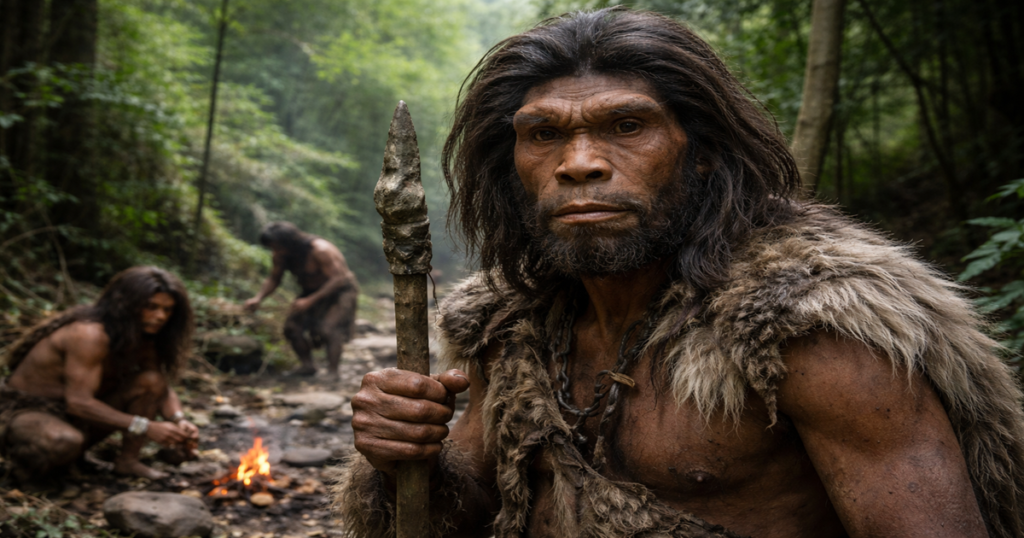
For most of the twentieth century, human evolution was taught as a tidy story — a single ancestral line stretching from ape-like ancestors in Africa to modern Homo sapiens. That story has been unravelling for decades. Ancient DNA from a Siberian cave revealed the Denisovans in 2010. The “Dragon Man” skull from Harbin introduced Homo longi in 2021. And now, in 2026, a team of researchers from the Chinese Academy of Sciences and the University of Hawaii has proposed yet another new branch on the human family tree — one that lived in eastern Asia between 300,000 and 50,000 years ago and has been named Homo juluensis.
Moreover, this discovery is not entirely new in the sense of fresh bones pulled from freshly excavated soil. The fossils that led to it have existed in storage for decades — first uncovered in northern China in the late 1970s. Furthermore, for nearly fifty years, scientists struggled to classify them. They matched no known species. They were too advanced for Homo erectus but too different from Neanderthals or modern humans. As a result, they were filed under vague catch-all labels like “archaic Homo sapiens” — a scientific placeholder that means, in essence, “we do not know what this is.” Now, finally, researchers believe they do.
What Does Homo juluensis Mean — and Where Was It Found?
The name Homo juluensis comes directly from Chinese. “Ju lu” translates to “big head” or “huge head” in Mandarin — a name chosen because the most striking physical characteristic of these ancient humans was the remarkable size of their skulls. Moreover, the primary fossil site associated with the species is Xujiayao, located on the border of Shanxi and Hebei provinces in northern China. Furthermore, related fossils have also been identified at Xuchang County in Henan province and at Harbin in Heilongjiang province — suggesting that Homo juluensis was not confined to a single location but ranged across a significant portion of eastern Asia. As a result, this species may have been far more widespread than its current evidence base suggests.
The Fossils: A 50-Year-Old Mystery Finally Solved
The Xujiayao Site — 16 Individuals, Thousands of Artefacts
The core Homo juluensis fossils were unearthed at Xujiayao in the late 1970s. The dig produced remains from at least 16 individuals — skull fragments, teeth, jawbones, and other skeletal material — alongside thousands of stone tools and animal bones. Moreover, the animal bones told a vivid story: researchers found evidence that these ancient humans hunted wild horses in coordinated group hunts. Furthermore, they used every part of the animal — eating the meat and marrow, extracting cartilage for food, and using the hides to make clothing that protected them against brutal northern Chinese winters. As a result, even before their taxonomic identity was settled, the Xujiayao fossils revealed a population of surprisingly capable, organised, and adaptive humans.
Why Did Classification Take 50 Years?
The delay between discovery and species identification reveals something important about the complexity of paleoanthropology. The Xujiayao fossils defied easy placement. Christopher Bae, professor of anthropology at the University of Hawaii at Manoa and one of the study’s lead researchers, explained to CNN that the fossils’ features seemed to belong simultaneously to several different ancient groups — making classification impossible without the kind of comprehensive digital reconstruction and cross-site comparison that recent technology now permits. Moreover, the fossils were not the only problematic remains in China. Similar hard-to-classify skulls had appeared at Xuchang County between 2007 and 2014 — featuring brain capacities of up to 1,800 cubic centimetres — and the Harbin skull, which had spent roughly ninety years hidden at the bottom of a well before resurfacing. Furthermore, it was only when Bae and his colleague Wu Xiujie of the Institute of Vertebrate Paleontology and Paleoanthropology in Beijing conducted a comprehensive digital reconstruction of the Xujiayao cranium and compared it across all these sites that the pattern became clear. As a result, what had seemed like scattered unrelated anomalies across decades of Chinese paleoanthropology resolved into a single, coherent, previously unrecognised species.
The Physical Features: What Made Homo juluensis Distinct
Homo juluensis had a set of physical characteristics that set it apart from every known human relative. Understanding those features is key to understanding why the classification is both compelling and controversial.
| Physical Feature | Homo juluensis | Modern Humans (Homo sapiens) | Neanderthals |
| Brain volume (cranial capacity) | ~1,700 cc (up to 1,800 cc) | ~1,350 cc average | ~1,450 cc average |
| Skull shape | Large, low, wide — distinct from all known species | Tall, globe-shaped | Long, low — occipital bun at rear |
| Cranial bone thickness | Thick — more archaic trait | Thinner | Moderate |
| Teeth size and pattern | Large teeth — pattern resembles Denisovan teeth | Smaller, more refined | Larger than modern human |
| Chin | Absent — like archaic hominins | Present — defining Homo sapiens feature | Absent |
| Facial features | Wide, prominent facial structure | Flatter, more reduced | Protruding mid-face and nose |
| Body size | Unknown — insufficient postcranial fossils | Variable globally | Stocky, cold-adapted build |
The brain volume figure deserves particular attention. Homo juluensis appears to have had a brain capacity roughly 25-30% larger than modern humans. Moreover, scientists are careful to note that brain size alone does not mean greater intelligence — the organisation and structure of the brain matters at least as much as overall volume. Furthermore, the skulls’ large, low, and wide shape was, as CNN reported, “completely distinct from the skulls of other known hominin species such as Neanderthals or Homo erectus, and different from the globe-shaped skulls of Homo sapiens.” As a result, the physical profile of Homo juluensis does not closely resemble any previously described ancient human — which is precisely why researchers concluded they were looking at something genuinely new.
The Denisovan Connection: The Most Controversial Claim
The most explosive aspect of the Homo juluensis proposal is not the species itself — it is the suggestion that Homo juluensis and the Denisovans may be the same population. This claim, if confirmed, would resolve one of the longest-standing mysteries in paleoanthropology.
The Denisovans are perhaps the strangest chapter in the human story. Scientists identified them in 2010 entirely through ancient DNA extracted from a tiny finger bone found in Denisova Cave in Siberia. Genetic analysis revealed they were a previously unknown group closely related to both Neanderthals and modern humans. Moreover, Denisovan DNA exists today in the genomes of living people — particularly populations across Asia and the Pacific islands. Papua New Guineans and Aboriginal Australians carry the highest known proportions of Denisovan ancestry. Furthermore, traces of Denisovan DNA have been found to provide certain living populations with beneficial adaptations — including a gene variant that helps Tibetans survive at high altitude. As a result, the Denisovans were not a marginal footnote but a significant contributor to the modern human gene pool.
Yet despite their genetic significance, almost no one knows what Denisovans looked like. The total Denisovan fossil record consists of a few fragments — a finger bone, several teeth, a partial jawbone found on the Tibetan plateau, and a handful of other fragments. None of these are considered distinctive enough for a formal species classification under traditional paleoanthropological rules. Moreover, Bae and Wu Xiujie examined the teeth from the Xujiayao site — and found that their patterns closely resembled the Denisovan teeth and jaw fragments that had previously been identified. Furthermore, the researchers made a bold proposal: rather than referring to this ancient population as Denisovans — a name derived from a Siberian cave — they should be recognised as Homo juluensis, with the full taxonomic dignity of a formally named species. As a result, this is also a geopolitical and scientific argument about who gets to name the deep past.
The Decolonisation Argument: Science and Politics Collide
The Homo juluensis proposal carries an explicit intellectual agenda that its authors do not shy away from. Lead researchers Bae and Wu Xiujie stated directly that their work contributes to the “decolonisation” of paleoanthropology — the argument that Asia must assume its rightful place in the story of human evolution.
Moreover, Interesting Engineering reported that Chinese researchers told the South China Morning Post that “Denisovan” refers to a general population rather than a specific species — and that Western scientists’ insistence on naming Chinese fossils after a Siberian cave reflects a historical pattern of centring European and Siberian discoveries while marginalising Asian ones. Furthermore, this argument has merit in a broader context: for most of the twentieth century, the dominant narrative of human evolution was Africa-centric, occasionally acknowledging European Neanderthals but largely treating Asian fossils as peripheral. As a result, the Homo juluensis proposal is simultaneously a scientific classification and a statement about whose fossils get taken seriously.
How Does Homo juluensis Fit Into the Human Family Tree?
If Homo juluensis is confirmed as a distinct species, it would add a new branch to an already densely populated human family tree during the Late Quaternary period — roughly 300,000 to 50,000 years ago. This was a remarkably crowded time in human evolution.
| Species | Time Period | Region | Status |
| Homo sapiens | 300,000 years ago — present | Africa, then global | Living — us |
| Homo neanderthalensis | 400,000 — 40,000 years ago | Europe and western Asia | Extinct — interbred with Homo sapiens |
| Denisovans / Homo juluensis (proposed) | 300,000 — 50,000 years ago | Eastern Asia, Siberia | Extinct — interbred with Homo sapiens |
| Homo longi (Dragon Man) | 146,000+ years ago | Harbin, northern China | Extinct — possible Denisovan link |
| Homo erectus | 1.9M — 250,000 years ago | Africa to Southeast Asia | Extinct — ancestor to multiple lineages |
| Homo luzonensis | 67,000 — 50,000 years ago | Luzon, Philippines | Extinct |
| Homo floresiensis | 100,000 — 50,000 years ago | Flores, Indonesia | Extinct |
| Xuchang hominin | 125,000 — 105,000 years ago | Central China | Possibly Homo juluensis |
Chris Stringer of the Natural History Museum in London — one of the world’s leading authorities on human evolution — previously described this period as producing multiple “experiments in how to be human.” Moreover, the Archaeology Magazine reported Stringer saying that with the Harbin skull, “you’ve got all these different experiments in how to be human, and Harbin adds one more.” Furthermore, Homo juluensis — if accepted — adds yet another experiment to that list, reinforcing the picture of a Late Quaternary Asia teeming with diverse hominin populations living, hunting, and possibly interacting simultaneously. As a result, the human family tree now looks less like a tree and more like a tangled thicket.
How Did Homo juluensis Live? Hunting, Survival, and Social Structure
The artefacts found alongside the Xujiayao fossils allow researchers to reconstruct a picture of daily life for Homo juluensis — and it is a picture of resourceful, organised survival in a demanding environment.
Cooperative Horse Hunters
The thousands of animal bones found at Xujiayao were dominated by wild horse remains. Moreover, the pattern of butchery marks on the bones — combined with stone tools found at the same level — indicates that Homo juluensis hunted horses cooperatively in organised group hunts. Furthermore, they used every part of the animal: meat was eaten, marrow was extracted from bones, cartilage was consumed, and hides were processed into clothing. As a result, these were not scavengers picking over carcasses — they were active, coordinated hunters who maximised every caloric and material resource their prey provided.
Cold-Weather Adaptation
Northern China between 300,000 and 50,000 years ago was significantly colder than it is today — subject to brutal winters, glacial episodes, and the resource scarcity that comes with extreme seasonal variation. Moreover, the use of animal hides for clothing suggests that Homo juluensis had developed the cognitive and technical capacity to manufacture insulating garments. Furthermore, the use of stone tools to process hides and bones indicates a technology sufficient for sustained cold-weather living. As a result, Homo juluensis was not a tropical species that wandered north — it was adapted to survive in one of Asia’s most challenging environments.
Small, Isolated Groups — and a Vulnerability
Researchers believe Homo juluensis lived in small, relatively isolated social groups. Moreover, this social structure may explain their eventual disappearance. Small group size limits genetic diversity. Isolation limits the ability to respond collectively to sudden environmental change. Furthermore, researchers believe they likely disappeared around 50,000 to 120,000 years ago — precisely the period when Homo sapiens began expanding out of Africa and into Asia in larger, more adaptable groups. As a result, Homo juluensis may have succumbed to a combination of competition, climate stress, and the numerical disadvantage of small isolated populations facing a more numerous and flexible incoming species.
The Scientific Debate: Is Homo juluensis Really a New Species?
Not all researchers are convinced. The Homo juluensis proposal has generated significant debate within the paleoanthropological community — and the objections are substantive.
The Lack of Genetic Evidence
The most significant challenge to the Homo juluensis classification is the absence of ancient DNA. Denisovans were identified and defined entirely through genetics. Moreover, all subsequent Denisovan identifications have been confirmed by matching DNA patterns. Furthermore, none of the Xujiayao, Xuchang, or related fossils have yet yielded usable ancient DNA — the geological conditions in northern China are generally unfavourable for DNA preservation over such timescales. As a result, the identification rests entirely on morphology — physical characteristics — without the genetic confirmation that now forms a central pillar of species classification in paleoanthropology.
Could These Simply Be Denisovans?
Critics such as Eleanor McRae told CNN that the dearth of genetic evidence was a significant objection. Moreover, if these fossils are Denisovans — as some of the dental evidence suggests — then naming them Homo juluensis creates a competing taxonomy that may generate more confusion than clarity. Furthermore, the scientific community has not yet reached consensus on whether the Denisovans should receive a formal species name at all — given that their entire original identification came from DNA, not bones. As a result, Homo juluensis sits in a contested space: proposed, debated, and awaiting the ancient DNA that would settle the question definitively.
Could They Belong to an Existing Species?
Some researchers have suggested that the Xujiayao and related fossils could represent a regional variant of Homo heidelbergensis — an archaic human species known from Africa and Europe during a similar time period. Moreover, human populations across vast geographic ranges often display significant morphological variation without constituting separate species. Furthermore, the large skull size, while striking, falls within the range of variation seen across known archaic humans. As a result, while the Homo juluensis proposal is compelling, it requires peer replication, further fossil discovery, and — ideally — ancient protein or DNA analysis before the broader scientific community is likely to accept it as settled.
What the Yunxian Discovery Adds
Alongside the Homo juluensis announcement, a separate but related discovery published in Science Advances has added further depth to the story of human evolution in China. A new dating of two Homo erectus skulls found at the Yunxian site in central China — published by researchers including Granger and Bae in 2026 — places the fossils at approximately 1.77 million years ago. Moreover, Live Science reported this as “the oldest in situ Homo erectus crania in eastern Asia” — pushing back the confirmed date of ancient human presence in China by a significant margin. Furthermore, Chris Stringer suggested that if the new dates are correct, they may require experts to reconsider the origin of the ancestor to Homo sapiens. As a result, China is not merely producing evidence of a new species from 200,000 years ago — it is simultaneously pushing the earliest known human presence in East Asia back nearly two million years.
Conclusion
The discovery — or more precisely, the formal recognition — of Homo juluensis is a landmark moment in paleoanthropology. It resolves five decades of taxonomic confusion about a set of fossils that scientists have possessed since the 1970s. It proposes a bold identification with the enigmatic Denisovans. And it makes an explicit argument that Asia’s deep human history deserves the same rigorous attention that Africa and Europe have long received. Moreover, the picture that Homo juluensis adds to is one of extraordinary diversity: a Late Quaternary world in which at least four or five distinct human species shared the same planet simultaneously, sometimes meeting, sometimes mating, and sometimes competing.
Furthermore, the story of Homo juluensis is not yet complete. Ancient DNA would confirm or complicate the Denisovan connection. More fossil sites across eastern Asia could expand the geographic range. Protein analysis from the bones could provide genetic signal where full DNA has not survived. As a result, the “big-headed people” of northern China are not merely a new entry in a scientific catalogue — they are an open question about who we are, where we came from, and just how many different experiments in humanity once walked this earth before only one remained.
Frequently Asked Questions (FAQs)
Q1: What is Homo juluensis and where was it discovered?
Homo juluensis is a proposed new species of ancient human identified by researchers from the Chinese Academy of Sciences and the University of Hawaii. The name means “big head” in Chinese, referring to the unusually large skull size of the fossils. Moreover, the primary fossils were found at the Xujiayao site in northern China in the late 1970s, with related fossils identified at Xuchang County and Harbin. Furthermore, these individuals are believed to have lived between 300,000 and 50,000 years ago. As a result, if confirmed, Homo juluensis would represent a distinct branch of the human family tree that existed in eastern Asia simultaneously with Neanderthals and early modern humans.
Q2: How is Homo juluensis different from modern humans?
Homo juluensis had several striking physical differences from modern Homo sapiens. Most notably, their brain volume was approximately 1,700 cubic centimetres — roughly 25-30% larger than the modern human average of 1,350 cubic centimetres. Moreover, their skulls were large, low, and wide — distinctly different from the tall, globe-shaped skulls of modern humans. Furthermore, they lacked a chin, had thicker cranial bones, and had notably large teeth with patterns resembling Denisovan dental fossils. As a result, the physical profile of Homo juluensis does not closely match any previously known human species.
Q3: Are Homo juluensis and the Denisovans the same species?
This is the central controversy of the discovery. The lead researchers — Christopher Bae and Wu Xiujie — propose that Homo juluensis and the Denisovans are the same population. The dental patterns of Xujiayao fossils closely match known Denisovan teeth and jaw fragments. Moreover, the researchers argue that the fossils deserve a formal species name — Homo juluensis — rather than being called Denisovans after a Siberian cave. However, no ancient DNA has been recovered from the Chinese fossils. Furthermore, other researchers argue that without genetic confirmation, the Denisovan connection remains unproven. As a result, the proposal is compelling but scientifically contested.
Q4: What happened to Homo juluensis — why did they go extinct?
Researchers believe Homo juluensis disappeared approximately 50,000 to 120,000 years ago. The most likely explanation involves a combination of factors. They lived in small, isolated social groups — limiting genetic diversity and collective resilience. Moreover, this was precisely the period when anatomically modern Homo sapiens began expanding out of Africa and into Asia in larger, more numerous and adaptable populations. Furthermore, climate fluctuations during the Late Quaternary placed additional pressure on small isolated groups with limited ability to relocate or adapt quickly. As a result, Homo juluensis likely succumbed to a combination of competition with incoming modern humans and the structural vulnerability of small, isolated populations.
Q5: Does the discovery of Homo juluensis change what we know about human evolution?
Significantly, yes. The discovery reinforces the emerging picture of human evolution as a complex, branching web rather than a straight line. Moreover, it confirms that eastern Asia during the Late Quaternary was home to multiple distinct human species living simultaneously — not a marginal outpost of a story centred elsewhere. Furthermore, if the Denisovan connection is confirmed through future DNA analysis, it would resolve one of the most significant remaining mysteries in human evolution — finally revealing what the Denisovans, whose genetic legacy survives in millions of living people today, actually looked like. As a result, Homo juluensis is not merely a new species name — it is a key to understanding a missing chapter in the human story.