On March 19, Brent crude surged to $116.2 per barrel — up 8% in a single day. That is the highest oil price since 2022. Moreover, it marks a 50% rise since the US-Israel war on Iran began on February 28. The trigger was a wave of Iranian missile and drone strikes on energy infrastructure across Kuwait, Qatar, the UAE, and Saudi Arabia overnight. Furthermore, QatarEnergy confirmed a ballistic missile hit its Ras Laffan facility — the world’s largest LNG export hub — causing “extensive damage.” As a result, global energy markets now face their most severe supply disruption since the 1973 oil crisis.
This article explains exactly what happened, which facilities were struck, what the price surge means for consumers, and what comes next — including Qatar’s warning that oil could hit $150 per barrel within weeks.
What Happened Overnight: The Full Attack Sequence
The March 18-19 attacks represent the most significant escalation of the energy war since the conflict began. Both sides struck each other’s energy infrastructure simultaneously.
| Date / Time | Attack | Target | Attacker | Status |
| March 18 — afternoon | Ballistic missile strike | South Pars gas field, Iran — world’s largest gas reserve | Israel | Extensive damage confirmed — US said it was not informed in advance |
| March 18 — afternoon | Strike on Asaluyeh port | Iran’s onshore processing centre for South Pars — refineries and export terminals | Israel | Processing and export disrupted |
| March 18 — evening | Drone attack | Kuwait’s Mina Al-Ahmadi refinery — 730,000 bpd capacity | Iran / IRGC proxies | Fire broke out — no injuries — production disrupted |
| March 18 — evening | Drone attack | Kuwait’s Mina Abdullah refinery | Iran / IRGC proxies | Fire set — facility offline |
| March 18 — night | Ballistic missile strike | Qatar’s Ras Laffan Industrial City — world’s largest LNG export hub | Iran | Extensive damage — fire extinguished — production halted |
| March 18 — night | Attack on UAE facilities | Habshan gas plant and Bab oil field, Abu Dhabi | Iran | Both facilities shut — no injuries reported |
| March 18 — night | Ship attack | Vessel off UAE coast | Iran / IRGC | Ship burned — waters increasingly dangerous |
| March 19 — morning | Force majeure declared | QatarEnergy, Kuwait Petroleum Corp, Bapco (Bahrain) | N/A — corporate response | Production halted — contracts suspended |
| March 19 — morning | Saudi Aramco response | Saudi refineries shut as precaution | N/A — precautionary | ADNOC (UAE) also shut refineries |
The Price Surge: Every Market in the Red
| Market / Commodity | Price Before War (Feb 26) | Price Today (March 19) | Change |
| Brent Crude (global benchmark) | $65-70/barrel | $116.2/barrel (intraday high) | Up ~70% |
| WTI Crude (US benchmark) | ~$62/barrel | $97.65/barrel | Up ~58% |
| European Natural Gas (TTF) | ~EUR30/MWh | EUR66-68/MWh | Up ~120% |
| US Natural Gas | Baseline | Up 5-8% | Significant rise |
| Petrol / Gasoline (US pump) | ~$3.10/gallon | ~$4.20-4.50/gallon | Up ~79 cents |
| LNG Tanker Freight Rates | Baseline | Up 40%+ | Massive premium for available cargoes |
| Brent — Intraday Peak (March 9) | — | Nearly $120/barrel | Short-term spike during peak fear |
The price of Brent crude is now up close to 50% since the start of the war. Moreover, Qatar warned oil could soar to $150 a barrel within weeks as the Strait of Hormuz remains de facto closed. Furthermore, the IEA decided to release 400 million barrels from emergency reserves — but at 105 million barrels per day of global consumption, that covers just four days of supply. As a result, emergency measures can soften short-term panic but cannot solve the fundamental supply problem.
Qatar: The World’s LNG Capital Under Attack
What Is Ras Laffan and Why Does It Matter?
Ras Laffan Industrial City sits on Qatar’s northeastern coast. It houses QatarEnergy’s LNG production and export operations. It is the world’s single largest LNG export facility. Qatar produces roughly 20% of all global LNG from this one complex.
Moreover, Qatar already halted LNG production earlier in the conflict after initial Iranian strikes. The March 18 ballistic missile strike caused what QatarEnergy described as “extensive damage” — with a fire that burned before crews extinguished it. Furthermore, with Ras Laffan offline, the 20% of global LNG it produces disappears from world markets. As a result, countries across Asia and Europe that depend on Qatari LNG — including Japan, South Korea, Pakistan, India, and Germany — now face acute supply gaps.
Trump’s Warning on Qatar and South Pars
Trump responded to Iran’s strike on Qatar with an unusually specific threat. He posted on Truth Social: “No more attacks will be made by Israel pertaining to this extremely important and valuable South Pars Field unless Iran unwisely decides to attack a very innocent, in this case, Qatar — in which instance the United States of America, with or without the help or consent of Israel, will massively blow up the entirety of the South Pars gasfield.”
Moreover, this threat is significant because South Pars is Iran’s most important energy asset. Destroying it entirely would cripple Iran’s gas exports and its domestic energy supply. Furthermore, Iran shares the South Pars field with Qatar — they sit on opposite sides of the same geological structure. As a result, Trump’s threat puts Iran on notice that further Qatar strikes carry an existential economic cost.
Kuwait: Two Refineries Burning Simultaneously
Mina Al-Ahmadi and Mina Abdullah
Kuwait operates two of the Middle East’s largest refineries side by side on its southern coast. Mina Al-Ahmadi processes 730,000 barrels per day. Mina Abdullah adds further capacity. Together they handle the bulk of Kuwait’s oil export processing.
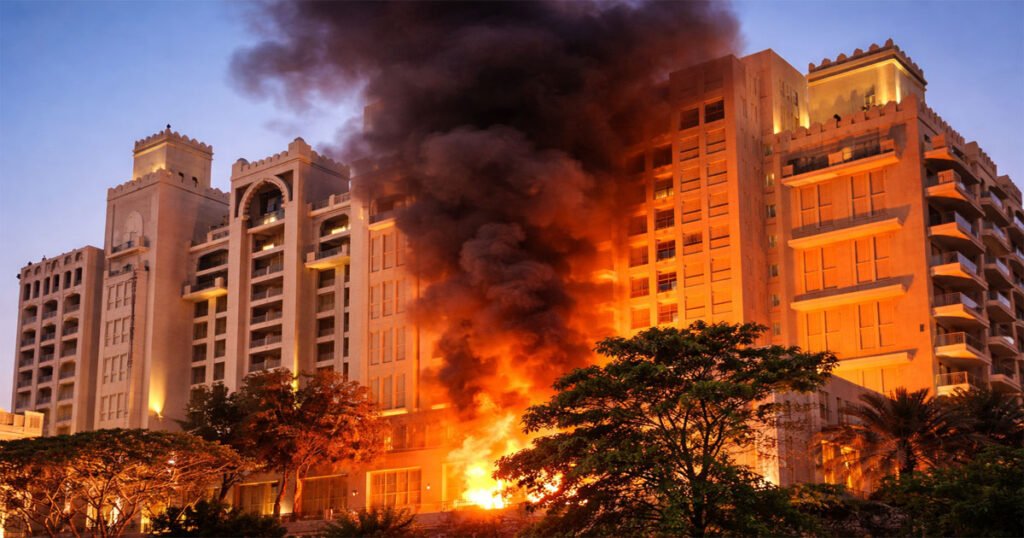
Iranian drone strikes set both facilities on fire overnight on March 18. Kuwait’s state-run KUNA news agency confirmed the attacks. No injuries were reported — but production at both facilities stopped. Moreover, Kuwait Petroleum Corporation declared force majeure — a legal declaration that it cannot fulfil export contracts due to circumstances beyond its control. Furthermore, Kuwait had already cut production earlier in the conflict as Strait of Hormuz closure prevented exports from leaving. As a result, Kuwait’s oil output — already constrained — took a second direct blow.
UAE and Saudi Arabia: Precautionary Shutdowns
Abu Dhabi announced that Iranian attacks targeted its Habshan gas plant and Bab oil field overnight. Both facilities shut down. No injuries were reported. Moreover, ADNOC — the Abu Dhabi National Oil Company — shut its refineries as a precautionary measure alongside Saudi Aramco. Furthermore, Iran had previously expanded its target list to include energy infrastructure in Saudi Arabia’s Eastern Province — home to the bulk of Saudi oil production. As a result, the world’s largest oil producer now operates its facilities under active threat of attack.
The Strait of Hormuz: Still Effectively Closed
The Strait of Hormuz remains the core problem. Iran insists the waterway is open — just not to the US or its allies. In practice, war-risk insurance withdrawal and IRGC drone threats have made commercial transit impossible for most operators.
Hundreds of tankers sit idle on both sides of the strait as Iran has effectively closed the waterway. Moreover, a top British military official told reporters that any reopening is a long way off because threats include mines, attack boats, and drones. Furthermore, Trump expressed growing frustration on social media that no allies offered to help open the strait, posting: “WE DON’T NEED THE HELP OF ANYONE!” As a result, the world’s most critical energy chokepoint remains blocked — and every attack on Gulf energy facilities compounds a supply crisis already driven by the closure.
The Emergency Response: What Governments Are Doing
| Actor | Emergency Action | Effectiveness |
| IEA (International Energy Agency) | Released 400 million barrels from member country reserves | Limited — covers only ~4 days of global consumption |
| US Strategic Petroleum Reserve | Holds 415.4 million barrels — drawdown authorised | Takes 13 days to reach US markets after release order |
| Trump administration | Eased Venezuela sanctions to boost oil supply | Limited additional supply — Venezuela capacity constrained |
| OPEC+ | No emergency meeting announced as of March 19 | Saudi and UAE facilities under threat — cannot easily increase output |
| India (Ministry of Petroleum) | Ordered refineries to increase LPG production for domestic supply | Domestic palliative only — does not address crude import gap |
| Japan | Asked government to release strategic stockpiles for refineries | Buys weeks — does not solve structural closure problem |
| Turkey | Seeking additional LNG cargoes on spot market | Competing with Asia and Europe for scarce available cargoes |
| QatarEnergy, Kuwait PC, Bapco | Declared force majeure — suspended export contracts | No supply impact — confirms supply is already stopped |
Al Jazeera’s energy analyst summarised the situation clearly: “The release may soften the shock and calm nerves temporarily, but it will remain limited as long as the fundamental problem — the freedom of supply and tanker movement through Hormuz — remains unresolved.” Moreover, the SPR release equals only 20 days of normal Hormuz flows. As a result, without Hormuz reopening, no emergency measure solves the underlying supply gap.
What This Means for Consumers
Petrol and Diesel
US petrol prices have already risen approximately 79 cents per gallon since the war began. Each additional $10 per barrel rise in Brent crude adds roughly 23 cents per gallon to US pump prices. Moreover, with Brent at $116 and Qatar warning of $150, further pump price increases are directly ahead. Furthermore, European petrol prices carry the double burden of crude oil costs and natural gas price surges — European TTF gas prices hit EUR68/MWh on March 19, the highest since 2022. As a result, transport, heating, and electricity bills face upward pressure across every major economy.
Food and Goods
Energy costs feed into every step of the supply chain. Fertiliser production uses natural gas as a primary input — higher gas prices raise food production costs. Moreover, freight costs for goods transported by sea are rising as LNG tanker and crude tanker rates surge. Furthermore, airlines face jet fuel price increases that will translate into higher ticket prices within weeks. As a result, the oil and gas price surge does not stay at the petrol station — it flows through to grocery bills, airline tickets, and the price of manufactured goods.
The $150 Scenario
Qatar’s warning of $150 per barrel is not an outlier forecast. It reflects a straightforward supply-demand calculation. The US EIA estimates world petroleum consumption at 105.17 million barrels per day in 2026. The Hormuz closure removed roughly 20 million barrels from daily circulation. Every additional attack on Gulf energy infrastructure removes more.
Moreover, major Gulf exporters are preparing force majeure declarations — the legal step that precedes complete production suspension. Furthermore, with Saudi Aramco and ADNOC shutting refineries as a precautionary measure, even the producers not yet directly struck are reducing output. As a result, if the conflict continues and Gulf energy infrastructure attacks escalate, $150 per barrel is a realistic near-term outcome.
Historical Comparisons: How Bad Is This?
| Crisis | Year | Oil Price Peak | Cause | Duration |
| 1973 Arab Oil Embargo | 1973 | ~$50/barrel (inflation-adjusted ~$350) | Arab OPEC embargo after Yom Kippur War | 6 months — embargo lifted March 1974 |
| Iranian Revolution shock | 1979-1980 | ~$40 nominal (~$150 adjusted) | Iranian revolution + Iran-Iraq War | ~2 years of elevated prices |
| Gulf War spike | 1990-1991 | ~$40 nominal | Iraq invasion of Kuwait | Resolved within 8 months |
| Russian invasion of Ukraine | 2022 | ~$130/barrel (Brent peak) | Sanctions on Russian exports, supply fear | Prices elevated for ~18 months |
| US-Iran War — current | 2026 | $116+ (intraday $120 peak) | Hormuz closure + Gulf infrastructure attacks | Ongoing — no resolution timeline |
The current surge draws direct comparisons to the 1973 oil crisis during the Yom Kippur War and the second oil shock following the Iranian Revolution — turmoil that drove crude to record levels by 1980 and contributed to high inflation, economic stagnation and recessions across advanced economies. Moreover, the current crisis is unique because it combines Hormuz closure with direct attacks on Gulf energy infrastructure simultaneously. As a result, the supply disruption is broader and harder to route around than any previous crisis.
Conclusion
The March 18-19 energy infrastructure attacks mark a dangerous new chapter in the US-Iran war. Iran struck Kuwait, Qatar, the UAE, and Saudi Arabia in a coordinated overnight campaign. Kuwait’s two largest refineries caught fire. Qatar’s Ras Laffan — the world’s largest LNG export hub — took a ballistic missile hit causing extensive damage. The UAE shut its Habshan gas plant. Saudi Aramco and ADNOC shut refineries as a precaution.
Moreover, Brent crude surged to $116.2 per barrel — up 50% since February 28 and up 70% from pre-war levels. Furthermore, Qatar warned $150 per barrel is achievable within weeks if the Hormuz closure and infrastructure attacks continue. Emergency reserve releases help calm nerves but cannot replace 20 million barrels per day of lost Hormuz throughput.
As a result, the global economy now faces what analysts compare to the 1973 oil embargo — a supply shock without a clear timeline for resolution, driven by a conflict both sides are escalating rather than winding down.
Frequently Asked Questions (FAQs)
Q1: Why did oil prices hit $116 on March 19?
Iran launched coordinated drone and missile strikes on energy infrastructure across Kuwait, Qatar, the UAE, and Saudi Arabia overnight on March 18-19. The strikes hit Kuwait’s two largest refineries, Qatar’s Ras Laffan LNG facility, and UAE gas plants. Moreover, this followed Israel’s strike on Iran’s South Pars gas field — the world’s largest. Furthermore, with force majeure declared by QatarEnergy, Kuwait Petroleum Corporation, and Bapco, markets priced in a significant additional supply reduction on top of the existing Hormuz closure. As a result, Brent rose 8% intraday to $116.2 per barrel.
Q2: What is Ras Laffan and why does it matter so much?
Ras Laffan Industrial City in Qatar houses the world’s largest LNG export complex. Qatar produces roughly 20% of all global liquefied natural gas from this single facility. Moreover, countries across Asia and Europe — including Japan, South Korea, Pakistan, India, and Germany — depend on Qatari LNG for power generation and heating. Furthermore, QatarEnergy had already halted production before the March 18 missile strike, which caused extensive additional damage. As a result, the facility’s continued outage removes one-fifth of global LNG supply from world markets.
Q3: Could oil prices reach $150 per barrel?
Qatar officially warned $150 per barrel is achievable within weeks if the current situation continues. The supply-demand arithmetic supports this. Global consumption runs at 105 million barrels per day. The Hormuz closure removed 20 million barrels from daily circulation. Moreover, attacks on Gulf energy infrastructure are now taking additional supply offline — Kuwait’s refineries, Qatar’s LNG, UAE facilities, and precautionary Saudi and UAE shutdowns. Furthermore, no emergency reserve release can cover this scale of sustained disruption. As a result, $150 per barrel is a realistic near-term scenario if the conflict escalates further.
Q4: What does this mean for petrol prices?
US petrol prices have already risen roughly 79 cents per gallon since the war began. Each $10 per barrel rise in Brent adds approximately 23 cents per gallon at the pump. Moreover, with Brent at $116 and rising, further significant pump price increases are mathematically certain in the coming days and weeks. Furthermore, European consumers face the double burden of crude oil costs and natural gas price surges — TTF gas hit EUR68/MWh on March 19, the highest since 2022. As a result, transport, heating, electricity, and food costs all face upward pressure.
Q5: Can the Strait of Hormuz reopen soon?
British Armed Forces Minister Al Carns told reporters that any reopening is a long way off. The threats include mines, attack boats, and drones — not just diplomatic disagreement. Moreover, Iran insists the strait is open only to non-US-allied vessels. Commercial insurers have withdrawn war-risk coverage, making transit economically impossible for most operators regardless of physical access. Furthermore, Trump expressed frustration on social media that no allies offered to help reopen the strait. As a result, the Hormuz closure has no clear resolution timeline — and every day it remains closed deepens the global supply crisis.