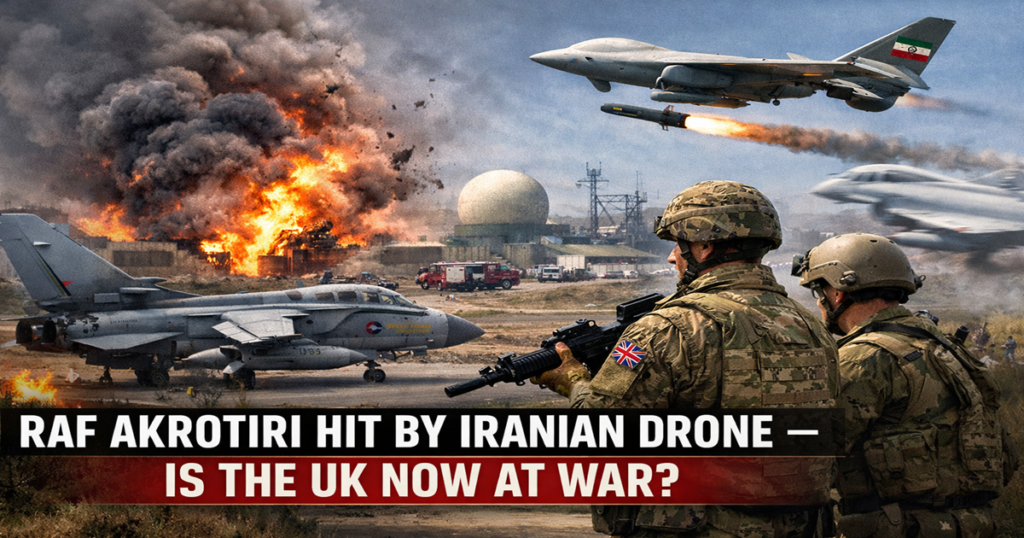
Just after midnight on March 2, a loitering munition — a Shahed-type kamikaze drone — slipped through the air defences at RAF Akrotiri in Cyprus and hit a hangar near the runway. It burst into flames. No one died. But Britain had just experienced its first attack on a sovereign military base in Cyprus since 1986. The RAF Akrotiri drone strike changed everything about the UK’s position in the Iran war.
Keir Starmer insists the UK is not at war. Middle East minister Hamish Falconer repeated it on BBC Radio Scotland. Moreover, British officials point out that the drone caused “relatively limited damage” and no casualties. But the UK now lets the US use its bases to strike Iranian targets. It deploys F-35s and Typhoons to Akrotiri. It sends Royal Navy destroyers to protect the base. Furthermore, Iran’s IRGC has explicitly warned it will “launch missiles at Cyprus with such intensity that the Americans will be forced to leave the island.” As a result, the gap between what the UK calls its position and what the UK is actually doing grows wider every day.
What Happened: The Full Timeline
| Date / Time | Event | Source |
| Feb 6, 2026 | UK deploys 6 additional F-35 Lightning II jets to Akrotiri — joining 10 Typhoons already there | Wikipedia / Euronews |
| Feb 28, 2026 | US-Israel launch Operation Epic Fury on Iran — UK initially denies use of its bases | Al Jazeera / TIME |
| Feb 28 — evening | Starmer says UK will not join the conflict — refuses US request to use Diego Garcia and Akrotiri | Euronews / GB News |
| March 1 — evening | Iran escalates attacks on Gulf states — strikes UK allies Qatar and UAE | Al Jazeera / Wikipedia |
| March 1 — 21:00 UTC | Starmer reverses — agrees to let US use UK bases for strikes on Iranian missiles ONLY — not political or economic targets | TIME / Euronews |
| March 2 — midnight local | Shahed-type drone evades radar — flies low and slow — strikes RAF Akrotiri hangar — fire breaks out | Middle East Eye / Kyiv Post |
| March 2 — hours later | Two more drones intercepted heading toward Akrotiri — Paphos airport evacuated | Wikipedia / TIME |
| March 2 — morning | UK MoD confirms attack — “force protection at highest level” — families moved off base | GB News / UK Defence Journal |
| March 3 | Greek F-16s intercept two Iranian drones in Lebanese airspace heading toward Cyprus | Wikipedia |
| March 3 | NATO Secretary General Mark Rutte says alliance will “defend every inch” of NATO territory | Wikipedia |
| March 3 | UK confirms drone was NOT launched from Iran — believed launched by pro-Iran militia in Lebanon or western Iraq | Middle East Eye / Kyiv Post |
| March 4 | Two more drones intercepted — UK sends Royal Navy Type 45 destroyer HMS Dragon to Cyprus | The Wire / Kyiv Post |
| March 18 | Ukraine offers to send drone specialists to help protect Akrotiri and Dhekelia | Wikipedia |
What the Drone Did — and What It Missed
The Shahed-type loitering munition struck a hangar at RAF Akrotiri. The hangar housed American U-2 spy planes. It burst into flames on impact. UK Foreign Secretary Yvette Cooper confirmed the first strike targeted the runway.
Cypriot President Nikos Christodoulides described the damage as “minor.” The UK MoD confirmed no equipment inside the hangar suffered damage. No military personnel died. Moreover, the drone evaded detection by flying low and slow — a deliberate counter-radar tactic that exploited gaps in Akrotiri’s air defence. Furthermore, Calibre Defence analyst Sam Cranny-Evans noted this exposed a critical vulnerability: “It is not clear what if any air defences are at RAF Akrotiri. But it is clear that Iran’s drone strike got through.” As a result, the attack caused limited physical damage but significant strategic shock.
Who Launched the Drone — and Why It Matters
The UK MoD issued a surprising clarification days after the attack. It confirmed the Shahed-type drone that struck Akrotiri was NOT launched from Iran directly.
British defence intelligence concluded the drone was launched by a pro-Iran militia — believed to be in Lebanon or western Iraq. The investigation found it impossible to establish the launch point conclusively. Moreover, this distinction matters legally and politically. A direct Iranian state attack on a British sovereign base triggers different legal thresholds than a proxy militia attack. Furthermore, the IRGC never denied involvement — and IRGC General Sardar Jabbari had explicitly warned Akrotiri was “in the frame” after the UK allowed US aircraft to land there. As a result, Iranian deniability — thin as it is — complicates British legal options for direct retaliation.
Starmer’s Impossible Position
The Initial Refusal
Starmer’s starting position was straightforward: Britain would not join the war. He denied US requests to use Diego Garcia and RAF Akrotiri. He refused to confirm whether the UK supported the US-Israeli strikes on Iran. Moreover, British Defence Secretary John Healey also refused to state whether the UK backed the operation.
The UK’s reasoning was primarily legal. Officials feared allowing US use of British bases for offensive strikes against Iran would violate international law. Furthermore, Starmer drew a clear line — Britain would not participate in the opening wave of strikes.
The Reversal
That position lasted less than 48 hours. As Iran struck Qatar, the UAE, Kuwait, and Bahrain — all British allies — Starmer reversed course on March 1. He agreed to let the US use UK bases — but imposed strict conditions.
The US could use Akrotiri and Diego Garcia to strike Iranian missiles and their launch sites. The US could NOT use British bases to strike Iranian political or economic targets. Moreover, Starmer framed the shift as “collective self-defence of longstanding friends and allies.” Furthermore, Trump publicly attacked Starmer for the delay. He told the Telegraph it “took far too long” and said he was “very disappointed” in the British prime minister. As a result, Starmer satisfied neither Washington nor his own parliamentary backbenchers — who formed an anti-war alliance with the Greens and Labour rebels.
The Diego Garcia Complication
The Chagos Islands sovereignty deal added a further dimension to Britain’s awkward position. The UK had been negotiating to hand sovereignty of Diego Garcia — home to a critical joint UK-US military base — to Mauritius.
Trump had already expressed strong opposition to the Chagos deal. The Iran war placed the base at the centre of Britain’s strategic calculations. Moreover, the Middle East Eye reported the US was likely to use Diego Garcia — not Akrotiri — for its heaviest strikes on Iranian targets. Furthermore, Yvette Cooper told reporters that despite Starmer’s announcement, the US had not actually been granted access to Akrotiri itself for offensive operations. As a result, the exact status of British base access remains deliberately ambiguous — apparently by design.
Is the UK Legally at War?
| Question | UK Government Position | Legal Reality |
| Is the UK at war with Iran? | No — “the UK is not at war” | No formal declaration of war exists — but UK allows use of bases for offensive strikes |
| Did the UK participate in initial strikes? | No — “deliberate decision not to join the first wave” | Confirmed — UK did not strike Iran on Feb 28 |
| Can US use UK bases to strike Iran? | Yes — but ONLY for missile sites and launch sites | Confirmed March 1 — limited access granted |
| Can US use UK bases to strike political targets? | No — explicitly excluded | UK-stated condition — unclear if enforceable in practice |
| Did Akrotiri suffer an attack? | Yes — “relatively limited damage” | Confirmed — hangar hit, fire, no casualties |
| Is Akrotiri covered by NATO Article 5? | Unclear — Akrotiri is a British Overseas Territory | Wikipedia notes it can invoke Article 4 or 5 — no formal NATO discussion held |
| Who launched the drone? | Pro-Iran militia — NOT Iran directly | UK MoD confirmed — origin unverified conclusively |
| Has the UK responded militarily? | No direct retaliation announced | UK sent warships, increased air defences — no offensive response |
Britain’s legal position rests on a narrow but carefully constructed distinction. Allowing a military ally to use your bases under the UN Charter’s collective self-defence provisions — Article 51 — does not automatically constitute a declaration of war. Moreover, the House of Commons Library confirmed this in its analysis of Operation Epic Fury. Furthermore, the UK never declared war on Germany before several of the most significant British military operations in recent decades — it operates under UN Security Council resolutions or Article 51 collective self-defence instead. As a result, Starmer’s “we are not at war” formulation is legally defensible — but politically fragile.
The Parliamentary Battle at Home
Inside Westminster, the RAF Akrotiri attack triggered the sharpest parliamentary confrontation of Starmer’s premiership. Greens, Labour backbenchers, and the Scottish National Party built a formal anti-war alliance.
Labour backbenchers demanded an emergency parliamentary debate on UK involvement. The Greens called for immediate withdrawal from any role in supporting the strikes. Moreover, opposition politicians pointed out the contradiction: families moved off the Akrotiri base, flights suspended across the Middle East, the Foreign Office drawing up evacuation plans for tens of thousands of Britons stranded in the Gulf — but officially “not at war.” Furthermore, the government’s position — that the drone attack inflicted “relatively limited damage” — struck many MPs as inadequate when UK military families faced evacuation. As a result, parliamentary pressure on Starmer intensified significantly in the weeks following the strike.
The Broader UK Exposure: 100,000 Britons in the Gulf
The RAF Akrotiri attack forms only one part of Britain’s exposure to the Iran war. The Foreign Office faces a more immediate human crisis: tens of thousands of British citizens stranded across the Gulf as regional airlines suspend flights.
With flights suspended across much of the Middle East, the Foreign Office drew up evacuation plans for British nationals in Qatar, the UAE, Bahrain, Kuwait, and Oman. Moreover, British tourists who booked holidays in Dubai, Abu Dhabi, and Doha found themselves unable to depart as airports suspended operations during Iranian strikes. Furthermore, UK citizens working in Gulf energy and financial sectors — many employed by British companies — faced a suddenly hostile operating environment. As a result, the human cost of the conflict for British citizens extends far beyond the military base in Cyprus.
What Happens Next: The Four Scenarios
| Scenario | Likelihood | UK Implication |
| Diplomatic ceasefire — Iran agrees conditions, Hormuz reopens | Possible but uncertain (20%) | UK steps back from base access — declares position successfully managed |
| Conflict continues at current level — no further UK base strikes | Most likely near-term (40%) | UK maintains awkward limited-access position — parliamentary pressure grows |
| Further attacks on Akrotiri or British assets — UK forced to respond | Possible (25%) | UK faces genuine Article 5 / collective self-defence decision — conflict involvement deepens |
| Full escalation — Iran targets Diego Garcia or UK mainland assets | Low but not zero (15%) | UK effectively drawn into active combat role — “not at war” formulation collapses |
NATO Secretary General Mark Rutte drew the clearest line on March 3. He said the alliance will “defend every inch” of NATO territory. Moreover, while Akrotiri and Dhekelia are British Overseas Territories rather than mainland UK, the legal basis for invoking collective defence exists. Furthermore, no formal NATO Article 5 discussion has yet occurred — but the machinery for one is in place. As a result, any further attack on British forces in Cyprus triggers a decision point that goes beyond Starmer’s careful “not at war” framing.
Conclusion
The RAF Akrotiri drone strike did not start a war between Britain and Iran. But it ended Britain’s carefully maintained neutrality. The UK now lets the US use its bases. It sends destroyers to protect its facilities. It deploys additional F-35s and Typhoons. It draws up evacuation plans for tens of thousands of its citizens. Iran’s proxies have already struck its sovereign territory once.
Moreover, Starmer faces a political reality his formulations cannot fully contain. The gap between “not at war” and “allowing offensive strikes from our bases, deploying warships, and evacuating military families” is not a gap the British public will accept indefinitely if the situation escalates. Furthermore, the IRGC has promised to strike Cyprus with enough force to drive American aircraft out. As a result, the question is not whether the UK is currently at war. The question is whether it can avoid being fully drawn in — and how long that remains possible.
Frequently Asked Questions (FAQs)
Q1: What happened at RAF Akrotiri on March 2?
A Shahed-type loitering munition struck RAF Akrotiri in Cyprus shortly after midnight on March 2. The drone evaded radar detection by flying low and slow. It hit a hangar near the runway that housed American U-2 spy planes. The hangar caught fire. No military personnel died and UK officials said no equipment inside was damaged. Moreover, two further drones heading toward the base were intercepted later the same day. Furthermore, Paphos International Airport was evacuated following the attack. As a result, the strike marked the first attack on a British military base in Cyprus since 1986.
Q2: Did Iran directly attack the UK?
The UK MoD confirmed the drone was NOT launched from Iran directly. British defence intelligence concluded it was launched by a pro-Iran militia — believed to be based in Lebanon or western Iraq. The investigation could not conclusively establish the exact launch point. Moreover, the drone used was an Iranian-manufactured Shahed-type — the same weapon Iran supplies to its proxy networks across the Middle East. Furthermore, IRGC General Sardar Jabbari had explicitly warned Akrotiri was “in the frame” before the attack. As a result, Iranian deniability exists technically — but the connection to Iran’s proxy network is clear.
Q3: Is the UK officially at war with Iran?
No — not by any formal legal definition. The UK made no declaration of war. British officials repeat that “the UK is not at war.” However, Britain now allows the US to use its bases for strikes on Iranian missile sites. It has deployed additional F-35s, Typhoons, warships, and air defence systems to the region. Moreover, Starmer reversed his initial refusal to allow US access after Iran struck British allies in the Gulf. Furthermore, parliamentary opposition has built a formal anti-war alliance challenging the government’s position. As a result, the UK occupies a legally defensible but politically difficult middle position — deeply involved without formal belligerency.
Q4: What conditions did Starmer set for US base access?
Starmer agreed on March 1 to allow US forces to use UK bases for strikes on Iranian missiles and their launch sites only. He explicitly excluded use of British bases for strikes on Iranian political or economic targets. Moreover, he framed the decision as “collective self-defence of longstanding friends and allies” under international law. Furthermore, the UK foreign secretary separately stated the US had not actually been granted access to Akrotiri itself — suggesting the primary base in question was Diego Garcia in the Indian Ocean. As a result, the exact scope of British base access remains deliberately ambiguous.
Q5: Could Britain be drawn more deeply into the war?
Yes — this is the central risk. NATO Secretary General Mark Rutte confirmed the alliance will defend every inch of NATO territory. Moreover, Akrotiri and Dhekelia as British Overseas Territories carry legal grounds for invoking NATO Article 4 consultations or Article 5 collective defence. Furthermore, the IRGC has explicitly threatened to strike Cyprus with enough force to drive US aircraft out — a direct escalatory signal. If further attacks hit British personnel or assets, the political and legal pressure for a direct British response grows sharply. As a result, Britain’s current limited-access position is sustainable only if Iran’s proxies do not strike British targets again.