
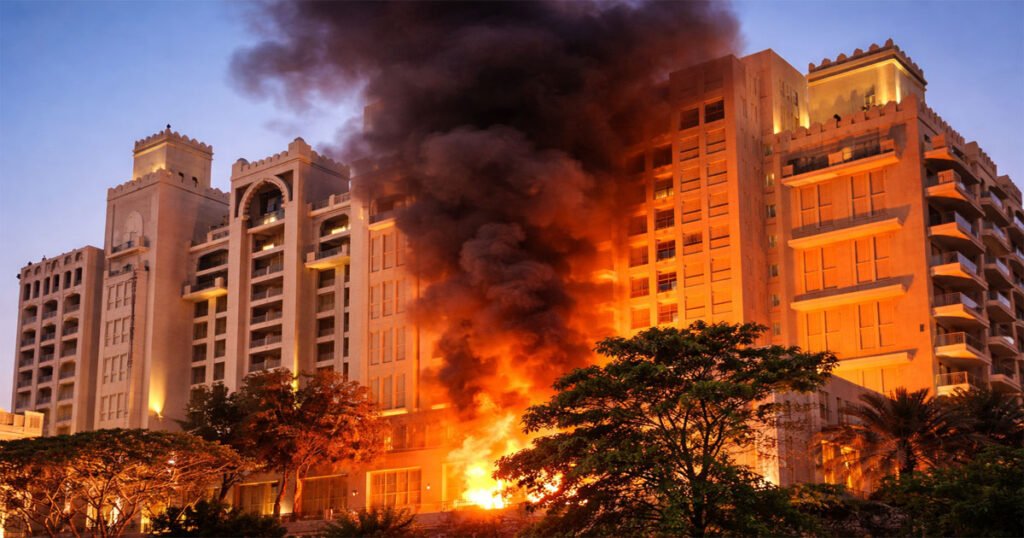
In the early hours of March 1, 2026 — less than 24 hours after the United States and Israel launched coordinated strikes against Iran — Tehran unleashed its most geographically wide-ranging military response in history. Moreover, what followed was not a single targeted counterstrike but a sustained, multi-day campaign of missile and drone attacks that swept across the entire Middle East, striking US military assets in at least nine countries and territories. Therefore, this is not simply a bilateral US-Iran confrontation. It is a regional war, and understanding exactly where US assets were struck — and what the consequences have been — is essential for anyone trying to make sense of the most dangerous crisis in the Middle East since the 2003 Iraq War.
Furthermore, Iran’s Islamic Revolutionary Guard Corps officially declared that all US assets throughout the region are considered legitimate military targets. As a result, from the headquarters of the US Navy’s 5th Fleet in Bahrain to air bases in Kuwait and Qatar to commercial ports in Oman, no corner of the Gulf has been untouched by the violence of what Iran has named Operation True Promise IV.
DISCLAIMER: This article is a factual news-based analysis compiled from verified international sources including Al Jazeera, UN News, Wikipedia, and the UK House of Commons Library. All events referenced occurred as of March 3-4, 2026. This article does not advocate for any party in this conflict.
Background: What Triggered the Strikes
The immediate trigger for this regional confrontation was the joint US-Israeli military operation launched on February 28, 2026 — codenamed Operation Epic Fury by the United States and Operation Roaring Lion by Israel. Moreover, the operation was explicitly aimed at regime change in Iran, targeting the country’s top leadership, nuclear facilities, ballistic missile infrastructure, and military command centers across five cities: Tehran, Isfahan, Qom, Karaj, and Kermanshah.
Furthermore, the most significant single outcome of those strikes was the assassination of Supreme Leader Ali Khamenei, confirmed by Iranian state media on March 1, 2026 — ending his 35-year rule. As a result, Iran was simultaneously plunged into a leadership crisis and a state of full military mobilization. Therefore, the strikes that followed were not merely retaliatory — they were also a demonstration that despite losing its supreme leader, Iran’s military apparatus remained capable and operational.
Complete Country-by-Country Breakdown of US Assets Struck
Bahrain: The US Navy’s 5th Fleet Headquarters Targeted
Bahrain was among the first and most symbolically significant targets of Iran’s retaliation. According to Al Jazeera and verified by multiple international outlets, Iranian missiles targeted the headquarters of the US Navy’s 5th Fleet in the Juffair area of Manama — one of the most important American military installations in the entire region. Moreover, Iranian drones also struck Bahrain’s international airport, causing material damage though no reported loss of life at the airport itself.
Furthermore, footage circulating on social media showed an Iranian Shahed drone striking a tower block near the 5th Fleet headquarters, setting the building ablaze. As a result, Bahrain’s Interior Ministry confirmed several residential buildings in Manama were hit, with civil defence engaged in firefighting and rescue operations. Ambassador Shaikh Abdullah bin Rashid Al Khalifa condemned the attacks as a “blatant violation of sovereignty,” while noting that Bahrain had explicitly assured Iran it would not allow its territory to be used against Tehran.
Qatar: Al Udeid Air Base — Home to US Central Command
Qatar’s Al Udeid Air Base — the largest US military installation in the Middle East and home to US Central Command’s forward headquarters — was directly struck by Iranian ballistic missiles. According to Qatar’s Ministry of Defence, two ballistic missiles hit the base while a drone targeted an early warning radar installation. Moreover, Qatari air defences, operating in coordination with regional partners, intercepted approximately 65 Iranian missiles and 12 drones over Qatari airspace before the successful strikes occurred.
Furthermore, the consequences for Qatar extended far beyond military infrastructure. QatarEnergy — the world’s largest producer of liquefied natural gas — announced a halt to production following the Iranian attacks, sending global LNG prices surging and alarming energy-dependent economies across Europe and Asia. As a result, the Qatar Civil Aviation Authority suspended all air navigation indefinitely. Qatar Airways grounded all flights. Schools shifted to remote learning, and public Ramadan gatherings were suspended entirely.
Kuwait: US Fighter Jets Downed, Air Base and Embassy Struck
Kuwait experienced some of the most alarming individual incidents of the regional conflict. According to verified reports, Iran struck the Ali al-Salem Air Base with ballistic missiles, all of which were intercepted by Kuwaiti air defence systems. However, separately, three US fighter jets crashed in Kuwait — the US military later claimed these aircraft were mistakenly shot down, in what represents a significant and deeply troubling friendly fire incident.
Moreover, a drone targeted Kuwait International Airport, injuring a number of employees and causing material damage to the passenger building. Furthermore, Kuwait’s foreign ministry officially condemned the targeting of the US Embassy by Iranian forces — marking one of the most direct attacks on American diplomatic infrastructure in the entire conflict. As a result, Kuwait is now in the extremely difficult position of being both a host of US military forces and a country that has seen its civilian infrastructure directly attacked.
United Arab Emirates: Jebel Ali Port and Dubai Explosions
The UAE, which had spent years carefully positioning itself as a neutral business hub above regional conflicts, was drawn into the war by Iranian strikes on its territory. Moreover, footage verified by AFP and broadcast internationally showed a plume of smoke rising from the port of Jebel Ali — one of the busiest and most economically significant commercial ports in the entire Middle East — following a reported Iranian attack on March 1, 2026.
Furthermore, multiple explosions were reported in Dubai, which witnesses described as caused by missile interceptions in the city’s airspace. As a result, three people were killed in UAE attacks — confirmed by the Ministry of Defence in Abu Dhabi as Pakistani, Nepalese, and Bangladeshi nationals. A Pakistani national was also separately reported killed after being struck by falling debris from an intercepted missile. Consequently, the UAE government confirmed it had intercepted a wave of missiles, and major airlines including Emirates immediately suspended operations.
Saudi Arabia: Riyadh and the Critical Eastern Province
Saudi Arabia presents one of the most politically complicated cases in the entire conflict. According to multiple reports — including from CNN and Al Jazeera — Crown Prince Mohammed bin Salman had privately encouraged the Trump administration to conduct the strikes against Iran. However, Iran targeted both the Saudi capital Riyadh and the kingdom’s Eastern Province, home to the majority of Saudi Arabia’s oil infrastructure and the King Abdulaziz Air Base.
Furthermore, the Saudi Ministry of Foreign Affairs issued an unusually strong statement confirming the attacks and noting that they occurred “despite the Iranian authorities knowing that the Kingdom had confirmed that it would not allow its airspace and territory to be used to target Iran.” Moreover, Saudi authorities stated that all attacks were repelled and reported no casualties as of the first days of the conflict. As a result, Riyadh finds itself in the deeply uncomfortable position of having quietly supported the strikes while now facing direct Iranian military retaliation on its own soil.
Iraq: Erbil and Proxy Group Strikes
Iraq is experiencing the conflict on two distinct levels simultaneously. On one level, the United States still maintains troops in Iraq’s autonomous Kurdish region as part of the international anti-ISIS coalition, and these forces were targeted by Iranian strikes. Moreover, Al Jazeera’s correspondent reported that Erbil Airport in the Kurdish region was targeted twice, though air defences successfully intercepted drone attacks on the airport itself.
Furthermore, on a second level, Iranian-aligned proxy forces operating in Iraq — particularly the Islamic Resistance in Iraq and Kataib Hezbollah — have conducted over 23 separate drone strikes against US assets in Erbil and other locations. Additionally, the US and Israel separately targeted the Jurf al-Sakher base in southern Iraq, which houses Popular Mobilisation Forces aligned with Iran, killing two fighters and wounding five. As a result, Iraq is simultaneously a battlefield and a victim of a conflict it did not initiate.
Jordan: Airspace Violations and Interceptions
Jordan has been drawn into the conflict primarily through its airspace rather than direct ground-level strikes. According to Al Jazeera Arabic, Jordanian armed forces reported intercepting 49 drones and ballistic missiles that entered Jordanian airspace over the capital Amman and the country’s northern areas. Moreover, sirens were heard across multiple Jordanian cities as the country’s air defence systems were put to an extraordinary test.
Furthermore, Jordan’s situation is particularly sensitive given that the US Air Force deployed F-15E Strike Eagle fighters to bases in Jordan as part of the military buildup preceding the Iran strikes. As a result, Jordan has found itself caught between its security alliance with the United States and the physical reality of Iranian missiles passing through its airspace.
Cyprus: RAF Base Struck — The UK Enters the Conflict
Britain’s Akrotiri and Dhekelia military base in Cyprus was struck by an Iranian drone in early March 2026 — a development that formally drew the United Kingdom into the conflict as an active participant. Moreover, according to the UK House of Commons Library research briefing published on this conflict, the RAF has been deployed in a defensive capacity following the strike on British sovereign territory.
Furthermore, European mobilization around Cyprus — prompted by Iranian threats to the island — led Iranian Foreign Minister Abbas Araghchi to issue a stark warning: any kind of military involvement, including purely defensive actions by European nations, would be considered “an act of war.” As a result, the conflict has now extended beyond the Middle East to directly involve European NATO members in ways that could trigger broader alliance obligations.
Oman: Duqm Port Struck — The Mediator Punished
Perhaps the most diplomatically significant single strike of the entire campaign was Iran’s attack on Oman. The Oman News Agency reported that the Duqm commercial port in the Al Wusta Governorate was struck by two drones, injuring an expatriate worker. Moreover, this attack is remarkable because Oman had served as the primary neutral mediator between Iran and the United States throughout the pre-conflict negotiations.
Furthermore, Oman’s Foreign Minister Badr Albusaidi had publicly expressed optimism just hours before the US-Israeli strikes began, stating that peace was “within reach” after Iran had agreed during Geneva talks never to stockpile enriched uranium. As a result, striking Oman — the one country in the Gulf that Iran had previously spared and that had been working to prevent the war — signals either a breakdown in Iran’s targeting discipline or a deliberate message that no country in the region can consider itself safe from the consequences of hosting US assets.
The Wider Impact: Airlines, Ports, Energy, and Digital Infrastructure
Beyond the direct military strikes, Iran’s campaign has caused cascading civilian and economic damage across the region that is affecting the entire world. Moreover, the scale of this collateral disruption is unprecedented in modern Middle Eastern conflicts.
| Sector | Impact | Countries/Entities Affected |
| Aviation | Dozens of airlines suspended all Middle East flights | Air India, BA, Lufthansa, Virgin Atlantic, Cathay Pacific, Qatar Airways, Kuwait Airways |
| Energy | QatarEnergy halted LNG production; oil surged 9% | Global LNG markets, oil-importing nations worldwide |
| Shipping | Strait of Hormuz closed; Jebel Ali port struck | 20% of global daily oil supply disrupted |
| Digital | Amazon AWS data centers struck — web outages reported | Global internet infrastructure affected |
| Heritage | UNESCO World Heritage Site (Golestan Palace) damaged | Iran — condemned by UNESCO as war crime |
| Education | A girls school in Minab, Iran struck — 148 children killed | Iran — condemned internationally |
| Diplomacy | US Embassy in Kuwait targeted; Oman mediator struck | US diplomatic network across region |
The Human Cost: A Conflict With No Winners
As of day four of the conflict — March 3, 2026 — the human toll is already devastating and continues to rise. According to Al Jazeera’s verified death toll tracker, more than 700 people have been killed in Iran alone, including Supreme Leader Khamenei. Furthermore, the single most shocking individual incident of the conflict was the destruction of a primary school for girls in the southern Iranian city of Minab, which killed at least 148 children — condemned by UNESCO as a grave violation of humanitarian law.
Moreover, on the US side, six American service members have been confirmed killed — two whose bodies were recovered from a regional facility struck by Iran. Furthermore, the US military’s accidental downing of three of its own F-15E Strike Eagle jets in Kuwait represents a significant and concerning operational failure in the chaos of the multi-front conflict. As a result, the US State Department issued urgent warnings for all American citizens to immediately depart Israel, the West Bank, Gaza, and several other Middle Eastern nations using any available commercial transportation.
What Happens Next: The Path to Escalation or Resolution
The conflict as of March 4, 2026 is at a critical juncture. Moreover, Washington has warned publicly that “harder hits” are still to come against Iran, while Tehran has declared through the IRGC that its operation will “continue relentlessly until the enemy is decisively defeated.” Therefore, the trajectory currently points toward further escalation rather than de-escalation.
Furthermore, several key variables will determine whether this conflict expands or contracts in the coming days. These include the fate of diplomatic efforts by Turkey, Qatar, and Oman to broker a ceasefire; whether China — deeply affected by the Strait of Hormuz closure — chooses to use its leverage with Iran to push for talks; whether Hezbollah escalates or stands down in Lebanon; and whether Trump decides that his stated objectives have been sufficiently achieved to justify pausing military operations. As a result, the next 72 to 96 hours may prove to be the most consequential period in Middle Eastern geopolitics in over two decades.
Conclusion
The striking of US assets across the Middle East by Iran in March 2026 is not a single event — it is a sustained, coordinated military campaign targeting the full architecture of American military presence in the region. Moreover, from the 5th Fleet headquarters in Bahrain to LNG terminals in Qatar, from the RAF base in Cyprus to the neutral port of Oman, no location has been entirely spared. Therefore, the scale and breadth of Iran’s response has exceeded the expectations of most military analysts and has transformed a bilateral US-Iran conflict into a genuinely regional war with global economic consequences.
Furthermore, the world now watches as mediators struggle to open a diplomatic channel, energy markets absorb the shock of Hormuz disruption, and civilian populations across ten countries deal with airspace closures, missile alerts, and the fear of further strikes. As a result, this conflict has already entered the historical record as one of the most significant military escalations of the 21st century — and its final chapter has yet to be written.
Frequently Asked Questions (FAQs)
Q1: How many US military bases has Iran struck in this conflict?
According to the IRGC’s own statements, Iran has launched strikes against 27 military bases where US troops are deployed across the Middle East. Moreover, verified reports confirm direct strikes or attempted strikes on major bases in Bahrain, Qatar, Kuwait, Saudi Arabia, Iraq, Jordan, and Cyprus. Furthermore, not all strikes successfully penetrated air defences — many were intercepted — but the scope of targeting is unprecedented.
Q2: Why did Iran strike Oman, which was trying to mediate peace?
This remains one of the most debated questions of the conflict. Oman had served as a neutral mediator and Iranian Foreign Minister Araghchi had expressed optimism about peace talks just hours before the US-Israeli strikes began. Furthermore, analysts offer two explanations: either Iran’s targeting systems malfunctioned in the chaos of launching hundreds of simultaneous strikes across the region, or Tehran deliberately struck Oman to signal that any country in the region hosting or facilitating US military activity — including diplomatic facilitation — faces consequences.
Q3: What is the Strait of Hormuz and how does its closure affect the world?
The Strait of Hormuz is a narrow waterway between Iran and the Arabian Peninsula through which approximately 20% of the world’s daily oil supply and significant volumes of LNG pass. Moreover, Iran’s closure of the strait has already caused crude oil prices to surge over 9% and has prompted QatarEnergy — the world’s largest LNG producer — to halt production entirely. As a result, any prolonged closure would cause severe energy price inflation affecting virtually every economy on the planet.
Q4: Are European countries now directly involved in the conflict?
The UK is now directly involved following the Iranian drone strike on the RAF’s Akrotiri base in Cyprus, which is British sovereign territory. Moreover, Iranian Foreign Minister Araghchi has explicitly warned that any defensive military action by European nations will be treated as an act of war. Furthermore, several EU member states have military personnel or assets in the region, and the French, German, and Italian governments are all under pressure to clarify their positions as the conflict expands.
Q5: Is a ceasefire possible, and who is trying to negotiate one?
Multiple actors are actively pursuing a ceasefire despite the intensity of the ongoing conflict. Turkey, Oman, and Qatar were all engaged in mediation efforts before the strikes began and have resumed diplomatic outreach. Moreover, China — whose economy is severely affected by the Strait of Hormuz closure — has significant incentive to push for a halt to hostilities. However, both the US military’s declaration that harder strikes are coming and Iran’s vow to fight until the enemy is defeated suggest that the window for a rapid ceasefire is narrow and closing.