Emotional intelligence — widely known as EQ — is one of the most researched and sought-after human skills in both personal development and the modern workplace. Understanding what emotional intelligence is, how it works, and why it matters has become essential for anyone looking to thrive in their career, relationships, and everyday life. Moreover, a growing body of peer-reviewed research now confirms that EQ predicts professional success more reliably than IQ in the majority of careers.
The World Economic Forum ranks several emotional intelligence skills — including self-awareness, empathy, and active listening — among the top ten core competencies employers demand today. Furthermore, TalentSmart research shows that emotional intelligence contributes to roughly 58% of job performance across all industries and roles. Whether you are a student, a manager, a healthcare worker, or an entrepreneur in the UK or USA, developing your emotional intelligence is no longer optional — it is a professional and personal imperative.
This guide explains what emotional intelligence is, breaks down its five core components, examines the science behind it, and gives you practical, research-backed strategies to develop it at every stage of life.
What Is Emotional Intelligence? A Clear Definition
Emotional intelligence is the ability to recognise, understand, manage, and use emotions effectively — both your own and those of other people — to guide your thinking, behaviour, and interactions. The Harvard Division of Continuing Education defines it as a set of skills that help us recognise and understand our own emotions and those of others, and to use that awareness to manage ourselves and our relationships effectively.
The concept first entered academic literature in 1990 when psychologists Peter Salovey and John Mayer published their foundational paper defining emotional intelligence as a distinct form of human intelligence. However, it was Daniel Goleman’s 1995 book that brought EQ into mainstream conversation by arguing that emotional intelligence could be a stronger predictor of life success than traditional cognitive ability. Since then, the term has become a cornerstone of leadership development, educational psychology, and workplace research across the UK, USA, and beyond.
Importantly, emotional intelligence is not the same as being emotional. Rather, it is the conscious, skilled management of emotions — knowing what you feel, why you feel it, and what to do about it. As a result, high-EQ individuals tend to make better decisions, build stronger relationships, and navigate adversity with greater resilience than those with underdeveloped emotional skills.
The Five Core Components of Emotional Intelligence
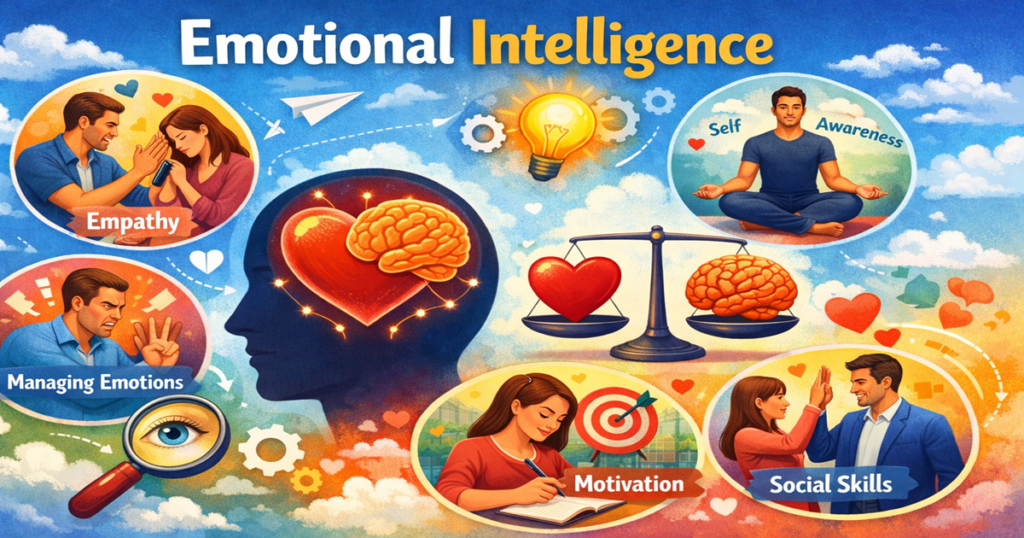
Daniel Goleman’s widely adopted EQ framework identifies five core components. Each one builds on the last, moving from inner self-awareness outward to social relationship management.
1. Self-Awareness
Self-awareness is the foundation of emotional intelligence. It refers to the ability to accurately recognise your own emotions as they occur, understand how those emotions affect your thoughts and behaviour, and identify your personal strengths and weaknesses without delusion or denial. People with strong self-awareness rarely allow emotions to drive impulsive decisions. Moreover, they seek feedback and use honest self-reflection as a tool for continuous growth.
2. Self-Regulation
Self-regulation is the ability to manage and control your emotional responses — particularly in stressful, challenging, or provocative situations. Rather than reacting impulsively when frustrated or threatened, self-regulated individuals pause, process, and choose their response deliberately. Furthermore, self-regulation includes managing disruptive impulses, staying calm under pressure, and maintaining integrity and composure even when circumstances are difficult.
3. Motivation
Motivation in the EQ framework refers specifically to intrinsic motivation — the drive that comes from within rather than from external rewards like salary or status. Emotionally intelligent people set meaningful goals, maintain optimism in the face of setbacks, and demonstrate a passion for work that goes beyond short-term incentives. As a result, they tend to show greater persistence, resilience, and long-term achievement than those motivated primarily by external factors.
4. Empathy
Empathy is the ability to understand and share the feelings of others — to see a situation from another person’s perspective, pick up on emotional cues, and respond with appropriate sensitivity. It is the social bedrock of emotional intelligence and a critical skill in leadership, healthcare, education, and any role involving human interaction. Research from a 2024 Child Development study found that empathy transmits across generations within families: more empathetic parents consistently raise more empathetic children.
5. Social Skills
Social skills represent the outward expression of emotional intelligence in relationships. They encompass communication, conflict resolution, collaboration, persuasion, and the ability to build rapport and inspire others. Leaders with strong social skills create psychologically safe team environments where people feel valued, understood, and motivated to perform at their best.
| EQ Component | Core Ability | Real-World Example |
| Self-Awareness | Recognise your own emotions and triggers | Noticing you feel anxious before a presentation |
| Self-Regulation | Control impulsive reactions | Pausing before responding to an angry email |
| Motivation | Drive from internal values and goals | Persisting through a project despite early failure |
| Empathy | Understand others’ emotional perspective | Adjusting your tone with a colleague under stress |
| Social Skills | Build and manage relationships | Mediating a conflict between two team members |
Why Emotional Intelligence Matters: The Research Evidence
The evidence for EQ’s impact on personal and professional outcomes is extensive and growing. Research consistently shows that emotional intelligence is not a soft skill in the dismissive sense — it is a measurable, developable competency with concrete, quantifiable outcomes.
According to TalentSmart, 90% of top workplace performers demonstrate above-average emotional intelligence, while only 20% of poor performers share that trait. Furthermore, people with high EQ earn, on average, $29,000 more per year than those with low EQ — and every incremental point increase in emotional intelligence adds approximately $1,300 to an annual salary. For businesses, the impact is equally striking: organisations that prioritise emotional intelligence are reported to be 22 times more likely to outperform competitors in their sector.
The Yale Center for Emotional Intelligence confirms that leaders who demonstrate high EQ create more positive, motivating work climates. Employees who report to emotionally intelligent leaders show greater creativity, higher job satisfaction, and lower rates of burnout. By contrast, workers whose managers lack EQ consistently report feeling undervalued and disengaged. As a result, turnover rates in teams led by high-EQ managers are up to 40% lower than those led by low-EQ counterparts.
Moreover, a 2025 Frontiers in Psychology paper introduced the concept of the Emotional Recession — a measurable global decline in emotional intelligence competencies that poses a structural risk to workforce resilience. As EQ declines across populations, the researchers warn that organisations face rising burnout, reduced adaptability, and weaker interpersonal cohesion. This finding makes the case for investing in emotional intelligence training more urgent than ever.
| EQ Statistic | Source | What It Means |
| EQ accounts for 58% of job performance | TalentSmart | Stronger predictor than IQ or technical skill |
| 90% of top performers have high EQ | TalentSmart | EQ separates the best from the rest |
| High-EQ professionals earn $29,000 more | TalentSmart | EQ has direct financial value |
| Leaders with high EQ see 40% lower turnover | Zenger Folkman, 2025 | Retention improves under emotionally intelligent leadership |
| EQ-focused orgs are 22x more likely to outperform | Six Seconds | Systemic EQ drives competitive advantage |
| Only 36% of people globally are emotionally intelligent | TalentSmart | EQ is rare — developing it is a genuine differentiator |
Emotional Intelligence in the Workplace: UK and USA Perspectives
In both the UK and USA, emotional intelligence has moved from a niche HR concept to a mainstream leadership and hiring priority. The World Economic Forum’s Future of Jobs report consistently places EQ skills — including empathy, motivation, and active listening — in the top ten competencies sought by employers across both economies.
In the UK context, NHS workforce research highlights emotional intelligence as a critical competency for healthcare professionals, particularly those in patient-facing roles. The ability to empathise with patients, manage emotional distress, and maintain composure under clinical pressure directly affects patient outcomes. Furthermore, British corporate leadership programmes at institutions like the Chartered Management Institute increasingly include EQ development as a core module in executive education.
In the USA, companies across Fortune 500 industries — from technology firms in Silicon Valley to financial institutions on Wall Street — now use EQ assessments as part of their hiring and promotion processes. According to available data, 75% of Fortune 500 companies incorporate emotional intelligence training into their leadership development programmes. Moreover, Harvard Medical School professor Ron Siegel noted in 2025 that the single greatest challenge in business is not acquiring technical expertise — it is finding people who genuinely understand and get along with one another.
Additionally, research from O.C. Tanner’s 2025 Global Culture Report found that employees working in high-EQ organisations are nine times more likely to report a strong sense of purpose at work, and thirteen times more likely to produce excellent work. These findings make the business case for emotional intelligence investments impossible to ignore.
How to Develop Emotional Intelligence: Practical Strategies
Unlike IQ, which remains relatively stable throughout adulthood, emotional intelligence is highly developable at any age. Research by Mattingly and Kraiger confirmed that structured EQ training interventions produce sustained improvements in emotional regulation, empathy, and relationship management. Furthermore, the O.C. Tanner report confirms that practising even one EQ behaviour consistently can meaningfully improve trust, conflict management, and overall workplace performance.
Build Self-Awareness Through Reflection
Begin with a daily journaling practice. At the end of each day, write down what emotions you experienced, what triggered them, and how you responded. Over time, patterns emerge that reveal your emotional default settings. Moreover, tools like the EQ-i 2.0 or the Mayer-Salovey-Caruso Emotional Intelligence Test (MSCEIT) provide structured, validated assessments of your current EQ level across all five components.
Practise Mindfulness
Mindfulness — the practice of bringing non-judgmental awareness to the present moment — is one of the most evidence-supported methods for improving self-regulation. Regular mindfulness practice trains the brain to pause between stimulus and response, reducing impulsive reactions and improving emotional regulation. Even ten minutes of daily mindfulness meditation has been shown to produce measurable improvements in emotional regulation within eight weeks.
Develop Active Listening Skills
Most people listen to respond rather than to understand. Active listening — giving full attention, withholding judgement, asking clarifying questions, and reflecting back what you have heard — dramatically improves empathy and social skills. Therefore, in your next conversation, resist the urge to formulate your response while the other person is still speaking. Focus entirely on understanding their perspective first.
Seek and Accept Feedback
Emotionally intelligent people actively seek honest feedback about how their behaviour affects others. Ask trusted colleagues or managers: ‘How do I come across when under pressure? Are there situations where my emotional reactions create problems?’ This input, while sometimes uncomfortable, provides the raw material for targeted EQ growth.
Surround Yourself with High-EQ People
Research published in Scientific American confirms that empathy is a socially motivated process — people become more empathetic when they exist within communities where empathy is the established norm. Therefore, deliberately seek environments, teams, and friendships where emotional intelligence is modelled and valued. As a result, your own EQ will develop through immersion and social reinforcement.
Practise Self-Compassion
A significant body of research shows that speaking to yourself as you would speak to a close friend — with warmth, understanding, and forgiveness — leads to greater productivity, wellbeing, and resilience. Self-compassion is not self-indulgence. It is a scientifically validated path to better emotional regulation and higher achievement.
Emotional Intelligence in Education and Child Development
Emotional intelligence is not only a workplace skill. It develops throughout childhood and adolescence, and the foundations laid in early life have lifelong consequences. Educational research consistently shows that students with higher EQ demonstrate better academic performance, stronger peer relationships, lower anxiety, and greater capacity to recover from setbacks.
A 2025 Frontiers in Psychology study found that emotional intelligence significantly improves quality of life and academic outcomes for university students, including those with disabilities. Specifically, students who developed stronger EQ reported higher self-efficacy, greater social connectedness, and improved academic performance compared to their lower-EQ peers. Furthermore, a 2026 Scientific Reports study found that incorporating emotional awareness into AI-driven educational platforms significantly improved learner engagement and task performance.
In UK schools, Social and Emotional Learning (SEL) programmes are increasingly embedded in the national curriculum, particularly at primary level. In the USA, the Collaborative for Academic, Social, and Emotional Learning (CASEL) has documented that well-designed SEL programmes improve academic achievement by an average of 11 percentile points. Therefore, investing in EQ education from an early age produces measurable lifelong benefits.
| Age Group | EQ Development Focus | Key Strategies |
| Children (5-12) | Naming emotions, empathy, sharing | SEL programmes, emotionally responsive parenting |
| Teenagers (13-17) | Self-regulation, peer empathy, resilience | Mindfulness, conflict resolution skills |
| Young Adults (18-25) | Self-awareness, motivation, social skills | EQ assessments, coaching, feedback culture |
| Adults (26-50) | Leadership EQ, empathy, relationship management | EQ training, mentoring, 360-degree feedback |
| Older Adults (50+) | Wisdom, perspective, emotional generativity | Reflection, mentoring others, community involvement |
Emotional Intelligence vs IQ: Which Matters More?
The relationship between emotional intelligence and traditional IQ has been debated since Goleman’s original work. The academic consensus today is nuanced: both matter, but they matter in different contexts and for different outcomes.
IQ remains a strong predictor of academic achievement in highly technical fields — mathematics, engineering, and the natural sciences all reward high cognitive processing ability. However, research consistently shows that beyond a cognitive threshold sufficient to perform a given job, EQ becomes the primary differentiator between average and exceptional performance. Moreover, in leadership, customer-facing, and team-based roles, emotional intelligence consistently outpredicts IQ as a driver of effectiveness.
Furthermore, IQ is largely fixed by late adolescence, while EQ can be actively developed throughout life. This makes EQ uniquely actionable — it responds to deliberate practice, training, and feedback in ways that IQ does not. As a result, individuals and organisations that invest in EQ development gain a compounding competitive advantage over time.
EQ and Mental Health: The Connection
Emotional intelligence and mental health are closely intertwined. Higher EQ is associated with lower rates of anxiety, depression, and stress-related illness. Moreover, people with strong emotional self-regulation are better equipped to recognise the early signs of emotional distress in themselves and others, seek support proactively, and apply effective coping strategies before problems escalate.
Research published in the Journal of Clinical Psychology shows that therapeutic approaches focused on developing emotional awareness and regulation improve mental health outcomes by approximately 35%. Furthermore, high EQ reduces burnout risk by up to 40% according to Gallup data, making it a significant protective factor in high-pressure work environments like healthcare, education, and emergency services — sectors under enormous strain across both the UK NHS and the US healthcare system.
It is worth noting that emotional intelligence does not eliminate emotional pain or guarantee happiness. Rather, it gives individuals the skills to navigate difficult emotions more effectively — recognising what they feel, processing it constructively, and choosing responses that align with their values and long-term wellbeing.
Frequently Asked Questions About Emotional Intelligence
Q1. Can emotional intelligence be learned, or are people born with it?
Emotional intelligence can absolutely be learned and developed. Unlike IQ, which remains relatively fixed after adolescence, EQ responds to deliberate practice, training, coaching, and self-reflection throughout life. Daniel Goleman himself stated that emotional intelligence seems to be largely learned, continuing to develop as people gain experience and self-awareness. Research by Mattingly and Kraiger confirms that structured EQ training interventions produce sustained, measurable improvements.
Q2. How is emotional intelligence measured?
Emotional intelligence is measured through three main approaches: self-report questionnaires (such as the EQ-i 2.0), ability-based tests (such as the MSCEIT, which measures EQ like a cognitive test), and 360-degree feedback assessments that gather input from colleagues, managers, and direct reports. Each approach has strengths and limitations, and practitioners often combine methods for a fuller picture of an individual’s EQ profile.
Q3. Is emotional intelligence more important than IQ at work?
In the majority of workplace roles, emotional intelligence is a stronger predictor of performance than IQ. TalentSmart research shows EQ accounts for 58% of job performance across all job types. Moreover, 85% of employers report that EQ matters more than IQ when assessing candidates, particularly for leadership, collaborative, and customer-facing roles. IQ sets a baseline competency threshold, but EQ determines how effectively people use that competency in a social and organisational context.
Q4. What is the link between emotional intelligence and leadership?
The link is direct and well-documented. Research confirms that emotional intelligence explains approximately 67% of a leader’s overall effectiveness. Leaders with high EQ create positive work climates, inspire trust and motivation, manage conflict constructively, and retain talent more effectively. Furthermore, a 2026 Sage Journals review found that leaders who cannot regulate their own emotions are significantly more likely to struggle with stress management, impairing their ability to perform and lead effectively.
Q5. How does emotional intelligence affect personal relationships?
High EQ individuals build deeper, more authentic personal relationships. They communicate more openly, listen more actively, resolve conflicts more constructively, and demonstrate genuine empathy. Moreover, research shows that emotionally intelligent people are better at reading social cues, managing misunderstandings before they escalate, and maintaining stable long-term relationships. In families, high-EQ parenting produces more empathetic children, extending the benefits across generations.
Q6. What is the difference between emotional intelligence and emotional sensitivity?
Emotional sensitivity refers to how intensely a person experiences emotions, while emotional intelligence refers to how effectively they manage and use those emotions. A highly sensitive person is not necessarily emotionally intelligent — in fact, without strong self-regulation skills, high sensitivity can lead to overwhelm and impulsive reactions. Emotional intelligence is the skilled application of emotional awareness, not simply the intensity of feeling.
Q7. How can organisations build a more emotionally intelligent workforce?
Organisations build EQ capacity by investing in targeted training programmes, incorporating EQ assessments into hiring and promotion decisions, creating feedback-rich cultures, and modelling emotionally intelligent behaviour from the top down. O.C. Tanner’s research shows that employees in high-EQ organisations are 18 times more likely to feel a strong sense of success at work. Furthermore, even focusing on a single EQ behaviour — such as active listening or transparent communication — can produce significant improvements in team performance and employee wellbeing.
Conclusion: Why Emotional Intelligence Defines Modern Success
Emotional intelligence is no longer a peripheral concept in psychology textbooks. It is a measurable, developable, and economically valuable set of human skills that shape outcomes across every domain of life — from career performance and leadership effectiveness to personal wellbeing and family relationships. The evidence is conclusive: emotional intelligence predicts success more reliably than IQ in most contexts, and yet only around 36% of people globally demonstrate strong EQ in practice.
Furthermore, as the World Economic Forum projects a 26% increase in demand for EQ skills by 2030, and as automation reshapes the labour market in both the UK and USA, the uniquely human capacities at the heart of emotional intelligence — empathy, self-awareness, resilience, and genuine connection — will become even more economically and socially valuable. Therefore, whether you are looking to advance your career, strengthen your relationships, or simply navigate life with greater clarity and ease, investing in your emotional intelligence is one of the highest-return commitments you can make.
Start small: reflect on your emotions daily, listen more carefully, seek honest feedback, and practise the self-compassion that decades of research confirms is the foundation of lasting growth. Emotional intelligence is not a destination — it is a lifelong practice that rewards you every step of the way.