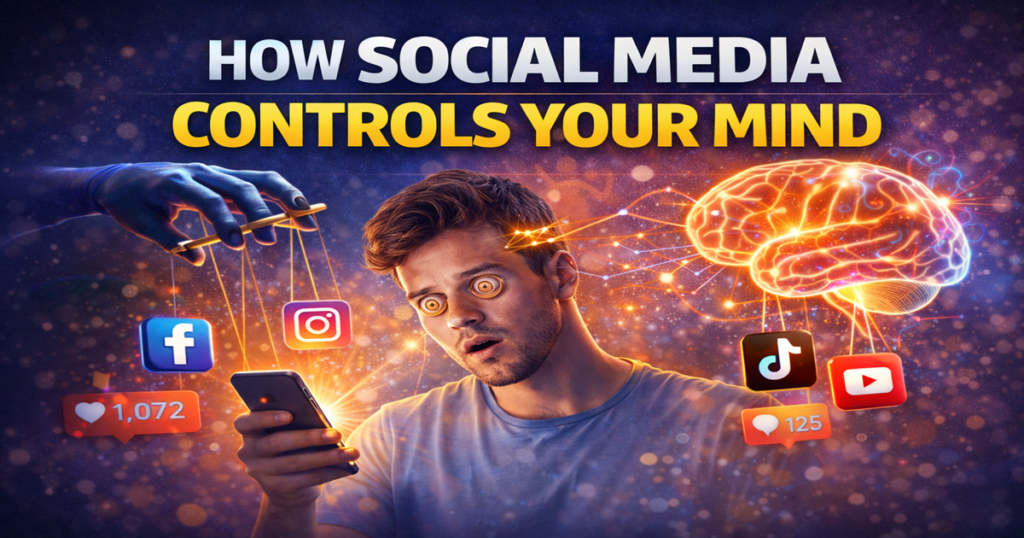
Picture this. You pick up your phone to check one notification. Forty-five minutes later, you are deep in a thread about something you did not even care about when you woke up this morning. Your thumb is still moving. You have not consciously decided to keep scrolling — it simply kept happening. When you finally put the phone down, you feel mildly irritated, oddly restless, and vaguely ashamed. Sound familiar? That is not an accident. That is engineering.
Social media controls your mind through mechanisms so precisely calibrated and so deeply embedded in your neurobiology that calling it manipulation feels almost too mild a word. In July 2025, researchers monitored the real-time brainwaves of 500 people while they scrolled through social media. Within minutes of opening Instagram or TikTok, participants’ brain activity began changing in patterns identical to gambling addiction. Not similar to — identical to. And yet, unlike a casino, you carry this slot machine in your pocket, sleep with it beside your bed, and give it to your children.
Sean Parker — one of the founders of Facebook — has spoken publicly about how the platform was designed. He was not apologetic. He described the deliberate exploitation of a vulnerability in human psychology: the need for social validation, approval, and belonging. He added, with disarming candour, that the creators understood this consciously — and built it anyway. So did the engineers at Instagram, TikTok, YouTube, and X. The science of how social media controls your mind is not a conspiracy theory. It is a business model. And understanding it, clearly and in detail, is the first step toward reclaiming the one thing these platforms are actively taking from you: the freedom to think.
Your Brain Was Never Designed for This
To understand how social media controls your mind, you first need to understand the brain it is targeting. Your brain evolved over hundreds of thousands of years in a world where social rejection could mean death. Being excluded from the tribe was not merely embarrassing — it was lethal. As a result, your brain is exquisitely, urgently sensitive to social information: who approves of you, who ignores you, what your status is within your group, whether your tribe still accepts you today.
Scientific American’s analysis of social media psychology captured this with precision: humans have a fundamental need to belong and a fundamental desire for social status. Because of this deep wiring, information about ourselves — who has liked us, who has commented, who has shared what we created — triggers the brain’s valuation system. The same neural circuits that fire when you receive money or food fire when you see that someone has approved of your post. Your brain literally treats a like as a reward. It was designed to. The tragedy is that the platforms know this, and they are using it against you.
Furthermore, your brain has another vulnerability that social media exploits with equal precision: its insatiable hunger for novelty. Throughout human evolution, new information meant potential danger, potential food, potential opportunity. The brain therefore pays disproportionate attention to anything new — which is why you can sit for hours consuming a feed that, if you thought critically about it, contains almost nothing of real value to your life. Every new post, every new story, every new video delivers a small dopamine-driven jolt of novelty. Your brain cannot stop seeking the next one, because seeking new information was, for most of human history, essential for survival. Social media is an infinite novelty machine pointed directly at this ancient neural drive.
“We have a basic biological imperative to connect with other people. That directly affects the release of dopamine in the reward pathway. Millions of years of evolution are behind that system. So there’s no doubt that a vehicle like social media, which optimises this connection, is going to have the potential for addiction.” — Centre for Humane Technology
The Dopamine Trap: How Platforms Keep You Scrolling
Dopamine is widely described as the pleasure chemical — the thing that makes you feel good. But that description, while popular, is fundamentally wrong, and understanding the truth about dopamine is essential to understanding how social media controls your mind. Dopamine is not the pleasure chemical. Dopamine is the wanting chemical. It does not make you feel satisfied. It makes you feel the compulsion to seek.
SarkariBrain’s 2026 research on social media’s neurological effects explained the distinction clearly: when you get a notification, dopamine spikes before you check it — because your brain anticipates a potential reward. It is the anticipation, not the reward, that keeps you coming back. This is precisely how slot machines work, and it is no coincidence that the parallel is exact. Variable ratio reinforcement — delivering rewards unpredictably, sometimes on this pull, sometimes not — is the most powerful form of behavioural conditioning ever identified in psychology. You do not know if this refresh will deliver something exciting or something dull. That uncertainty is the addiction. The reward would be satisfying. The uncertain possibility of reward is consuming.
Dr. Aaron Hartman, writing for Richmond Functional Medicine in December 2025, described the consequences of this dopamine manipulation with clinical specificity. Over time, the nucleus accumbens and connected circuits become hypersensitive to the hyper-palatable content these platforms deliver, while everyday offline experiences lose their motivational pull. A book feels boring. A walk feels pointless. A real conversation feels slow. This is not because books, walks, and conversations have become objectively less interesting. It is because your reward circuitry has been recalibrated to expect the rapid, unpredictable, intense stimulation that social media provides. Everything else, by comparison, has been made to feel like withdrawal.
The Algorithm: A Machine That Learns Your Weaknesses
The algorithm is the engine of how social media controls your mind — and it is far more intelligent, far more personalised, and far more sinister than most people realise. Every click you make, every second you pause on a post, every time you share something or leave a reaction teaches the algorithm something about what makes you tick. Not what informs you. Not what enriches you. What engages you — which, as Dr. Aaron Hartman noted, translates to what makes you angry, scared, excited, or curious — and then feeds you more of exactly those triggers.
Consider what this means in practice. If you spend three extra seconds on a post that makes you feel a flicker of outrage, the algorithm registers that outrage drove engagement and serves you more outrage-inducing content. If body-comparison content causes you to scroll more slowly — even while it makes you feel worse — the algorithm identifies this as engagement and amplifies it. You are not being shown content that is good for you. You are being shown content that keeps you on the platform longest, because every additional minute you spend scrolling is advertising revenue for a corporation that has no legal or moral obligation to consider your wellbeing.
“The algorithm creates what researchers call filter bubbles — showing you content that confirms your existing beliefs and triggers strong emotional responses. Why? Because emotional engagement keeps you scrolling longer.” — Dr. Aaron Hartman, Richmond Functional Medicine
The Humane Tech Centre’s analysis of persuasive technology added a crucial further dimension: when endless content creates an overwhelming amount of want, users can end up addicted to seeking satisfaction, scrolling mindlessly, often with minimal oversight from the cognitive control regions of the brain. The prefrontal cortex — the part of you that plans, reasons, and makes deliberate decisions — has been progressively sidelined. The scrolling happens not because you chose it but because the limbic system, hijacked by engineered dopamine loops, is running the show.
In 2026, adults average two hours and twenty-one minutes daily on social media, according to Doolly’s February 2026 brain health analysis. On TikTok alone, users spend an average of 52 minutes per day, with 95% of their content curated by algorithms specifically designed to maximise engagement — not wellbeing. These are not neutral numbers. They represent billions of human hours per day directed by machines optimised for commercial retention, not human flourishing.
What These Platforms Are Doing to Your Brain: The Neuroscience
Enough has been said about the manipulation. Now let us look at what it is actually doing to your brain, because the neurological evidence is both damning and deeply important to understand.
The Prefrontal Cortex: Your Rational Mind Under Attack
The prefrontal cortex is the seat of everything that makes you distinctly human: long-term planning, impulse control, rational decision-making, empathy, and moral reasoning. It is also the region that social media use most directly and most measurably harms. A 2025 study found that people who spent more than two hours daily scrolling experienced a 35% decline in prefrontal cortex impulse control. A landmark University of North Carolina study documented that teenagers who check social media more than 15 times daily show altered brain sensitivity in regions critical for decision-making and emotional regulation. Furthermore, heavy social media use produces decreased dorsolateral prefrontal cortex activity — matching, with disturbing precision, the neural pattern observed in clinical addiction disorders.
When the prefrontal cortex is suppressed and the limbic system is dominant, your capacity for critical thinking degrades. You become more reactive, more impulsive, and more susceptible to emotional content. You are less able to distinguish reliable information from misinformation. You are less capable of resisting the next scroll. This is not a metaphorical weakening of willpower. It is a measurable neurological change produced by sustained heavy use — and it is the precise state the algorithm is designed to maintain, because a person in limbic-dominant mode is far more likely to keep scrolling than a person whose prefrontal cortex is fully engaged.
Grey Matter and Structural Brain Changes
More alarming still are the studies documenting structural changes in the brain associated with heavy social media use. Dr. Hartman’s December 2025 analysis cited a four-year study published in Scientific Reports finding decreased cerebellum volume in high social media users. Doolly’s 2026 analysis documented grey matter reduction in the prefrontal cortex among heavy users — changes associated with reduced attention span and difficulties with deep cognitive work. These are not temporary mood shifts. They are physical alterations to brain architecture, produced over months and years of sustained algorithmic stimulation.
The PMC review on the digital revolution’s impact on the human brain confirmed that neurological consequences have been observed related to internet and social media addiction, including changes to language development and the processing of emotional signals. Furthermore, in the UK — where 95% of people aged 16 to 24 own a smartphone and check it on average every 12 minutes, according to Ofcom data cited by the same PMC review — an entire generation is accumulating these neurological changes during the developmental period when the brain is most plastic and most vulnerable to lasting structural influence.
Attention Spans and the Fractured Mind
Psychology Today’s January 2026 piece on brains and social media quoted research indicating that smartphone users check their phones close to 85 times a day and interact with their phones about five hours daily. Each check is an attentional interruption that takes approximately 23 minutes to fully recover from. If you check your phone 85 times in a waking day, you are spending most of your conscious existence in a state of post-interruption attentional fragmentation — unable to sustain the deep, focused thinking that produces learning, creativity, problem-solving, and meaningful work.
Georgetown University’s research on digital detox found that a two-week reduction in smartphone use produced attention improvements equivalent to reversing ten years of age-related cognitive decline. That statistic is worth sitting with. Ten years. In two weeks. The implication is not simply that detox helps — it is that the average heavily-connected person in 2026 is operating with the attentional capacity of someone a decade older than they actually are, and they have normalised this because it happened gradually and because everyone around them is in the same state.
| What Social Media Does to Your Brain | Mechanism | Measured Effect | Source |
| Suppresses prefrontal cortex | Dopamine flooding shifts brain to limbic dominance | 35% decline in impulse control at 2h+/day | 2025 major medical journal study |
| Rewires reward pathways | Variable ratio reinforcement (slot machine effect) | Hypersensitivity to digital rewards; offline life feels dull | Doolly 2026; SarkariBrain 2026 |
| Fragments attention | Constant interruptions disrupt attentional recovery | Attention equivalent to 10 years older than actual age | Georgetown University 2025 |
| Reduces grey matter | Structural change from sustained stimulation over-use | Grey matter reduction in prefrontal cortex | Scientific Reports 4-year study |
| Dysregulates sleep | Blue light + emotional arousal before bedtime | Later sleep onset, shallower sleep architecture | Journal of Sleep Research |
| Amplifies anxiety and depression | Social comparison + algorithmic outrage loops | +13% depression risk per additional hour (adolescent girls) | JAMA Psychiatry |
| Narrows world view | Filter bubbles and echo chambers limit diverse exposure | Algorithmic systems structurally amplify ideological homogeneity | MDPI Systematic Review 2025 |
| Erodes critical thinking | Outrage-primed limbic dominance reduces scepticism | Fake news more believable when fed ideologically aligned stories | ICPSR study |
The Filter Bubble: How Social Media Tells You What to Think
Beyond the neurological damage, social media exerts a second, more subtle and arguably more dangerous form of control: it shapes the actual content of your beliefs, your political views, and your understanding of reality — without you realising it is happening.
The filter bubble is the invisible wall the algorithm builds around your information environment. Every platform analyses your behaviour — what you click, how long you pause, what you share — and then progressively narrows your feed to show you content that aligns with what those behaviours suggest about your existing beliefs and preferences. The result, as Outside the Case’s February 2026 analysis described it, is an information environment that feels familiar and confirming, where content that challenges or complicates your worldview is progressively filtered out.
This is not benign personalisation. A landmark MDPI systematic review published in October 2025, synthesising thirty studies using the PRISMA 2020 framework, confirmed three consistent patterns: algorithmic systems structurally amplify ideological homogeneity; they reinforce selective exposure while limiting viewpoint diversity; and echo chambers not only foster ideological polarisation but also serve as spaces where identity reinforcement prevents the exposure to diverse perspectives that is fundamental to both personal growth and democratic health. This was observed across Facebook, YouTube, Twitter/X, Instagram, TikTok, and Weibo — meaning no major platform is exempt.
The echo chamber intensifies this effect. Once the algorithm has placed you in a filter bubble, the social environment within it — the community of like-minded users who engage with the same content — reinforces the narrowing further. Disagreeing voices are drowned out by a chorus of confirmation. Extreme positions within your ideological direction get amplified, because they trigger stronger emotional reactions and therefore more engagement. As the Vocal Media analysis of social media mind control described it: you think your feed is showing you reality, but it is actually showing you what the algorithm decides you should see, which is the version of reality most likely to keep you emotionally engaged and therefore scrolling.
Participants assigned to conditions where content agreed with their political worldview found fake stories significantly more believable than those who received a heterogeneous mix of news from multiple perspectives. — Filter Bubbles and Fake News research, ICPSR
Outrage as a Business Model
There is a reason that your social media feed feels so exhausting. There is a reason that people seem angrier online than they are in person. There is a reason that nuanced, moderate perspectives rarely go viral while outrage, fear, and division generate millions of shares. That reason is simple, blunt, and worth stating plainly: outrage is the most commercially valuable emotion that social media can trigger.
Research has established that emotionally charged content — particularly content that provokes anger, fear, or moral indignation — spreads faster and further than calm, informational content. Algorithms detect this engagement signal and amplify content that drives it. The Outside the Case February 2026 analysis of algorithmic political polarisation documented that algorithms reward viral content regardless of accuracy, facilitating the rapid spread of falsehoods, conspiracy theories, and emotionally charged messages. Content virality further fuels division, with politically charged posts spreading faster and wider than balanced alternatives.
Furthermore, the Humane Tech Centre’s research on persuasive technology identified what this creates at a societal level: when social media forces constant engagement in social comparison, users experience negative emotions — envy, shame, anxiety, and conceit. When frequently exposed to negative content, fear and outrage become the norm, eroding the sense of goodness and shared humanity that makes civil society function. The Vocal Media analysis added a pointed observation: if you feel constantly angry online, that is not an accident. It is a business model.
Social Comparison: The Psychological Wound That Never Heals
Alongside the outrage machine, social comparison represents one of the most insidious ways that social media controls your mind — precisely because it feels personal and private rather than engineered and external. Social comparison is the deeply human tendency to evaluate yourself relative to others. Evolutionary psychologists believe it originated as a useful calibration tool — helping you gauge your relative status, skills, and resources within a group. On social media, this ancient instinct is weaponised.
Every platform serves you a curated version of other people’s lives. The holidays, the achievements, the relationships, the bodies, the success — all filtered, lit, edited, and selected for maximum impression. Nobody posts their 6 AM anxiety or their third rejection letter or their mundane Tuesday. The result, as netpsychology.org’s March 2026 social media psychology analysis described, is that social comparison online creates a perfect trap: you are measuring your unfiltered interior life against everyone else’s carefully curated highlight reel. Your normal feels deficient. Your average feels like failure. Your body, your relationship, your career, your home — all of them arrive perpetually short of a standard that is both artificial and algorithmically amplified.
The mental health consequences are well-documented and severe. JAMA Psychiatry research found that adolescents who used social media for more than three hours daily had significantly higher risk of developing mental health problems. For adolescent girls specifically, each additional hour of social media use increases depression risk by 13%. Doolly’s 2026 analysis confirmed that problematic use affects an estimated 210 million people globally, with prevalence ranging from 5 to 31% across studies and countries. These are not marginal effects on a vulnerable minority — they are population-level mental health consequences produced by platforms serving over five and a half billion users in 2026.
The Gender Gap: Why This Hits Women and Girls Harder
The social comparison mechanism does not affect everyone equally. The evidence is consistent and clinically significant: women and girls bear a disproportionately severe burden of social media’s psychological harms. The World Happiness Report 2026, the Pew Research Center’s 2025 data, and clinical studies from multiple institutions all confirm the same gradient: girls aged 11 to 16 are the most vulnerable group, with each additional hour of social media use producing measurable increases in depression, anxiety, body image disturbance, and loss of life satisfaction.
The reason is not complicated. The platforms that teenage girls use most heavily — Instagram, TikTok, and Snapchat — are predominantly image-based and appearance-focused. The algorithmic content they serve is saturated with idealised, filtered, and often surgically altered body images. The social comparison instinct, already acute during early adolescence when identity is forming most rapidly, collides with a feed designed to maximise engagement through aspiration and inadequacy. Furthermore, as the article in this series on social media’s impact on teens documented, Meta’s own internal research — revealed through legal discovery in 2025 — confirmed that using Facebook worsened depression, anxiety, loneliness, and social comparison among users. Their researchers knew. They built it anyway.
The Political Dimension: Your Opinions Are Being Shaped
Some of the most consequential — and least discussed — ways that social media controls your mind operate at the level of political belief and civic understanding. The filter bubble does not merely personalise your entertainment. It shapes your worldview. Over time, the progressive narrowing of your information environment means that the version of political reality you inhabit is increasingly different from the version inhabited by people whose algorithmic profile differs from yours.
The Springer Nature systematic review of 129 echo chamber studies published in April 2025 documented that nearly a third of included studies identified polarisation as a key effect of echo chambers, with affective polarisation — the emotional hostility and negative sentiment between ideological groups — consistently amplified by algorithmic content curation. The same review found that algorithmic systems based on homophily (the tendency to cluster around similar views) strongly support the echo chamber hypothesis, with divergence from one’s own ideological community progressively eliminated by the algorithm’s curation.
The TechRxiv February 2025 paper on AI echo chambers confirmed that these environments reinforce users’ pre-existing beliefs by continuously feeding similar content — creating what its authors described as isolated information bubbles that distort perception, fuel misinformation, and limit critical thinking. In an era when elections are decided by margins of thousands of votes and when public trust in institutions is already eroding, the political consequences of this algorithmic mind control are not abstract. They are structural threats to the functioning of democracy.
You Are the Product. Here Is the Proof.
One of the most clarifying realisations about how social media controls your mind is understanding what these platforms actually are. Instagram, TikTok, Facebook, and X are not social services that happen to run advertising. They are advertising businesses that use social connection as the bait to keep you delivering your attention — the commodity they sell — to paying advertisers.
Your attention is the product. Your neurological vulnerabilities are the raw material. Your social comparison anxiety, your outrage, your loneliness, your fear of missing out — all of these are not unfortunate side effects of a service designed to connect people. They are, as Scientific American’s analysis put it, the output of a system that exploits human psychological vulnerabilities. And as Sean Parker admitted in his own words: the creators understood this consciously. And they built it anyway.
Machines using data from your digital footprint, as Scientific American noted, are now better judges of your personality than your friends and family. Your intelligence, your sexual orientation, your political beliefs, your fears and desires — all can be computed from your social media behaviour. The 21st-century challenge, the article concluded, is how to live when others know us better than we know ourselves. That is not dystopian fiction. In 2026, it is the commercial and operational reality of every platform you use.
Reclaiming Your Mind: What the Science Recommends
Understanding how social media controls your mind is not an invitation to despair — it is an invitation to agency. Your brain is neuroplastic. It heals. Doolly’s 2026 analysis found that a one-week social media detox cuts anxiety by 16%, depression by 25%, and insomnia by 14%. Georgetown University’s research found that two weeks of reduced phone internet use produced mental health improvements comparable to CBT and larger than typical antidepressant effects. The brain that was shaped by algorithmic manipulation can be reshaped by intentional behaviour. The following strategies represent the most evidence-supported approaches to reclaiming cognitive autonomy:
- Audit your usage with honesty. Use your phone’s built-in screen time tools — Screen Time on iOS or Digital Wellbeing on Android — to see your actual daily usage broken down by platform. Most people significantly underestimate how much time they spend on social media. Confronting the real number is the necessary first step.
- Turn off all non-essential notifications. Notifications are the algorithm’s delivery mechanism for the dopamine anticipation loop. Each buzz trains your brain to expect reward, heightens alert-state arousal, and makes deliberate, self-directed behaviour harder. Turning them off is not a sacrifice — it is recovering control over when and why you engage with these platforms.
- Curate your feed with intention. Unfollow accounts that consistently make you feel worse — that trigger social comparison, envy, inadequacy, or outrage. Follow accounts that genuinely inform, inspire, or entertain rather than those that simply hook you emotionally. The algorithm cannot fully be overridden, but you can shift its inputs.
- Seek diverse perspectives deliberately. Because algorithms amplify ideological homogeneity, actively reading or watching sources that hold different perspectives from your own is a form of cognitive self-defence. It does not mean abandoning your own views. It means ensuring that your views are formed by genuine engagement with reality rather than by an algorithm’s commercial interests.
- Create phone-free protected zones. Charging the phone outside the bedroom eliminates the two most damaging usage patterns simultaneously — late-night scrolling and first-thing-in-the-morning checking. Protecting mealtimes, the first hour of the morning, and time with people you care about from phone intrusion restores the quality of presence that social media systematically erodes.
- Replace consumption with creation. Passive scrolling is the mode of highest manipulation — you are purely receiving what the algorithm serves. Switching to active creation — writing, making, building, moving — activates the parts of the brain that social media suppresses and depletes the parts it over-activates. Even brief periods of creation begin to restore cognitive balance.
- Consider a structured detox. The research supports a defined, time-bounded period of significantly reduced social media use — ideally two weeks — as the most powerful reset available. This is not a permanent lifestyle change but a recalibration that allows you to reintroduce social media with clearer understanding of its effects and greater capacity to use it on your own terms.
Frequently Asked Questions About How Social Media Controls Your Mind
Q1. Is social media addiction real?
Yes — and the neurological evidence is now extensive. A July 2025 study monitoring 500 people’s real-time brainwaves found that within minutes of opening Instagram or TikTok, brain activity patterns became identical to those of gambling addiction. The nucleus accumbens, the reward circuitry, and dopamine pathways are all engaged in patterns that researchers describe as virtually identical to behavioural addictions such as gambling disorder. While ‘social media addiction’ does not yet appear in the DSM-5 as a formal diagnosis, the neuroscience documenting its mechanisms — variable ratio reinforcement, dopamine anticipation loops, prefrontal cortex suppression — is the same neuroscience that explains other recognised addictions. Between 5 and 10% of Americans currently meet clinical criteria for social media addiction, and problematic use affects an estimated 210 million people globally.
Q2. Why do I feel worse after using social media even though I enjoy it in the moment?
Because social media exploits the distinction between wanting and liking — which, in neurological terms, are processed by entirely different systems. Dopamine, the wanting chemical, drives you to seek and scroll. But seeking is not the same as satisfaction. The temporary pleasure of a like, a funny video, or an interesting post is rapidly displaced by the wanting circuitry demanding more. Furthermore, the social comparison content that drives engagement on image-based platforms like Instagram consistently produces worse self-evaluation — even when you know consciously that the images are filtered and curated. The limbic system processes the comparison before the prefrontal cortex can contextualise it. You feel it before you can reason about it. And after enough scrolling, the cumulative effect of hundreds of these micro-comparisons produces the deflated, dissatisfied feeling that most heavy social media users know intimately.
Q3. How do filter bubbles affect real-world beliefs?
Filter bubbles affect real-world beliefs in ways that are measurable and genuinely alarming. Research cited in the ICPSR study found that participants who consumed content aligned with their existing political worldview found fake news stories significantly more believable than participants who received a diverse information diet. The mechanism is that the filter bubble creates a state of reduced cognitive scepticism: when everything you read confirms what you already believe, the critical evaluation reflex that should fire on encountering new claims is progressively suppressed. Furthermore, the MDPI October 2025 systematic review of 30 studies confirmed that algorithmic systems structurally amplify ideological homogeneity, reinforcing selective exposure. The result at scale is a population whose collective grip on shared factual reality is progressively loosening — which is precisely what has been observed in political discourse across the UK, USA, and other heavily-connected democracies over the past decade.
Q4. Is it worse for young people than for adults?
Significantly worse, for several compounding reasons. The adolescent brain is still developing — particularly the prefrontal cortex, which is not fully mature until the mid-to-late twenties — making it both more susceptible to neurological changes from heavy use and less equipped to apply the critical evaluation that would moderate the effects. Social comparison during early adolescence coincides with the period of most intense identity formation, making appearance-focused and status-focused content especially harmful. Furthermore, young people use social media for more hours per day and with less life experience against which to contextualise the curated realities it presents. The evidence is consistent: each additional hour of social media per day increases depression risk by 13% for adolescent girls. The World Happiness Report 2026 described harm occurring at a scale sufficient to shift population-wide mental health trends — not just individual cases.
Q5. Can using social media mindfully prevent these effects?
Partially — but mindfulness alone is not sufficient to fully counteract engineered manipulation. The mechanisms through which social media controls your mind — dopamine loops, limbic hijacking, filter bubbles, social comparison — operate largely beneath the level of conscious awareness. You cannot simply decide to be less affected by social comparison any more than you can decide not to flinch at a loud noise. That said, intentional curation of your feed, deliberate seeking of diverse perspectives, time limits, notification management, and periodic detox periods all produce measurable benefits. Georgetown University’s research confirmed that even partial digital detox — reducing some screen time rather than eliminating it entirely — produces positive impacts. The goal is not perfection but recalibration: ensuring that you are using social media as a tool that serves your purposes rather than a machine that is serving you to advertisers.
Q6. How quickly can your brain recover from social media’s effects?
Faster than most people expect. SarkariBrain’s 2026 review of the recovery research found that even a one-week digital detox produced substantial and lasting improvements in mental health and cognitive function. Reaction times improved measurably. Anxiety decreased significantly. Sleep quality improved. Georgetown University’s two-week study found attention restoration equivalent to ten years of cognitive age reversal. Doolly’s analysis of a JAMA Network Open 2025 study following young adults through a one-week social media detox found cuts of 16% in anxiety, 25% in depression, and 14% in insomnia within seven days. The brain’s neuroplasticity — its ability to reshape itself in response to changed behaviour — means that the changes social media produces are reversible. The changes begin within days. The key insight is that recovery does not require abandoning technology permanently. It requires changing the terms of your relationship with it.
Q7. What can parents do to protect their children from social media mind control?
The evidence supports several specific, actionable approaches. Delaying smartphone access is consistently recommended: Vail Health’s clinical guidance, Georgetown’s Kushlev, and the entire body of adolescent mental health research all support the position that earlier access produces greater harm. The World Happiness Report 2026 and Australia’s world-first under-16 social media ban reflect growing governmental consensus that the current minimum ages of 13 are not evidence-based. For families where smartphones are already present, the most effective protective factors identified in research are open, non-judgemental conversations about social media’s mechanisms — not just its content — so children understand how they are being targeted; consistent phone-free family time, particularly at mealtimes and in the hour before sleep; and collaborative rather than unilateral screen time management, which produces better buy-in and longer-term behaviour change than top-down restriction alone.
Conclusion: The Most Powerful Force in Your Head May Not Be Your Own Thought
The question of how social media controls your mind is ultimately not an academic one. It is the most practically urgent question about the quality of your daily life, the authenticity of your beliefs, the health of your relationships, and the integrity of your democracy. Five and a half billion people — the majority of the connected world — are experiencing engineered dopamine manipulation, algorithmic narrowing of reality, socially engineered comparison anxiety, and prefrontal cortex suppression, every single day. Most of them have no idea this is happening, because the manipulation is invisible and because the discomfort it produces — the restlessness, the dissatisfaction, the anger, the inadequacy — has been normalised so thoroughly that it now simply feels like contemporary life.
But it is not contemporary life. It is a commercial product delivered through your phone. And like any product with documented health harms, understanding exactly what it does is the necessary first step toward deciding what relationship, if any, you want to have with it. Your brain was not designed for this. It is being exploited. The exploitation is conscious, evidence-based, and enormously profitable. And your awareness of it is the one thing these platforms cannot engineer away.
The good news is real and the research is clear. Reduce usage and your brain recovers — quickly. Curate your feed deliberately and the filter bubble shrinks. Create protected spaces in your day where the algorithm cannot reach you and the Default Mode Network reactivates, producing the creativity, insight, and genuine presence that make life feel like yours again. Social media is powerful. But so is the mind that chooses, with full knowledge, how to engage with it. That choice begins right now.