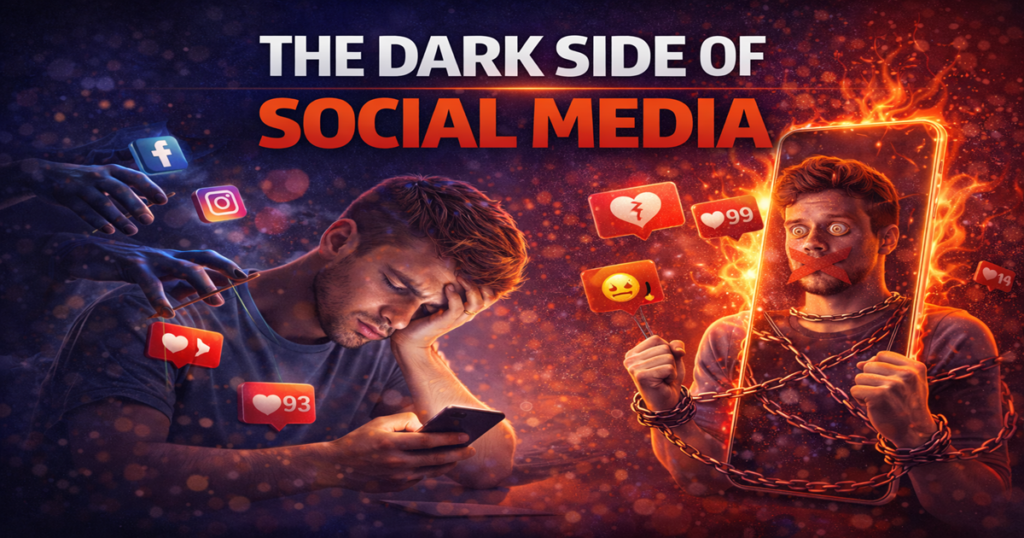
The dark side of social media is no longer a fringe concern. It sits at the heart of public health briefings, parliamentary debates, courtrooms, and kitchen-table conversations on both sides of the Atlantic. Over five and a half billion people use social media daily. Furthermore, the research now tells us clearly that, for millions of those users, the cost of that connection runs deeper than most realise.
Excessive social media use links to a 66% increase in depression among teenagers. People who scroll for more than three hours per day are twice as likely to experience serious mental health problems. Moreover, the World Economic Forum named disinformation and misinformation the top global risk of 2025 — and social media platforms carry the primary blame. This guide examines the most harmful consequences of social media in plain, evidence-based terms — and explains what individuals, parents, and policymakers can do about them.
The Dark Side of Social Media: Key Statistics at a Glance
| Issue | Key Statistic | Source |
| Teen depression | 66% rise linked to excessive use | Cropink 2026 |
| Mental health risk threshold | 2x risk at 3+ hours/day | US Surgeon General / HHS |
| Social media addiction globally | ~210 million people affected | SQ Magazine 2025 |
| Gen Z concern | 60%+ believe it does more harm than good | Cropink 2026 |
| Sleep disruption (teens) | 45% say it hurts their sleep quality | Pew Research 2025 |
| Productivity harm (teens) | 40% say it damages their productivity | Pew Research 2025 |
| Misinformation exposure (UK) | 98% of users encounter it in feeds | NatCen BSA 42, 2025 |
| Misinformation global risk | #1 global risk — immediate term | WEF Global Risks Report 2025 |
| Facebook & TikTok | Rated biggest misinformation threats | Reuters Institute DNR 2025 |
| Cyberbullying: anxiety & depression | 65% of victims show higher scores | Cyberpsychology, 2020 |
| Hate-based content exposure | 64% of adolescents encounter it | US Surgeon General, 2023 |
| UK girls (13-17): social media harm | 25% say it hurt their mental health | Pew Research 2025 |
| Lawsuits filed (April 2026) | 2,465+ harm lawsuits vs. platforms | Sokolove Law 2026 |
| Meta jury verdict | $375M awarded — New Mexico | Sokolove Law 2026 |
| Loneliness among users | More than 60% of users feel lonely | SQ Magazine 2025 |
1. Mental Health: The Most Documented Dark Side of Social Media
Mental health harm represents the most extensively researched dimension of the dark side of social media. The US Surgeon General issued a public health advisory warning that heavy use poses a significant risk to the mental health of children and adolescents. Moreover, Johns Hopkins Bloomberg School of Public Health hosted a media briefing on 26 February 2026 specifically to address the emerging mental and behavioural health impacts of digital media.
The numbers tell a stark story. Excessive use links directly to a 66% increase in depression among teenagers. People who spend more than three hours per day on social media face double the risk of mental health problems. Furthermore, among heavy teenage users, 41% rate their mental health as poor or very poor, compared to just 23% among light users. This is not a small difference — it is an 18-percentage-point gap that deserves serious attention.
Pew Research Center’s April 2025 survey of US teens aged 13 to 17 added important nuance. Girls experience disproportionately greater harm. Twenty-five percent of girls report that social media hurt their mental health, compared to 14% of boys. Girls are also more likely to say it damaged their sleep (50% vs 40%), their confidence (20% vs 10%), and their friendships. Therefore, any honest conversation about the dark side of social media must place adolescent girls at the centre.
“Young people are at particular risk because teen brains, identities, and coping skills are still developing.” — Johns Hopkins Bloomberg School of Public Health, February 2026
The scale of addiction compounds this crisis further. Approximately 210 million people globally struggle with social media addiction — roughly 4.7% of all users. In the United States, between 5% and 10% of people meet clinical criteria for the condition. Furthermore, a 2025 clinical study found that 40% of depressed or suicidal young people in treatment reported problematic social media use. These figures do not describe a niche population. They describe a widespread public health challenge.
2. Cyberbullying: When Platforms Become Weapons
Cyberbullying represents one of the most direct and viscerally damaging elements of the dark side of social media. Unlike schoolyard bullying, which ends when the victim walks away, cyberbullying follows its targets into their bedrooms, their phones, and every waking hour. It operates without breaks. Moreover, it often happens publicly, in front of a peer audience, amplifying the humiliation to a scale that face-to-face cruelty rarely achieves.
The consequences are severe and well-documented. A study of Norwegian young adults found that 65% of those involved in cyberbullying showed higher anxiety and depression scores compared to 36% of those with no cyberbullying involvement. The US Surgeon General’s advisory noted that approximately 64% of adolescents encounter hate-based content on social media platforms. Additionally, suicide sits as the second-leading cause of death for people aged 10 to 24, and researchers actively study social media’s potential role in exposure to harmful content that may worsen suicidal ideation.
The legal consequences for platforms are also escalating. As of April 2026, over 2,465 lawsuits involving TikTok, Instagram, and Facebook await resolution in US federal multidistrict litigation. A Los Angeles jury awarded $6 million in one social media harm case, finding Meta 70% liable and YouTube 30% liable for mental health injuries. Furthermore, a New Mexico jury ordered Meta to pay $375 million for violating consumer protection laws by marketing platforms as safe while failing to protect children. These verdicts mark a turning point in how courts view platform responsibility.
3. Misinformation: The Dark Side of Social Media That Threatens Democracy
Misinformation represents a systemic harm that extends beyond individual wellbeing. It attacks the shared factual foundation on which democracy depends. The World Economic Forum placed disinformation and misinformation at the top of its Global Risks Report 2025, describing it as the most pressing immediate threat facing the world. Moreover, research confirms that these risks travel primarily through social media.
In the United Kingdom, NatCen’s British Social Attitudes 42 survey published in 2025 found that a striking 98% of social media users report encountering misinformation in their feeds. The Reuters Institute for the Study of Journalism’s 2025 Digital News Report found that Facebook and TikTok rate as the biggest misinformation threats across multiple markets. In Germany, Ireland, and the UK, platform X attracts equal concern, with reduced content moderation feeding documented real-world consequences — including the 2024 riots in UK cities that followed the spread of false information about the Southport murders.
“Social media disinformation campaigns have been called an existential threat to human civilisation.” — Springer Nature Electronic Markets, 2025
The algorithmic architecture of platforms makes misinformation worse, not better. Algorithms reward emotionally engaging content regardless of accuracy. False stories spread faster than corrections. Furthermore, filter bubbles mean that people predominantly encounter content reinforcing their existing beliefs, making them more susceptible to misinformation aligned with those beliefs. A survey study published in the Journal of Elections, Public Opinion and Parties in 2025 found that participants who received content aligned with their political worldview considered false stories significantly more credible than those who received a diverse information diet.
AI-generated content accelerates the problem further. The ADL’s 2025 disinformation trends analysis documented how extremists increasingly use generative AI tools to produce and distribute hate speech and conspiracy theories at scale. As a result, the information environment on major social media platforms became more polluted — not less — as moderation efforts failed to keep pace with the volume and sophistication of synthetic content.
4. Sleep, Productivity, and the Hidden Daily Cost
Beyond the dramatic harms lies a quieter but pervasive dark side: the daily cost that social media extracts from sleep, productivity, and the texture of ordinary life. Pew Research’s 2025 survey found that 45% of US teens say social media hurt the amount of sleep they get. Meanwhile, 40% say it damaged their productivity. These are self-reported figures — meaning the real impact almost certainly runs higher.
The biological mechanism is well-understood. Blue light from screens suppresses melatonin production, the hormone that regulates sleep onset. Furthermore, emotionally arousing content — and social media algorithms serve a great deal of it — activates the sympathetic nervous system in ways that persist long after the phone goes down. However, the harm goes beyond biology. The simple habit of checking social media last thing at night and first thing in the morning fragments the mental space that restorative sleep and a calm morning require.
Productivity suffers similarly. The average worker who uses social media during the day loses significant focused time. Each notification check triggers a context switch that takes approximately 23 minutes to fully recover from. Therefore, a handful of social media checks in the morning can effectively consume the most productive hours of someone’s working day without a single hour of actual scrolling.
5. Body Image and the Comparison Trap
Image-heavy platforms like Instagram and TikTok present a curated version of human appearance that no person actually inhabits — filtered, lit, posed, and in many cases digitally altered beyond the possible. Nevertheless, the brain processes these images as social reality. Dr. Alison Tarlow, licensed clinical psychologist at Boca Recovery Center, explained it precisely: constant exposure to curated, ‘perfect’ lives fuels feelings of inadequacy, depression, and low self-esteem.
The data supports this directly. The US HHS Surgeon General’s advisory reported that 46% of adolescents aged 13 to 17 say social media makes them feel worse about their bodies. Girls bear the greater burden here. Among teen girls, 20% say social media hurt their confidence, versus 10% of boys. Moreover, SQ Magazine’s 2025 mental health statistics compilation found that 45% of US teen girls encounter eating disorder content online, and 45% also encounter suicide or self-harm content — an extraordinarily high exposure rate with direct mental health implications.
Furthermore, the platforms profiting from this harm have known about it for years. Legal discovery in US lawsuits against Meta revealed internal research confirming the company understood that Instagram damaged the body image of teenage girls. Nevertheless, the platform continued without meaningful reform. This internal awareness, now a matter of public court record, has significantly shaped legislative and regulatory discussions in both the UK and USA.
6. Political Polarisation: How Algorithms Divide Societies
The dark side of social media extends well beyond individual harm into collective social damage. Algorithms optimise for engagement, and engagement intensifies with emotional content — particularly outrage, fear, and moral indignation. As a result, algorithmically curated feeds push users toward more extreme versions of their existing views, fragment shared reality across ideological lines, and feed the polarisation that makes civil democratic discourse increasingly difficult.
A PMC study on political disinformation and hate speech demonstrated the definitive role of disinformation campaigns in polarising societies across 177 countries. Moreover, the NatCen BSA 42 survey confirmed that the social media environment heightens political polarisation directly: when users predominantly follow like-minded individuals, they encounter fewer opposing views, which pushes public opinion toward extremes and creates siloed discourse. The EU DisinfoLab’s December 2025 analysis documented Russian and Chinese state actors actively exploiting these dynamics — refining their playbooks to maximise social fragmentation in Western democracies.
Additionally, the Reuters Institute’s 2025 Digital News Report found deep public division between the US and Europe on where the limits of free speech online should lie. In the UK and Germany, 32% of people believe platforms remove too little harmful content. In the United States, conservatives overwhelmingly feel too much is already removed, while progressives hold the opposite view. This divide itself reflects how differently social media algorithms shape political reality for different audiences — even within the same country.
The Dark Side of Social Media: Harms by Category
| Category | Who Is Most Affected | Primary Harm | Evidence Strength |
| Mental health | Girls aged 11-16; heavy users | Depression, anxiety, addiction | Very strong — multiple RCTs, surveys |
| Cyberbullying | Teens, marginalised groups | Anxiety, depression, suicidality | Strong — longitudinal studies |
| Misinformation | All users; polarised audiences | False beliefs, distrust, real-world harm | Very strong — WEF, Reuters, PMC |
| Sleep disruption | Teens; late-night scrollers | Fatigue, cognitive impairment | Strong — clinical & survey evidence |
| Body image | Girls; heavy Instagram/TikTok users | Eating disorders, low self-esteem | Strong — leaked Meta research + studies |
| Political polarisation | High-frequency news consumers | Ideological extremism, distrust | Strong — 177-country PMC study |
| Productivity | All workers and students | Lost focus, reduced output | Moderate — consistent survey data |
| Child safety | Under-13s; vulnerable teens | Predatory contact, grooming risk | Growing — legal cases + platform audits |
What Can Individuals and Families Do?
Understanding the dark side of social media is the essential first step — but action must follow. The following strategies draw directly from research evidence and clinical guidance:
- Delay smartphone access for children. The evidence consistently supports later access as a protective factor. Australia implemented a world-first under-16 social media ban in December 2025. The UK opened a consultation on equivalent legislation in March 2026. Parents who delay access — even within existing legal frameworks — give their children’s developing brains crucial protection during their most vulnerable years.
- Set firm time boundaries. Adolescents who spend more than three hours per day on social media face double the mental health risk. Therefore, keeping usage below this threshold matters clinically. Use built-in tools — Screen Time on iOS and Digital Wellbeing on Android — to set daily limits by platform.
- Protect bedrooms and bedtimes. Charge phones outside the bedroom. This single change eliminates late-night scrolling and first-thing-in-the-morning checking simultaneously. Johns Hopkins researchers emphasised filling children’s time with in-person activities as a top protective strategy. Furthermore, face-to-face time directly counters the loneliness that over 60% of heavy social media users report.
- Build media literacy as a family. Teach children to question what they see online, understand how algorithms work, and recognise the difference between curated and authentic content. Digital literacy, emotional awareness, and the ability to recognise when online experiences cause harm represent the strongest long-term defences against social media’s darkest effects.
- Seek professional support when needed. When procrastination, anxiety, disordered eating, or persistent low mood appear alongside heavy social media use, professional assessment is appropriate. CBT has strong evidence for addressing social media-related anxiety and distorted thinking. Furthermore, the 2,465+ active lawsuits against platforms in the USA provide a legal pathway for families facing documented harm from addictive design.
What Policymakers Are Doing: UK and USA
Both the UK and USA are moving toward greater platform accountability — though through different mechanisms and at different speeds. In the UK, the Online Safety Act 2023 now imposes legal duties on platforms to protect children from harmful content. The Act requires platforms to be safer by design, with enforceable obligations rather than voluntary commitments. Moreover, in March 2026, the UK government opened a public consultation on whether to ban social media for under-16s — following Australia’s landmark decision the previous year.
In the United States, the federal legislative response has moved more slowly. However, the Surgeon General’s call for mandatory warning labels on social media platforms — comparable to those on tobacco and alcohol — marked a significant escalation in official position. Furthermore, multiple US states have passed or actively consider legislation restricting minors’ social media access, requiring age verification, or mandating parental consent. The ongoing federal multidistrict litigation against Meta, TikTok, and other platforms represents the most direct legal accountability mechanism currently in motion.
The EU’s Digital Services Act introduces transparency requirements and content moderation obligations for very large online platforms. Moreover, the European Parliament passed a non-binding resolution advocating a minimum age of 16 for social media access. However, as LSE’s Impact blog noted in January 2026, enforcing meaningful regulation remains complicated by tensions between attracting Big Tech investment and genuinely constraining platform harm.
Frequently Asked Questions About the Dark Side of Social Media
Q1. Is social media the direct cause of the teen mental health crisis?
The relationship is well-evidenced but complex. Multiple large studies — including Pew Research, the US Surgeon General’s advisory, and the World Happiness Report 2026 — confirm strong associations between heavy social media use and depression, anxiety, and poor wellbeing in teenagers. Furthermore, Meta’s own internal research, revealed through legal discovery in 2025, confirmed that reducing social media use improved users’ mental health. However, researchers at Johns Hopkins and elsewhere caution that other factors — poverty, family instability, academic pressure, the pandemic’s legacy — also contribute to rising youth mental health rates. Therefore, social media is a significant and well-documented contributing cause, but not the sole one.
Q2. Which platforms do the most harm?
Research consistently identifies image-based platforms — Instagram and TikTok — as most strongly linked to body image disturbance, anxiety, and self-esteem damage, particularly among teenage girls. Facebook and TikTok rank highest as misinformation threats across multiple markets, according to the Reuters Institute’s 2025 Digital News Report. X attracted particular concern in the UK and Germany regarding hate speech and reduced moderation. However, Johns Hopkins researchers note that platform-specific effects depend not just on which platform but on how it is used. Moreover, heavy passive scrolling on any platform produces worse outcomes than active, intentional use.
Q3. How does social media contribute to political polarisation?
Social media algorithms reward emotionally engaging content, and nothing engages people more reliably than outrage and moral provocation. Therefore, platforms serve more outrage-inducing content to people who react to it — progressively narrowing their information environment toward more extreme versions of their existing views. The NatCen BSA 42 survey confirmed that this creates siloed discourse pushing public opinion toward extremes. Furthermore, a PMC study covering 177 countries demonstrated that disinformation campaigns on social media definitively polarise societies. State-sponsored actors from Russia and China actively exploit these dynamics in Western democracies, according to the EU DisinfoLab’s December 2025 update.
Q4. What is the UK government doing about social media harm?
The UK’s Online Safety Act 2023 places enforceable legal duties on platforms to protect children from harmful content and to be safer by design. Furthermore, in January 2026, the government announced a consultation on children’s social media use. The consultation opened in March 2026 and specifically seeks views on whether to ban social media for under-16s, following Australia’s world-first ban in December 2025. The Children’s Wellbeing and Schools Bill also addressed social media provisions, with parliamentary debate ongoing into early 2026. Additionally, UK public opinion increasingly supports stronger regulation — NatCen found British respondents more likely than those in other countries to say platforms currently remove too little harmful content.
Q5. Can social media use ever be healthy?
Yes — and a balanced account of social media harm requires this acknowledgment. Research documents genuine benefits: connection for isolated and marginalised individuals, community for LGBTQ+ young people, access to mental health information, creative expression, and civic participation. Pew Research found that 74% of teens feel more connected to friends through social media, and 52% feel more supported in hard times. Moreover, Johns Hopkins’ Professor Mendelson emphasised that benefits and harms vary depending on the platform, how it is used, and characteristics of the user. However, the research consensus is that passive, heavy, unstructured use — particularly by adolescents — produces the harms documented throughout this article, while intentional, active, bounded use can preserve benefits. The goal is not elimination but conscious control.
Q6. How does cyberbullying on social media compare to offline bullying?
Cyberbullying carries unique features that often make it more damaging than offline bullying. It follows victims home, operates continuously without physical escape, and frequently takes place publicly in front of an audience of peers. Furthermore, it produces a permanent record — unlike a spoken insult, a social media post can be screenshotted and reshared indefinitely. A Norwegian study found that 65% of cyberbullying victims showed elevated anxiety and depression, compared to 36% of those with no cyberbullying experience — a gap nearly twice as large as the rate among non-victims. The permanence, publicity, and reach of cyberbullying amplify its psychological impact beyond what face-to-face bullying typically produces.
Q7. What should parents watch for in their children’s social media use?
Parents should watch for changes in mood, sleep, appetite, academic performance, or social withdrawal following significant social media use — particularly after periods of intense engagement. Additional warning signs include a child becoming defensive when access is limited, spending increasing time online despite stated attempts to cut back, and expressing negative comparisons between their own life and what they see online. Furthermore, 44% of US teens report trying to cut back on social media use — meaning many young people themselves recognise the problem. Parents who stay curious rather than punitive, ask open questions about what their children see and feel online, and maintain device-free family routines produce better outcomes than those who rely on restriction alone. Professional support is appropriate when concerns persist or when mood, behaviour, or eating habits change significantly.
Conclusion: Confronting the Dark Side of Social Media With Clear Eyes
The dark side of social media is real, documented, and serious. However, it is not invisible or inevitable. Research has identified the harms with increasing precision. Courts are holding platforms legally accountable. Governments on both sides of the Atlantic are moving — however slowly — toward meaningful regulation. Moreover, individuals who understand how these platforms work, and what they cost, can make deliberate choices about when, how, and whether they engage.
The evidence points consistently in one direction. Heavy, passive social media use — particularly among adolescents — drives depression, anxiety, sleep disruption, body image disturbance, and exposure to cyberbullying and misinformation. Therefore, the response must match the evidence: delayed access for children, bounded and intentional use for everyone, and genuine accountability from platforms that have, for too long, prioritised engagement metrics over human wellbeing. Social media is not going away. Furthermore, it delivers genuine value for millions of people. The challenge is not elimination but transformation — building a relationship with these platforms in which people, not algorithms, hold the power. The dark side of social media becomes most harmful precisely when it remains unseen. Seeing it clearly is where any meaningful change must begin.