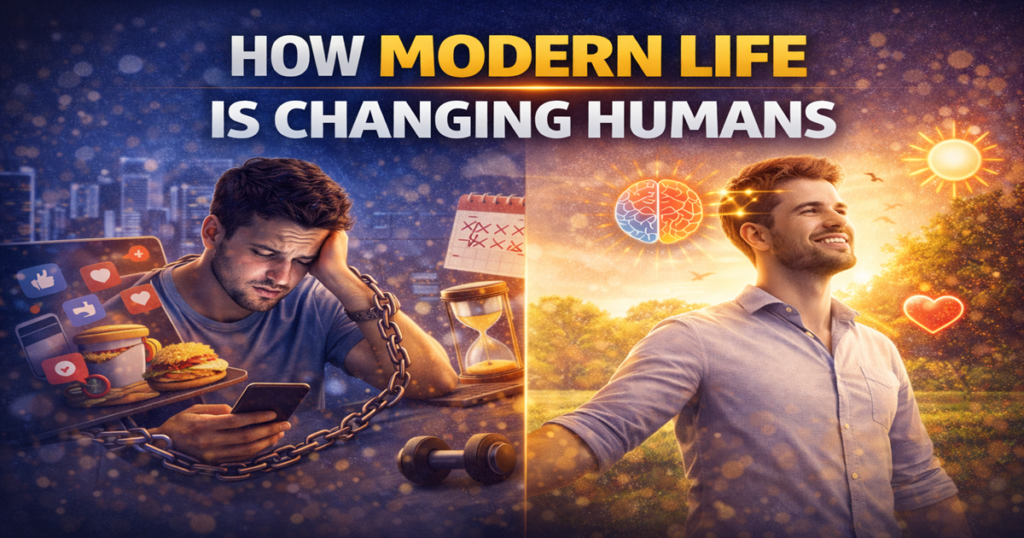
How modern life is changing humans is one of the most urgent questions in science right now. We built a world of extraordinary comfort. However, that world is also dismantling something equally extraordinary: the biology, the attention spans, and the social bonds that make us function. A landmark 2025 paper published in Biological Reviews by evolutionary anthropologists at the University of Zurich and Loughborough University argues plainly that the modern world has developed faster than human biology can adapt. The result is a species experiencing chronic stress, declining fertility, rising inflammation, fractured sleep, and epidemic loneliness — not because we are failing personally, but because our Stone Age physiology is colliding with a 21st-century environment it was never built for.
This guide draws on peer-reviewed research, WHO reports, and data from the CDC, OHSU, Cigna, and leading universities to examine exactly how modern life is reshaping us — across our bodies, brains, sleep, social lives, and long-term health. Moreover, it explains what we can do about it.
How Modern Life Is Changing Humans: The Evidence at a Glance
| Area of Change | Key Finding | Source |
| Human fertility | Sperm counts fell ~50–60% from 1973 to 2018 | Meta-analysis, Human Reproduction Update |
| Sleep deprivation | 35%+ US adults get under 7 hrs/night regularly | CDC Behavioral Risk Factor Survey 2025 |
| Sleep and longevity | Insufficient sleep is 2nd biggest predictor of early death | OHSU / SLEEP Advances, Dec 2025 |
| Loneliness | 1 in 6 people worldwide affected; 871,000 deaths/year | WHO Commission on Social Connection, June 2025 |
| Worker loneliness (USA) | More than 50% of American workers classify as lonely | Cigna Loneliness in America 2025 |
| Chronic disease burden | Rising autoimmune conditions linked to evolutionary mismatch | Biological Reviews, Univ. Zurich 2025 |
| Physical inactivity | ~27.5% of adults globally insufficiently active | WHO Physical Activity Factsheet |
| Attention disruption | Average person checks phone 85–96 times per day | Psychology Today / Freedom Matters 2025 |
| Evolutionary mismatch | Biological adaptation takes 10,000s of years; industry took 200 | Shaw & Longman, Biological Reviews 2025 |
| Nature deprivation | Urban dwellers at higher risk of anxiety, depression, and stress | ScienceDaily / Phys.org Nov 2025 |
1. The Evolutionary Mismatch: A Body Built for the Stone Age
Here is the central paradox of how modern life is changing humans. For 300,000 years, Homo sapiens lived as hunter-gatherers. We evolved to walk long distances, sprint in short bursts, eat whole unprocessed foods, sleep with the rhythm of daylight, and manage stress in brief intense episodes followed by long periods of recovery. That physiology — our muscles, our immune system, our stress hormones, our gut microbiome — remains essentially the same today.
However, the world around it has changed beyond recognition. Industrialisation transformed the human environment in roughly 200 years. Modern life now delivers constant sensory stimulation, processed food, artificial light around the clock, sedentary work, chronic low-grade stress without resolution, microplastics, and near-total separation from the natural settings our biology expects. The body is not broken. It is simply running outdated software in a radically upgraded environment.
Colin Shaw of the University of Zurich describes this mismatch with precision: there is a paradox where we have created tremendous wealth, comfort, and healthcare for a lot of people, but at the same time some of these industrial achievements are having detrimental effects on our immune, cognitive, physical, and reproductive functions. Furthermore, University of Michigan evolutionary biologist Jianzhi Zhang adds that natural populations are never truly adapted to their environments because environments change very quickly, and populations are always chasing. We have simply outrun our own evolution.
“Biological adaptation is very slow. Longer-term genetic adaptations are multigenerational — tens to hundreds of thousands of years. The mismatch between our evolved physiology and modern conditions is unlikely to resolve itself naturally.” — Colin Shaw, University of Zurich, 2025
2. What Modern Life Is Doing to the Human Body
Declining Fertility and Reproductive Health
One of the most measurable ways that modern life is changing humans shows up in reproduction. A comprehensive meta-analysis, widely reported across scientific literature, found that sperm counts among men in Western countries fell by approximately 50 to 60% between 1973 and 2018. Furthermore, Shaw and Longman’s 2025 Biological Reviews paper lists falling fertility rates across much of the world as direct evidence that modern environments are placing stress on human biology.
The causes form a familiar list of modern life hallmarks: endocrine-disrupting chemicals in plastics, pesticides in food, chronic stress elevating cortisol levels that suppress reproductive hormones, sedentary lifestyles reducing testosterone, and obesity increasing oestrogen in both sexes. Moreover, declining birth rates in the UK, USA, Japan, and across Europe reflect this biological reality at a population level. Therefore, reproductive decline is not merely a demographic trend — it is a physiological signal that the body is under pressure.
The Rise of Autoimmune and Inflammatory Disease
Modern life produces another measurable biological change: a dramatic increase in autoimmune and inflammatory conditions. Multiple sclerosis, Crohn’s disease, type 1 diabetes, rheumatoid arthritis, and allergies have all risen significantly in industrialised countries over the past century. Shaw and Longman’s research specifically highlights these rising inflammatory conditions as evidence that industrial environments are placing biological stress on the immune system.
The mechanism aligns with what researchers call the hygiene hypothesis and its more recent refinement, the old friends hypothesis. Our immune systems evolved to face constant challenges from parasites, bacteria in soil, and microorganisms in natural water. Modern environments, however, are too clean in some respects and too polluted in others — stripping the gut microbiome of the microbial diversity it needs while simultaneously loading the body with synthetic chemicals, ultra-processed food ingredients, and environmental toxins that the immune system has no evolutionary history with. The result is an immune system that misfires.
Sedentary Living and Its Consequences
Humans evolved as one of the most endurance-capable animals on Earth. Our upright gait, our sweat glands, and our slow-twitch muscle fibres all reflect a body designed for sustained movement across long distances. Yet modern life has largely replaced this movement with sitting. The WHO estimates that approximately 27.5% of adults globally do not meet minimum physical activity recommendations. In high-income countries, desk-based work, car culture, and passive entertainment push this figure considerably higher.
The health consequences extend well beyond weight gain. Prolonged sitting disrupts blood sugar regulation, raises inflammatory markers, reduces cardiovascular efficiency, and accelerates cognitive decline. Furthermore, the PMC research on sedentarism confirms that physical inactivity is independently associated with a wide range of chronic diseases — not merely as a risk factor for obesity, but as a direct driver of metabolic and inflammatory dysfunction. Our bodies are not designed to be still. When they are, they deteriorate in ways that medicine is still catching up to fully catalogue.
3. How Modern Life Is Changing Human Sleep
Sleep is arguably the area where modern life has most severely disrupted human biology — and recent research reveals the consequences are more serious than most people appreciate. OHSU’s landmark study, published in SLEEP Advances in December 2025, examined CDC data from all 3,143 US counties from 2019 to 2025 and found that insufficient sleep is the second strongest predictor of reduced life expectancy in the United States — surpassed only by smoking. Sleep outranked diet, physical activity, and loneliness as a driver of how long people live.
More than 35% of US adults regularly sleep fewer than seven hours per night. In the UK, similar proportions fall short of the NHS-recommended seven to nine hours. Moreover, the mechanisms connect sleep to virtually every system in the body. Sleep is when the brain clears toxic metabolic waste through the glymphatic system, consolidates memory, regulates the stress response, and repairs cardiovascular and immune function. Pakkay Ngai, a paediatric sleep physician at Hackensack Meridian Health, put it plainly: sleep is not a luxury or something to be sacrificed. It is a biological necessity on par with, and in some ways more impactful than, other cornerstone health behaviours.
“As a behavioural driver for life expectancy, sleep stood out more than diet, more than exercise, more than loneliness — indeed, more than any other factor except smoking.” — Andrew McHill PhD, OHSU, SLEEP Advances 2025
Modern life attacks sleep from multiple directions simultaneously. Artificial light — particularly the blue-wavelength light from screens — suppresses melatonin production and delays sleep onset. Social media and streaming services extend waking hours through habitual late-night use. Work cultures in both the UK and USA normalise sleep deprivation as evidence of dedication. Furthermore, urban noise, shift working patterns, and the psychological hyperarousal of always-on connectivity all fragment the deep, restorative sleep stages that biological repair requires. The result is a population functioning in a state of chronic, normalised sleep debt — with serious and measurable consequences for lifespan.
4. The Loneliness Epidemic: When Connection Goes Digital and Shallow
Perhaps the most paradoxical way that modern life is changing humans is through loneliness. We live in the most connected era in human history. We carry devices that give us instant access to billions of other people. Yet loneliness has reached epidemic scale — and its health consequences rival those of smoking and obesity.
The WHO Commission on Social Connection’s landmark report, released in June 2025, confirmed that 1 in 6 people worldwide experiences loneliness, with health consequences linking isolation to stroke, heart disease, diabetes, cognitive decline, and premature death. The Commission documented an estimated 871,000 deaths every year attributable to social isolation. Loneliness increases the risk of depression by 200%. Furthermore, the Cigna Group’s Loneliness in America 2025 research found that more than half of American workers classify themselves as lonely — making it not merely a personal experience but a workplace and economic crisis.
The mechanism matters here. Humans are the most socially dependent large mammal on Earth. Our nervous systems use cues of social warmth and belonging to regulate stress responses, immune function, and inflammatory markers. Loneliness, therefore, does not just feel painful — it activates threat responses in the body in the same way physical danger does. Chronic loneliness keeps cortisol elevated, disrupts sleep, accelerates inflammation, and ages the immune system faster. Furthermore, it compounds with other modern life factors: people who sleep badly feel less inclined toward social interaction, and people who are lonely sleep worse. Modern life has created an interlocking cycle of disconnection and physical decline.
5. How Modern Life Is Reshaping the Human Brain
Attention and the Notification Economy
The human brain was not designed for the information environment of the 21st century. It evolved in a world where novel stimuli were rare and meaningful — a rustle in the bushes, an approaching storm, a change in the light — and therefore demanded immediate attention. Modern life delivers hundreds of such stimuli every hour, in the form of notifications, alerts, social media feeds, news headlines, and messages. Each one activates the brain’s orienting response. Each one fragments the sustained attention that deep thinking, learning, and creative work require.
Psychology Today’s January 2026 piece on brains and smartphones documented that the average person checks their phone close to 85 times per day and interacts with it for around five hours. Georgetown University research found that two weeks of reduced smartphone use produced attention improvements equivalent to reversing ten years of age-related cognitive decline. Therefore, the attention cost of modern life is not trivial — it is functionally ageing people’s cognitive capacity, decade by decade, through a thousand daily interruptions.
Chronic Stress Without Resolution
Modern life has generated a uniquely damaging form of stress. For our ancestors, stress was acute: a predator appeared, cortisol and adrenaline surged, the body responded with explosive action, and then the threat passed and hormones returned to baseline. Today’s stress is chronic and unresolved. Financial pressure, career uncertainty, constant news exposure, social comparison on social media, and the relentless demands of always-connected professional life generate a low-grade cortisol elevation that never fully clears.
Shaw and Longman’s evolutionary mismatch paper specifically addresses this: modern stressors activate ancient physiological responses without resolution. Elevated cortisol, over time, damages the hippocampus, impairs immune function, disrupts the gut microbiome, raises blood pressure, and accelerates cardiovascular ageing. Furthermore, chronic stress interacts destructively with sleep deprivation — both elevate cortisol, and cortisol disrupts sleep, which then worsens stress tolerance, creating a feedback loop that many people experience as simply the texture of modern life. It is not. It is a biological emergency in slow motion.
Nature Deprivation and the Disappearing Default Mode
Humans spent their entire evolutionary history in natural environments. Our nervous systems respond to green spaces, natural light rhythms, birdsong, and unstructured time in ways that are measurably restorative. Research consistently shows that exposure to natural environments reduces cortisol, lowers blood pressure, restores attention, and improves mood. Shaw and Longman’s paper argues that designing environments that resemble our hunter-gatherer past is not nostalgic — it is a medical necessity.
Moreover, urban living removes not only natural settings but also the unstructured downtime that the brain requires to consolidate memory, process experience, and generate creativity. The Default Mode Network — the brain’s resting state system — requires periods of undirected thought to function optimally. Modern life fills every gap with stimulation, leaving the Default Mode Network chronically under-resourced. The result, researchers suggest, is declining creativity, reduced insight, and the persistent low-grade cognitive fatigue that many people in the UK and USA now experience as simply normal.
Stone Age Biology vs. Modern Life: The Mismatch at a Glance
| Domain | What We Evolved For | What Modern Life Delivers | The Biological Cost |
| Movement | 10–15 km walking daily; intermittent sprinting | 8+ hours sitting; sedentary commuting | Metabolic disease, cardiovascular decline, inflammation |
| Diet | Whole foods, seasonal variety, high fibre | Ultra-processed food, refined sugar, additives | Obesity, diabetes, gut microbiome disruption |
| Sleep | 8+ hrs aligned to natural light/dark cycle | 6–7 hrs disrupted by blue light and stress | Reduced longevity; 2nd biggest mortality predictor |
| Stress | Short-burst acute stress, then full recovery | Chronic low-grade stress without resolution | Hippocampal damage, immune suppression, CVD |
| Social life | Small, tight-knit communities of 50–150 people | Digital pseudo-connection, declining face-to-face contact | Loneliness epidemic; 871,000 deaths/year (WHO) |
| Sensory input | Natural soundscapes; predictable light rhythms | Screens, noise, artificial light 24/7 | Disrupted circadian rhythm, attention fragmentation |
| Reproductive health | Lower chemical exposure; physical activity | Endocrine disruptors, sedentary life, chronic stress | Declining sperm counts; falling birth rates globally |
| Nature exposure | Daily immersion in natural environments | Urban environments with minimal green space | Higher anxiety, depression, and stress responses |
What Can We Do? Evidence-Based Responses to Modern Life’s Pressures
Understanding how modern life is changing humans is not an invitation to despair. It is a blueprint for deliberate counter-measures. Furthermore, the researchers behind the most important work in this area are explicit: these mismatches are not inevitable, and societies can design their way out of many of them. At the individual level, the following evidence-backed strategies address the most serious biological costs of modern living:
- Protect sleep as non-negotiable. The OHSU SLEEP Advances study makes the case definitively: insufficient sleep outranks almost every other lifestyle factor as a predictor of shorter life. Therefore, treating sleep as a medical priority — not a luxury to be traded away for more screen time or productivity — is the single highest-impact health decision most people can make. Seven to nine hours of sleep in a consistent pattern, with screens out of the bedroom, represents what the CDC and American Academy of Sleep Medicine recommend.
- Move consistently, not occasionally. The evolutionary mismatch between our walking-built bodies and sedentary modern life is real and measurable. However, you do not need to run marathons to address it. Research consistently shows that consistent, moderate daily movement — walking 7,000 to 10,000 steps, cycling to work, taking the stairs — produces outsised biological benefits compared to occasional intense exercise. Moreover, breaking up prolonged sitting every hour reduces inflammatory markers even in people who exercise regularly.
- Invest in real social connection. The WHO’s Commission on Social Connection June 2025 report calls social connection a public health priority on par with clean air and nutrition. Therefore, actively investing in face-to-face relationships — not substituting them with digital contact — has measurable effects on cardiovascular health, immune function, cognitive longevity, and mental health. Furthermore, the Cigna research confirms that even small increases in meaningful human connection significantly reduce the health burden of loneliness.
- Reduce chronic stress with structural, not willpower-based, solutions. Mindfulness and meditation produce measurable cortisol reduction. However, structural changes — setting boundaries with work communication outside hours, protecting unstructured time, reducing news consumption to specific windows — produce more durable results than momentary relaxation practices. Shaw and Longman specifically argue for redesigning the environments people live and work in to reduce unnecessary chronic stressors rather than simply asking individuals to be more resilient.
- Seek nature deliberately. Research on the physical and psychological benefits of natural environments is robust and growing. Even short, regular exposure to green spaces — parks, gardens, watercourses — reduces cortisol, restores attention, and improves mood in measurable ways. Urban planners in the UK and USA are increasingly incorporating this evidence into city design, but individuals can act ahead of policy by prioritising nature access in daily routines.
- Critically manage your information environment. The attention and stress costs of chronic notification exposure are well-documented. Therefore, turning off non-essential notifications, protecting the first and last hour of each day from screens, and choosing specific times for news consumption rather than continuous passive exposure addresses two of the most significant ways modern life is reshaping the brain: chronic stress and attention fragmentation.
Frequently Asked Questions About How Modern Life Is Changing Humans
Q1. Are humans actually evolving in response to modern life?
Not quickly enough to matter. Biological evolution operates on timescales of tens to hundreds of thousands of generations. Modern industrialisation happened in roughly 200 years — too fast for genetic adaptation to follow. University of Michigan evolutionary biologist Jianzhi Zhang confirmed in 2025 that populations are always chasing their environments, rarely perfectly adapted. Therefore, the changes modern life is producing in humans are primarily physiological and behavioural responses to mismatched conditions, not evolutionary adaptations. Shaw and Longman’s Biological Reviews paper makes this explicit: the mismatch between our evolved physiology and modern conditions is unlikely to resolve itself through natural selection. Instead, it requires cultural and environmental solutions.
Q2. Why is sleep deprivation so dangerous in modern life?
Sleep is arguably the most biologically demanding process the body performs. During sleep, the brain clears metabolic waste through the glymphatic system, consolidates memory, regulates the immune system, and repairs cardiovascular tissue. Therefore, when modern life chronically interrupts or shortens sleep — through artificial light, stress, social media, and work culture — every one of these processes degrades. The OHSU study published in SLEEP Advances in December 2025, which analysed CDC data from all 3,143 US counties, found that insufficient sleep is the second strongest predictor of shortened life expectancy, surpassed only by smoking. Furthermore, OHSU researcher Andrew McHill noted that sleep outranks diet, exercise, and loneliness as a predictor of how long people live. More than 35% of US adults regularly fall short of the recommended seven hours.
Q3. Is loneliness really as dangerous as smoking?
According to the WHO Commission on Social Connection’s June 2025 report, yes. The Commission confirmed that social isolation and loneliness carry health consequences that rival smoking and obesity. Loneliness links to higher risks of stroke, heart disease, diabetes, cognitive decline, and premature death. Moreover, the WHO documented an estimated 871,000 deaths per year attributable to social isolation. The mechanism is biological: chronic loneliness keeps the stress response permanently activated, elevates inflammatory markers, disrupts sleep, and accelerates immune ageing. Furthermore, the Cigna Group’s 2025 research found that more than half of American workers classify as lonely — confirming this is a systemic problem of modern working life, not an individual failing.
Q4. How is modern life affecting human fertility specifically?
The evidence is consistent and alarming. Sperm counts in Western countries declined by approximately 50 to 60% between 1973 and 2018, according to a widely-cited meta-analysis in Human Reproduction Update. Shaw and Longman’s 2025 evolutionary mismatch paper highlights falling global fertility rates as direct biological evidence that modern environments place stress on human reproductive systems. The contributing factors include endocrine-disrupting chemicals in plastics and pesticides, chronic stress elevating cortisol and suppressing reproductive hormones, sedentary lifestyles reducing testosterone, obesity, and processed food altering hormonal balance. Furthermore, declining birth rates in the UK, USA, Japan, Germany, and across Europe reflect this biological pressure at a population scale.
Q5. Does living in cities specifically harm human health?
Urban living creates measurable health challenges that align with the evolutionary mismatch hypothesis. However, it also delivers significant benefits — including access to healthcare, social infrastructure, and economic opportunity — which complicate simple conclusions. The specific harms linked to urban living in the research evidence include higher chronic stress from noise, density, and reduced green space; less exposure to the natural environments the human nervous system evolved in; greater air and light pollution; and more sedentary lifestyles. Shaw and Longman argue that the solution is not abandoning cities but redesigning them to better align with human evolutionary needs — incorporating more green space, reducing unnecessary stressors, and building infrastructure that supports movement, community, and nature access.
Q6. What does modern diet do to human biology that evolution did not prepare us for?
Profoundly and measurably disrupts it. Humans evolved on a diet of whole, minimally processed foods with high fibre content, seasonal variation, and far lower sugar and refined carbohydrate loads than modern diets deliver. Ultra-processed food — which now constitutes more than 50% of dietary calories in many UK and US households — lacks the fibre diversity that the gut microbiome requires to function. Furthermore, it delivers refined sugars, artificial emulsifiers, and chemical additives that drive chronic inflammation, insulin resistance, and gut dysbiosis. The PMC research on evolutionary biology and global challenges describes the mismatch between modern human nutritional behaviour and our evolutionary past as a major contributing factor to the high incidence of obesity, type 2 diabetes, and associated illnesses. Therefore, diet is one of the most direct and modifiable ways that modern life is changing human biology.
Q7. Can individuals reverse the damage modern life causes, or is it irreversible?
Much of it is reversible, and some of the most encouraging evidence comes from relatively short intervention periods. Georgetown University’s research found that two weeks of reduced smartphone use reversed ten years of attentional decline. OHSU researchers emphasised that sleep is a modifiable behaviour — improving it measurably improves longevity outcomes. The WHO’s commission frames social connection as an asset that can be actively built at any age. Furthermore, Shaw and Longman’s paper concludes that societies need to rethink their relationship with nature and design healthier, more sustainable environments — suggesting that collective action can address what individual willpower cannot. Therefore, reversibility exists but requires intention. The body responds quickly to reduced stress, better sleep, more movement, and genuine social connection. These are not minor lifestyle preferences. They are biological requirements that modern life has progressively eroded — and that deliberate effort can restore.
Conclusion: How Modern Life Is Changing Humans — and What We Do Next
How modern life is changing humans is ultimately a story about speed. Our environment changed in 200 years. Our biology has barely moved. The result is a global human population experiencing chronic stress, disrupted sleep, declining fertility, epidemic loneliness, and rising inflammatory disease — not because individuals are making poor choices, but because the environments they inhabit are fundamentally misaligned with the bodies they inhabit.
However, understanding this mismatch is itself powerful. The evidence points clearly toward what the human body needs — movement, sleep, social connection, nature, manageable stress, whole food, and unstructured time — because these are the precise conditions it evolved in. Furthermore, the research confirms that the damage is largely reversible. Sleep improves when we protect it. Attention restores when we reduce interruptions. Loneliness lifts when we invest in real connection. The body is not broken. It is waiting for conditions it recognises.
Therefore, the most important response to how modern life is changing humans is not acceptance. It is redesign — of our environments, our cities, our workplaces, our relationship with technology, and our daily rhythms. Shaw and Longman put it well: addressing the mismatch requires both cultural and environmental solutions. The question is whether societies and individuals choose those solutions before the biological costs of inaction become impossible to ignore.