
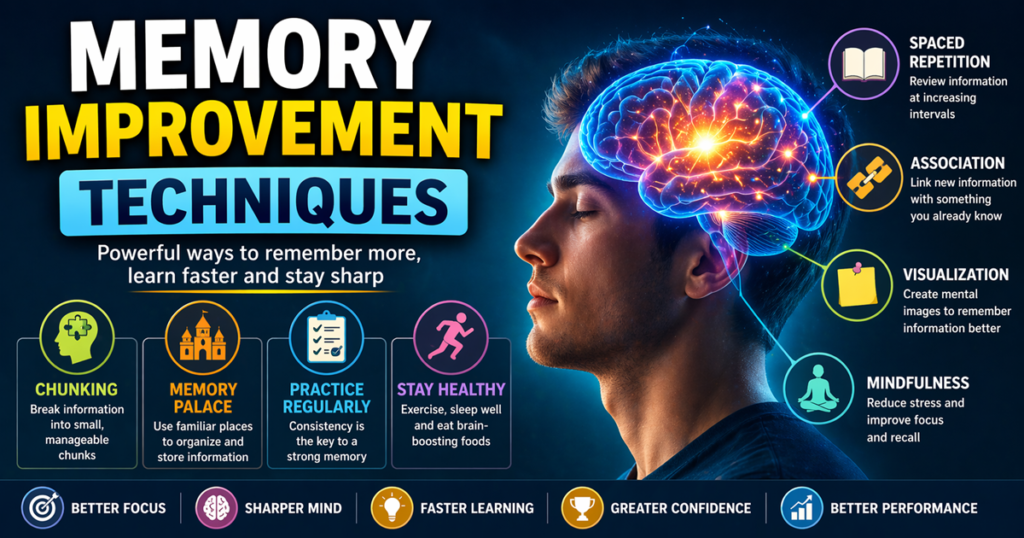
Memory improvement techniques are not about memorising tricks. They are about working with your brain instead of against it. Everyone forgets things — names, passwords, what they read last week. However, the research is clear: memory is not a fixed ability. You can train it deliberately. You can strengthen it consistently. And the techniques that actually work are backed by over a century of rigorous science.
This guide covers the most powerful memory improvement techniques available — from the testing effect discovered in 2006 to the 2,500-year-old memory palace still used by world champions today. Moreover, it explains the lifestyle foundations that determine how well any technique works. Whether you are a student, a professional, or someone who simply wants a sharper mind, these strategies will deliver measurable results.
How Memory Works: The Neuroscience in Plain Language
Before you can improve your memory, you need to understand how it works. Johns Hopkins Medicine explains it clearly. When you learn something new, your brain forms connections between neurons — synapses that create new circuits. The more often you revisit that information, the stronger those connections become. Ignore the information, and the connections weaken. That is why you remember your phone number perfectly but forget a name five minutes after hearing it.
Memory operates in three stages. First, encoding: your brain captures incoming information. Second, storage: that information sits in short-term or long-term memory. Third, retrieval: you pull it back when you need it. Most people focus on encoding — studying harder, reading more carefully. However, retrieval practice is far more powerful. Strengthening the retrieval pathway, not just the storage pathway, is what separates effective memory techniques from ineffective ones.
Furthermore, the hippocampus sits at the centre of memory formation. It is the brain region responsible for converting short-term memories into long-lasting ones — a process called memory consolidation. Crucially, this process happens during sleep, during exercise, and during the gaps between study sessions. Therefore, what you do between learning sessions matters as much as the sessions themselves.
“Memory is not a passive recording device. Our brains decide what matters, and emotional events can reach back in time to stabilise fragile memories.” — Professor Robert Reinhart, Boston University, Science Advances 2025
Memory Improvement Technique 1: Active Recall
Active recall is the single most powerful memory improvement technique supported by research. The principle is simple. Instead of reading your notes again, you close them and try to remember the information from scratch. That effort of retrieval — even when it feels difficult — is precisely what makes the memory stronger.
The landmark evidence comes from a 2006 study by Henry Roediger and Jeffrey Karpicke at Washington University. They compared two groups of students. One group re-read their material four times. The other group read it once and then tested themselves three times. Five minutes later, the re-reading group performed slightly better. However, one week later, the recall group remembered 50% more. Moreover, the re-reading group had forgotten 56% of what they originally recalled within two days.
In practice, active recall looks like this. After reading a chapter, close the book and write down everything you remember. Use flashcards and test yourself before looking at the answer. Answer practice questions without consulting notes first. Furthermore, even an unsuccessful recall attempt helps — the struggle of trying to retrieve information enhances the next learning attempt, even when you fail. Cognitive scientists call this the desirable difficulty effect.
Memory Improvement Technique 2: Spaced Repetition
Spaced repetition tackles the forgetting curve directly. In 1885, German psychologist Hermann Ebbinghaus conducted the first systematic memory experiments. He discovered that memory does not fade gradually. Instead, most forgetting happens within hours and days of learning, then levels off. This pattern — the forgetting curve — has been replicated consistently across 140 years of research.
The solution is to review information at expanding intervals. Review it the same day you learn it. Then after one day. Then after three days. Then a week. Then a month. Each review resets the forgetting clock and makes the memory trace stronger. As a result, you spend far less total time studying while retaining far more.
Furthermore, apps like Anki bring spaced repetition to daily life. They automatically schedule reviews based on your performance — showing you cards you struggled with more frequently, and cards you know well less often. Medical students use Anki extensively for exactly this reason. A 2026 PubMed study confirmed that combining spaced repetition with active recall improves academic performance significantly compared to traditional re-reading approaches. Therefore, pairing these two techniques creates the most powerful learning system available.
“Students who practised active recall remembered 50% more after one week than those who restudied the same material — despite spending less total time with it.” — Roediger & Karpicke, Washington University, 2006
Memory Improvement Technique 3: The Memory Palace
The memory palace — also called the method of loci — is over 2,500 years old. Ancient Greek orators used it to memorise hours-long speeches without notes. World memory champions use it today to memorise the order of an entire shuffled deck of cards in under two minutes. The technique works by exploiting the brain’s remarkable spatial memory.
Here is how it works. Choose a location you know intimately — your home, your school route, your workplace. Then mentally walk through it and place vivid, unusual images at specific points along the route. Each image represents a piece of information you want to remember. To recall the information later, simply walk the route in your mind and collect each image as you pass it.
Why does this work? The brain processes spatial information exceptionally well. Furthermore, adding emotion and vivid detail to an image strengthens it. Boston University’s 2025 research in Science Advances confirmed this directly: emotional and salient events reach back in time to stabilise fragile nearby memories. Therefore, the more dramatic and bizarre the image you attach to a memory, the more reliably you will recall it.
Memory Improvement Technique 4: Chunking
Your working memory — the mental space you use to hold information in the moment — is limited. Research suggests it holds approximately four to seven items at once. Chunking works by grouping individual pieces of information into larger meaningful units, reducing the load on working memory and making storage easier.
Consider a phone number. The string 07700900482 is hard to remember. However, broken into 077 009 00482, it becomes three manageable chunks instead of eleven separate digits. Moreover, your brain treats each chunk as a single item rather than multiple ones. According to Indeed’s March 2025 analysis of the chunking technique, this grouping is one of the most practical and underused memory techniques available for everyday life.
Chunking applies beyond numbers. When learning a new skill, group related steps into sequences. When reading, organise ideas into categories. When memorising vocabulary, cluster words by theme or root. Furthermore, once a chunk becomes automatic — like driving a car — it frees cognitive resources for new information. Therefore, chunking builds the mental infrastructure that makes advanced learning possible.
Memory Improvement Technique 5: Writing by Hand
Typing is fast. Writing by hand is slow. That slowness, however, is precisely what makes handwriting such a powerful memory improvement technique. Because you cannot write as fast as someone speaks, your brain must actively summarise and prioritise. This processing effort — selecting what matters most — deepens encoding significantly.
NPR’s May 2024 analysis of the research put it plainly: writing by hand beats typing for thinking and learning. Researchers found that handwriting activates distinct neural processes that typing does not. Moreover, the physical act of forming letters engages motor memory — a separate memory system that reinforces the cognitive memory of the content. Therefore, note-taking by hand produces better long-term retention than even excellent typed notes.
Furthermore, a 2025 study found that just 10 days of a diet high in added sugars negatively impacted memory recall — demonstrating how lifestyle and learning technique interact. The most effective approach combines handwritten notes with active recall: write your notes by hand, then close them and try to reconstruct the key ideas from memory the following day.
Memory Improvement Technique 6: Mnemonic Devices
Mnemonics transform abstract information into something the brain finds memorable. They work by connecting new information to existing knowledge through patterns, stories, acronyms, rhymes, or imagery. The brain stores meaning far more efficiently than arbitrary facts. Therefore, giving meaningless information a meaningful structure makes it dramatically easier to retain.
Acronyms represent the simplest form. ROYGBIV encodes the colours of the rainbow. Every Good Boy Does Fine encodes the lines of the treble clef. More complex mnemonics tell stories. The rhyme “In 1492, Columbus sailed the ocean blue” is still recalled by adults decades after they first learned it. According to USAHS research, mnemonic devices are particularly effective for long-term retention of facts that lack inherent meaning.
Moreover, the more personally relevant and emotionally engaging the mnemonic, the stronger its retention power. Research from Boston University confirms that connecting new information to emotionally significant context stabilises memory formation. Therefore, the best mnemonics are the ones you create yourself — because personal relevance is the most powerful memory anchor available.
Memory Improvement Techniques: Comparison at a Glance
| Technique | How It Works | Best For | Evidence Strength |
| Active recall | Retrieve information from memory instead of re-reading | Students, professionals, language learners | Very strong — 50% better retention (Roediger 2006) |
| Spaced repetition | Review at expanding time intervals to reset forgetting | Long-term retention of large volumes | Very strong — 140 years of consistent evidence |
| Memory palace | Store information at vivid spatial locations | Ordered lists, speeches, complex facts | Strong — ancient + modern champion evidence |
| Chunking | Group information into meaningful units | Numbers, steps, vocabulary, processes | Strong — working memory research |
| Handwriting notes | Slow writing forces active summarising | Lectures, reading, study notes | Strong — NPR/multiple university studies |
| Mnemonic devices | Connect new info to patterns, rhymes, stories | Arbitrary facts, sequences, definitions | Strong — USAHS and cognitive psychology research |
| Interleaved practice | Mix different topics instead of blocking one at a time | Exams, skill acquisition, problem-solving | Strong — desirable difficulty research |
| Sleep | Consolidates short-term into long-term memory overnight | All memory types — especially declarative | Very strong — NINDS, Mayo Clinic, Harvard |
| Aerobic exercise | Grows hippocampus; increases BDNF and blood flow | Long-term cognitive protection | Very strong — Harvard Health, multiple RCTs |
| Mindfulness | Reduces interference in working memory | Working memory, verbal learning, focus | Moderate-strong — Healthline 2025 review |
The Lifestyle Foundations of Memory Improvement
No technique works well in a sleep-deprived, sedentary, or stressed brain. The lifestyle foundations of memory improvement are not optional extras. They are the biological substrate on which every technique depends. Mayo Clinic’s October 2025 review identifies physical activity as one of the best strategies to improve and protect memory across all ages.
Sleep: The Non-Negotiable Foundation
Sleep is when memory consolidation happens. During sleep, the brain transfers learning from short-term storage in the hippocampus to long-term storage in the cortex. Furthermore, the brain clears metabolic waste through the glymphatic system — a process that directly affects cognitive clarity the following day.
The National Institute of Neurological Disorders and Stroke confirmed in 2025 that sleep plays a critical role in memory consolidation. Missing just one night of sleep impairs mental performance to a degree comparable to significant alcohol intoxication, according to UCLA research cited by multiple institutions. Moreover, the OHSU SLEEP Advances study found that insufficient sleep ranks as the second-biggest predictor of shortened life expectancy in the USA — suggesting that the cost of poor sleep extends far beyond memory alone.
Aerobic Exercise: Growing the Hippocampus
Regular aerobic exercise actually increases the size of the hippocampus — the brain region central to memory formation. Harvard Health Publishing confirmed this directly: aerobic exercise boosts the size of the hippocampus, improving verbal memory and learning. Furthermore, exercise increases BDNF (brain-derived neurotrophic factor), a protein that promotes neural growth and protects existing connections.
The Mayo Clinic recommends at least 150 minutes per week of moderate aerobic activity for most adults. However, even shorter bouts of movement produce measurable cognitive benefits. A 10-minute brisk walk after studying improves subsequent memory consolidation. Therefore, building movement into your daily routine is one of the most accessible memory improvement techniques available — and one of the most effective.
Diet, Hydration, and Stress
Your brain is 73% water. Even mild dehydration causes measurable brain shrinkage with adverse effects on concentration, alertness, and short-term memory. Therefore, maintaining good hydration is a simple and immediate memory improvement. Furthermore, a 2025 Healthline-reviewed study found that just 10 days of high added-sugar intake negatively impacted memory recall in adults aged 50 to 64. Anti-inflammatory diets, by contrast, show promising protective effects on long-term cognitive health.
Chronic stress is equally damaging. Sustained cortisol elevation damages the hippocampus over time and directly impairs the ability to form and retrieve memories. Mindfulness practices reduce this cortisol load. Moreover, Healthline’s 2025 review confirmed that mindfulness is associated with reduced interference in working memory and improved verbal learning. Therefore, managing stress is not merely a wellbeing strategy — it is a direct memory improvement technique.
How to Build a Daily Memory Improvement Routine
The most effective memory improvement techniques work best in combination. Here is a practical daily framework based on the strongest evidence available:
- After learning something new — whether from a lecture, book, or meeting — spend five minutes writing key points by hand without looking at the source. This is your first active recall attempt.
- Within 24 hours, review those handwritten notes and test yourself again. Cover your notes and try to reconstruct the ideas from memory. Where you fail, pay particular attention — those are your weakest memory traces.
- Use a spaced repetition app like Anki for information you need to retain long-term. Create a flashcard immediately after learning something important. Let the algorithm schedule your reviews automatically.
- For complex or sequential information — presentations, speeches, ordered facts — build a memory palace. Choose a familiar location, create vivid images, and test the palace walk within 24 hours of building it.
- Protect your sleep. Set a consistent sleep schedule and charge your phone outside the bedroom. This single habit enables the consolidation that every other technique depends on.
- Exercise at least three to five times per week with moderate aerobic activity. Even a 20-minute walk on days when a full workout is not possible produces measurable cognitive benefit.
- Once per week, review everything you have learned that week using active recall — without notes. This serves as both a consolidation session and a diagnostic tool for identifying what needs more work.
Frequently Asked Questions About Memory Improvement Techniques
Q1. Which memory improvement technique works fastest?
Active recall produces the most immediate and measurable results. The landmark Roediger and Karpicke study found that students who tested themselves outperformed re-readers within two days and retained 50% more information after one week. Moreover, active recall requires no special tools — just the willingness to close your notes and attempt retrieval. Therefore, if you adopt only one technique from this guide, make it active recall. You can start applying it to anything you read or study today, and see measurable results within days.
Q2. Does the memory palace actually work for ordinary people?
Yes. The memory palace is not just for memory competitors. Furthermore, it works because it exploits spatial memory — one of the most robustly developed memory systems in the human brain. Coursera’s February 2025 guide confirms it is accessible to anyone willing to practise. The key is vivid, unusual imagery. Start small: use your home as the palace and try to memorise a shopping list of ten items. With practice, the technique becomes faster and the palaces more elaborate. Moreover, Boston University’s 2025 research confirms that emotionally vivid images produce stronger memory traces — so the more dramatic and bizarre your images, the better.
Q3. Why does re-reading feel effective but is not?
Re-reading creates what cognitive scientists call the fluency illusion. The material feels familiar when you read it again — and the brain interprets that familiarity as knowledge. However, familiarity and retrievability are not the same thing. You can recognise information without being able to recall it from memory. Active recall tests actual retrievability, which is what matters in real life — in an exam, a meeting, or a conversation. Moreover, the testing effect works precisely because the effort of retrieval, even when difficult, strengthens the memory trace in a way that passive recognition never does.
Q4. How important is sleep for memory compared to studying?
Sleep is arguably more important than the study session itself — at least for long-term retention. The National Institute of Neurological Disorders and Stroke confirmed that sleep plays a critical role in memory consolidation: the process by which short-term memories are strengthened and transferred into long-lasting form. Furthermore, studying before sleep and then sleeping immediately after produces better retention than studying the same material at another time of day. Therefore, the optimal strategy is to study using active recall, then sleep. The sleep session consolidates what the study session encoded.
Q5. Can memory improvement techniques help with age-related memory decline?
Yes — and the research is encouraging. Virginia Tech’s October 2025 study identified specific molecular changes in the brain that contribute to age-related memory decline, demonstrating that memory loss is not simply an inevitable consequence of ageing but the result of specific, targetable processes. Furthermore, Harvard Health confirmed that regular aerobic exercise boosts hippocampus size — counteracting the hippocampal shrinkage associated with ageing. Spaced repetition and active recall also show benefits in older adults. Moreover, Mayo Clinic’s October 2025 review emphasises that staying mentally active, maintaining social connections, and managing vascular health all protect memory as people age. Therefore, memory improvement techniques are relevant at every age — not just for students.
Q6. What foods help improve memory?
Healthline’s July 2025 review, medically reviewed by Dr. Nancy Hammond, found that diets high in saturated fat and added sugar may impair hippocampus function. By contrast, anti-inflammatory dietary patterns — emphasising vegetables, whole grains, healthy fats, and lean protein — support both memory and long-term cognitive health. Furthermore, a 2025 study published in the Journal of the American Geriatrics Society found that inflammatory diets negatively impact cognition in older adults. Foods consistently associated with better cognitive health include oily fish (omega-3 fatty acids), berries (antioxidants), leafy greens (folate and vitamin K), nuts (vitamin E and healthy fats), and olive oil. Moreover, staying well hydrated is equally important — even mild dehydration measurably impairs short-term memory and concentration.
Q7. How long does it take to see results from memory improvement techniques?
Active recall and spaced repetition produce measurable results within days. Roediger and Karpicke’s study found significant differences between groups within two days. Moreover, students who adopted spaced repetition in the 2026 PubMed pharmacy study showed improved academic performance within weeks of adoption. Lifestyle changes take longer. Harvard Health research suggests that aerobic exercise begins to produce cognitive benefits within weeks of consistent practice, with hippocampal growth measurable after months of regular exercise. Furthermore, sleep improvement produces almost immediate benefits — one week of better sleep typically produces noticeable improvements in concentration and recall. Therefore, you can expect short-term results from technique changes and longer-term results from lifestyle improvements — with both compounding over months and years.
Conclusion: Memory Improvement Techniques That Actually Work
Memory improvement techniques work when they align with how the brain actually stores and retrieves information. Active recall and spaced repetition sit at the top of the evidence hierarchy — tested across more than a century of research and replicated consistently. Memory palaces, chunking, and handwriting activate distinct neural systems that pure repetition cannot reach. Furthermore, the lifestyle foundations — sleep, exercise, nutrition, and stress management — determine the ceiling for every technique you apply.
Moreover, the brain remains plastic throughout life. Virginia Tech’s 2025 research demonstrated that even age-related molecular changes in memory can be targeted and reversed. Harvard Health confirmed that the hippocampus grows with exercise at any age. Therefore, it is never too late to start improving memory — and the techniques in this guide deliver measurable results regardless of where you begin. Start with one technique. Apply active recall to whatever you learn today. Test yourself instead of re-reading. Sleep on it. Then add spaced repetition, build a memory palace, and protect your sleep as non-negotiably as you protect your work schedule. Memory improvement techniques are not hacks. They are the science of how learning actually works — applied deliberately, every single day.