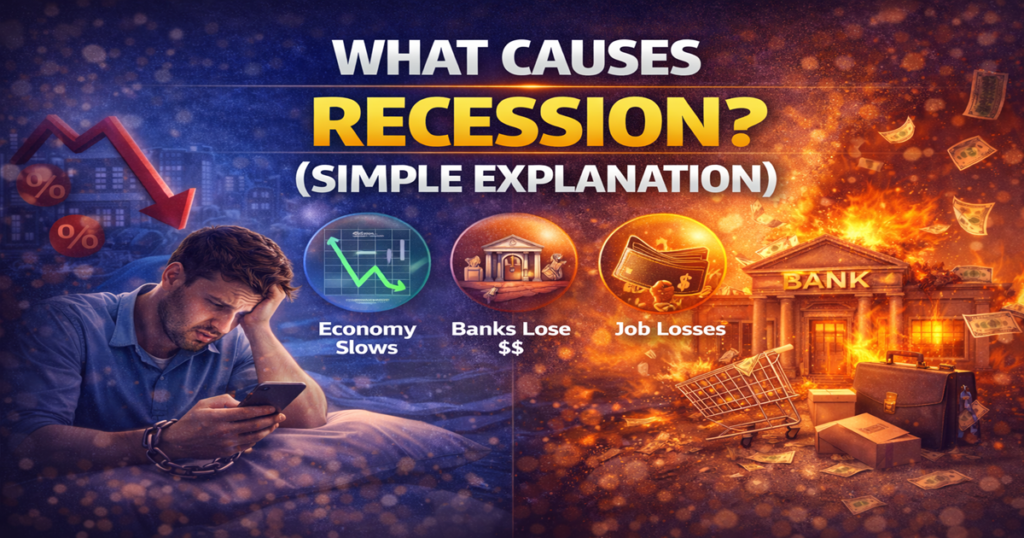
What causes recession is one of those questions that sounds simple but hides real complexity underneath. Most people know that a recession is bad. They know it means job losses, falling house prices, and a tighter economy. However, very few people understand why economies contract — and that lack of understanding makes recessions feel random, mysterious, and unstoppable.
They are none of those things. Recessions follow patterns. They have identifiable triggers. Furthermore, they respond to policy in predictable ways. This guide explains what causes recession in plain language — using real examples from the 1970s, the 2008 financial crisis, and the current environment to make the economics genuinely clear.
What Is a Recession? The Simple Definition
Before examining what causes recession, you need a clear definition. In the United Kingdom and many other countries, a recession means two consecutive quarters of negative GDP growth. In other words, the economy shrinks for at least six months in a row.
The United States uses a broader definition. The National Bureau of Economic Research (NBER) defines a recession as a significant decline in economic activity spread across the economy, lasting more than a few months. It must be visible in GDP, income, employment, industrial production, and retail sales. Therefore, the US looks at multiple indicators — not just GDP alone.
Both definitions agree on the fundamental point. A recession happens when an economy stops growing and starts contracting. People buy less. Businesses produce less. Workers lose jobs. Tax revenues fall. Moreover, each of these effects makes the others worse — creating a cycle that can spiral fast if left unchecked.
The S&P 500 has fallen by an average of 36% around the eight US recessions since 1970. However, recessions always end. — RBC Brewin Dolphin, 2026
What Causes Recession: The Core Mechanism
At its heart, every recession comes down to one thing: people stop spending enough money to keep the economy running. According to the US Congressional Research Service, recessions result from shocks to aggregate supply or aggregate demand — or both at once.
Think of the economy as a river. Under normal conditions, money flows steadily around the system. Businesses pay workers. Workers buy goods. Businesses earn revenue. The cycle continues. A recession happens when that flow slows dramatically. Something blocks the river — and suddenly the whole system runs dry.
That blockage can come from two directions. It can come from the demand side, when people and businesses choose not to spend. Or it can come from the supply side, when the ability to produce goods and services breaks down. Understanding these two pathways makes every historical recession easier to interpret.
What Causes Recession: Five Demand-Side Triggers
Demand-side recessions happen when spending collapses. People simply stop buying enough to keep businesses profitable. As a result, businesses cut production, lay off workers, and invest less. Those job losses then reduce spending further — creating the self-reinforcing cycle that makes recessions so damaging.
1. Rising Interest Rates
Central banks raise interest rates to fight inflation. Higher rates make borrowing more expensive. As a result, people take out fewer mortgages and car loans. Businesses borrow less to invest and expand. Consumer spending falls.
This is precisely what happened in the early 1980s. The US Federal Reserve raised interest rates to 20% to crush the 1970s inflation surge. It worked. However, those aggressive rate hikes also pushed the US into a severe recession in 1981 to 1982, with unemployment hitting 10.8%. Therefore, the very tools used to fix one economic problem can directly create another.
2. Loss of Consumer Confidence
Confidence is fragile. When people fear job losses, they save more and spend less — even before those job losses actually arrive. This self-fulfilling dynamic can tip an economy into recession through expectation alone.
According to Economics Help, a fall in consumer and business confidence — exacerbated by the negative multiplier effect — is one of the most common demand-side recession triggers. Moreover, the World Economic Forum identifies consumer confidence indices as key forward indicators of recession risk. When those indices drop sharply, spending typically follows.
3. Financial Crisis and Credit Contraction
Banks sit at the centre of the economy. They take deposits, make loans, and keep money circulating. When the banking system breaks down, the whole economy seizes.
This is the story of the 2008 Great Recession. Excessive speculation on US property values drove a massive housing bubble. Lenders issued subprime mortgages to borrowers who could not repay them. Banks packaged those toxic loans into complex financial products and sold them globally. When housing prices fell, those products collapsed. Lehman Brothers filed for bankruptcy on 15 September 2008. Markets worldwide froze with panic. Banks stopped lending to each other because nobody trusted anyone’s balance sheet. As a result, credit dried up across the entire economy — and the global recession that followed was the worst since the 1930s.
“The run on the shadow banking system was the fundamental cause of the 2008 crisis.” — Paul Krugman, 2009
4. Asset Bubble Bursting
Asset bubbles form when prices — of houses, stocks, or other assets — rise far beyond their real value. Investors pile in expecting prices to keep rising. Eventually, reality catches up. The bubble bursts. Asset values crash. Wealth evaporates. Spending collapses.
The dot-com crash of 2001 demonstrates this clearly. Investors bid up technology shares to extraordinary valuations through the late 1990s. However, when it became clear that many internet companies generated no profits, the bubble burst. The NASDAQ fell 78% from peak to trough. The US economy contracted. Furthermore, investor confidence took years to rebuild after the losses.
5. Trade Wars and Tariffs
International trade connects economies. When trade flows freely, countries specialise in what they produce best. All participants benefit. When trade is disrupted, costs rise, supply chains break, and growth slows.
The UCLA Anderson Forecast compared current US tariff levels to the Smoot-Hawley tariffs of the 1930s — which economists widely regard as a key factor that deepened the Great Depression. Furthermore, J.P. Morgan Research noted that tariff-related trade uncertainty contributed material headwinds to global growth throughout 2025. Therefore, protectionism is not merely a political choice. It carries direct economic consequences.
What Causes Recession: Supply-Side Shocks
Supply-side recessions are different. They happen when the economy loses the ability to produce goods and services at normal cost. Production breaks down, prices rise, and the economy contracts simultaneously. This creates what economists call stagflation — stagnant growth plus high inflation — which standard policy tools struggle to address.
The 1973 Oil Crisis: The Classic Supply Shock
In October 1973, OPEC imposed an oil embargo on the United States. Oil prices quadrupled almost overnight. The effect was immediate and brutal. Oil powers nearly every sector of a modern economy — manufacturing, transport, heating, agriculture. Therefore, when oil became scarce and expensive, production costs surged across every industry simultaneously.
Companies raised prices. Real wages fell. Consumers cut spending. Output dropped while inflation soared. The resulting stagflation confounded policymakers. Raising rates to fight inflation would deepen the contraction. Cutting rates to stimulate growth would worsen inflation. Both the UK and US suffered severe recessions through the mid-1970s as a result of this impossible dilemma.
COVID-19: The Modern Supply Shock
The 2020 recession combined supply and demand collapse simultaneously. Factories closed. Supply chains fractured. Workers stayed home. Consumer demand evaporated. Both the UK and US entered recession immediately. However, extraordinary fiscal and monetary intervention — furlough schemes, stimulus cheques, and central bank bond purchases — contained the damage more rapidly than in previous downturns.
Moreover, the subsequent supply chain disruptions persisted for years, contributing to the inflation surge of 2021 to 2023. Therefore, the supply-side consequences of COVID outlasted the initial recession by several years — demonstrating how a supply shock can reshape an economy long after the headline contraction ends.
Policy Errors: How Governments Can Cause or Deepen Recession
Recessions do not always start with a market shock. Sometimes, governments and central banks cause them directly — through poor timing, excessive tightening, or misguided austerity.
The Great Depression of the 1930s is the defining case study in policy failure. When the US stock market crashed in 1929, the Federal Reserve tightened monetary policy — precisely the wrong response. Banks failed. The money supply contracted by 25%. Unemployment reached 25%. Governments compounded the error by cutting spending at the exact moment the economy needed stimulus. According to historical economic analysis, this contractionary response transformed a severe recession into a decade-long depression.
Contrast that with 2008. The Federal Reserve slashed rates to near zero and injected trillions into the banking system. Congress passed a $787 billion stimulus package. The Bank of England cut rates and launched quantitative easing. Furthermore, governments maintained public spending to protect demand. As a result, the 2008 recession lasted approximately 18 months rather than a decade. The policy response made all the difference.
Warning Signs: How to Spot a Recession Coming
Economists cannot predict recessions with certainty. However, they monitor several leading indicators that frequently signal trouble ahead. Understanding these warning signs helps businesses, households, and policymakers prepare.
| Warning Sign | What It Measures | Why It Matters |
| GDP slowdown | Economic output growth rate | Two negative quarters = official UK recession |
| Rising unemployment | Jobs market health | Job losses reduce spending; spiral can worsen quickly |
| Falling consumer confidence | Willingness to spend | Drops before spending falls — a forward-looking signal |
| Inverted yield curve | Short vs. long-term interest rates | Historically predicts US recessions with ~80% accuracy |
| Declining business investment | Corporate spending plans | Businesses cut first when they expect trouble ahead |
| Rising credit defaults | Loan repayment health | Signals financial stress spreading through the economy |
| Falling industrial production | Manufacturing output | Drops fast when demand weakens; shows up early |
| High inflation + slowing growth | Stagflation risk | Limits Bank of England and Fed policy options simultaneously |
UK and USA: The Current Recession Outlook
Both the UK and USA face elevated, though manageable, recession risks in the mid-2020s. However, the drivers differ between the two economies.
In the United States, J.P. Morgan Research reduced its recession probability from 60% to 40% in 2025 after Federal Reserve rate cuts began to ease credit conditions. Nevertheless, tariff-related trade uncertainty continues to weigh on growth. Moreover, the UCLA Anderson Forecast identifies current equity valuations as near dot-com bubble levels — a potential amplifier if a downturn arrives. Therefore, the US economy navigates a narrow path between sustained growth and a demand-led contraction.
In the United Kingdom, RSM’s 2026 outlook projects GDP growth of just 0.8% — the product of fiscal contraction, weak consumer confidence, and slow business investment. Furthermore, the Bank of England is cutting rates carefully to support recovery. The high household saving ratio — above 10% — provides a buffer against sudden decline. However, slow pay growth and elevated debt costs leave UK households genuinely financially stretched. As a result, the UK economy remains more fragile than headline data suggests.
The Different Shapes of Recession
Not all recessions are equal. Economists describe their shapes by how quickly they strike and how fast the economy recovers.
| Shape | Pattern | Example | What It Means |
| V-shaped | Sharp drop, fast bounce back | US 1990-91 | Economy recovers quickly; damage is limited |
| U-shaped | Prolonged slump, slow recovery | US 1974-75 | Economy stays depressed before gradually recovering |
| L-shaped | Sharp fall, very slow growth after | Japan 1993-94 | Economy never fully returns to previous trend |
| W-shaped | Recovery, then relapse | US 1980-82 double-dip | Rates cut, economy recovers, inflation forces rates back up |
| K-shaped | Divergent recovery by group | Post-2020 COVID | Higher earners recover fast; lower earners stay depressed |
What Happens to People During a Recession
Statistics describe recessions in aggregate. However, real people experience them in concrete, often devastating ways. Understanding the human cost explains why preventing and shortening recessions matters so much.
- Job losses accelerate. Employers cut costs by laying off workers first. Unemployment rises sharply. Moreover, workers laid off during recessions often earn less in their next job — and the wage loss can persist for a decade.
- House prices fall. Fewer buyers can secure mortgages. Demand drops. Property values decline. For many families in both the UK and USA, their home is their largest asset. Therefore, falling prices directly erode household wealth and confidence.
- Credit tightens sharply. Banks grow cautious. They raise borrowing standards and restrict lending. As a result, small businesses struggle to fund operations. First-time buyers cannot get mortgages. This tighter credit deepens the contraction.
- Government finances come under strain. Tax revenues fall as incomes and spending drop. However, welfare spending rises as unemployment grows. This squeeze hits public services — the NHS in the UK, Medicaid in the USA — at exactly the moment more people need them.
- Investment falls. Businesses defer expansion plans and capital spending. This is rational for each individual firm. However, collectively it reduces economic activity further — making every cautious decision sensible in isolation while worsening the overall situation.
Frequently Asked Questions About What Causes Recession
Q1. What is the single biggest cause of recession?
No single cause dominates. However, the Congressional Research Service identifies demand shocks as the most common proximate cause. When consumers and businesses stop spending, GDP contracts. The most frequent driver of that collapse is a financial crisis, as demonstrated in 2008. However, supply shocks, interest rate errors, asset bubbles, and trade disruption all produce recessions too. Furthermore, most severe recessions involve multiple causes reinforcing each other. Therefore, the honest answer is that recessions are rarely caused by one thing alone.
Q2. How long does a typical recession last?
Post-World War II US recessions have lasted an average of approximately 11 months according to NBER data. However, the range is wide. The 1990 to 1991 recession lasted 8 months. The 2007 to 2009 Great Recession lasted 18 months. The Great Depression lasted a decade. UK recessions follow similar patterns. Moreover, the official end of a recession does not always mean a return to normal conditions. UK real wages did not return to their 2008 peak for nearly a decade after the Great Recession officially ended.
Q3. Can recessions be predicted accurately?
Not with precision. Economists monitor leading indicators — the inverted yield curve, declining consumer confidence, falling industrial production — that frequently foreshadow recessions. However, predicting exact timing remains extremely difficult. As noted by IE Business School, recessions are often recognised in retrospect after they have already occurred. Furthermore, tariff policy, geopolitical disruption, and financial market behaviour introduce unpredictable variables. Therefore, economists track risk levels rather than claim certainty.
Q4. What is the difference between a recession and a depression?
A recession is a significant but contained economic contraction. A depression is far more severe and prolonged. The Great Depression saw US unemployment hit 25% and the economy contract for years. By contrast, the Great Recession of 2008 — the worst since the Depression — peaked at 8.5% US unemployment and lasted roughly 18 months. According to standard economic definitions, a severe recession where GDP falls by 10% or one lasting three to four years qualifies as a depression. Therefore, a depression is essentially a recession that policy failed to contain.
Q5. Do recessions always cause inflation or deflation?
Neither automatically. It depends entirely on what caused the recession. Demand-led recessions typically produce deflation or lower inflation — too little spending chasing too much supply. Supply-led recessions produce stagflation instead — rising prices despite a contracting economy. The 1970s oil shock created exactly this. This combination is harder to fight because raising rates reduces inflation but deepens the recession. Moreover, the post-COVID period demonstrated a third pattern: demand collapse followed by supply chain disruption, producing a complex inflationary recovery that central banks struggled to manage.
Q6. What can the government do to end a recession?
Governments use two main tools. Fiscal policy means increasing public spending and cutting taxes to inject demand. The US $787 billion Recovery and Reinvestment Act of 2009 and the UK furlough scheme are clear examples. Monetary policy means cutting interest rates and, when rates hit zero, using quantitative easing to expand the money supply. Both the Bank of England and the Federal Reserve deployed unprecedented stimulus in 2008 and again in 2020. Furthermore, the speed and scale of the response strongly predicts whether a recession becomes a brief contraction or a prolonged depression. Therefore, early and decisive action matters enormously.
Q7. How does a UK recession differ from a US recession?
The definitions differ slightly. The UK officially defines a recession as two consecutive quarters of negative GDP growth. The US uses the NBER’s broader definition, looking at employment, income, and production alongside GDP. Therefore, a UK-style technical recession can occur without an NBER-designated US recession, and vice versa. Furthermore, their respective central banks respond differently. The Bank of England sets rates for the UK alone, while the Federal Reserve’s decisions carry global weight due to the dollar’s reserve currency status. The UK is also more exposed to European trade disruptions, while the US faces greater sensitivity to domestic consumption swings and financial market movements.
Conclusion: What Causes Recession Is Not One Thing — But It Is Understandable
What causes recession is not one thing. It is a confluence of forces — demand shocks, supply disruptions, financial crises, policy errors, and collapsing confidence — that combine differently in every downturn. However, the underlying pattern is remarkably consistent. Recessions happen when spending falls below the level the economy needs to sustain employment and growth. Moreover, policy response determines whether a recession lasts months or years.
Understanding what causes recession matters beyond academic interest. It helps individuals protect their finances when warning signs appear. It helps businesses make smarter decisions about when to expand and when to preserve cash. Furthermore, it helps citizens evaluate whether governments and central banks are making the right choices — and hold them accountable when they are not. Therefore, what causes recession is ultimately a story about human decisions. The decisions of lenders who ignored risk. Central bankers who tightened too fast. Politicians who protected the wrong interests. And ordinary consumers whose individually rational caution collectively produced a crisis no one wanted. The more clearly those patterns are understood, the better placed societies become to prevent them.